This is AI generated Response.
Asked by: Rahul
Created at: 2025-11-09 04:59:18
Final Answer:
RenderedRaw Text
Did you like this answer?
Let's solve each part step by step with explanations.
---
## a) What will the density be after four years?
### **Step 1: Identify the recursive relation and initial condition**
The system is:
\[
x_{t+1} = \frac{7x_t}{1 + 3x_t^2}
\]
with \( x_ = .9 \).
### **Step 2: Calculate \( x_1, x_2, x_3, x_4 \)**
- \( x_1 = \frac{7 \times .9}{1 + 3 \times (.9)^2} \)
- \( x_2 = \frac{7 \times x_1}{1 + 3 x_1^2} \)
- \( x_3 = \frac{7 \times x_2}{1 + 3 x_2^2} \)
- \( x_4 = \frac{7 \times x_3}{1 + 3 x_3^2} \)
Let's do the calculations one by one:
#### \( x_1 \):
\[
x_1 = \frac{7 \times .9}{1 + 3 \times (.9)^2} = \frac{6.3}{1 + 3 \times .81} = \frac{6.3}{1 + 2.43} = \frac{6.3}{3.43} \approx 1.837
\]
#### \( x_2 \):
\[
x_2 = \frac{7 \times 1.837}{1 + 3 \times (1.837)^2} = \frac{12.859}{1 + 3 \times 3.374} = \frac{12.859}{1 + 10.122} = \frac{12.859}{11.122} \approx 1.156
\]
#### \( x_3 \):
\[
x_3 = \frac{7 \times 1.156}{1 + 3 \times (1.156)^2} = \frac{8.092}{1 + 3 \times 1.336} = \frac{8.092}{1 + 4.008} = \frac{8.092}{5.008} \approx 1.617
\]
#### \( x_4 \):
\[
x_4 = \frac{7 \times 1.617}{1 + 3 \times (1.617)^2} = \frac{11.319}{1 + 3 \times 2.616} = \frac{11.319}{1 + 7.848} = \frac{11.319}{8.848} \approx 1.279
\]
**Explanation:**
Each value is calculated by plugging the previous value into the recurrence relation. This tracks the density year by year.
**Final answer:**
\[
x_4 \approx 1.279
\]
---
## b) What is the updating function \( f(x) \)?
### **Step 1: Identify the function from the recurrence**
From the recurrence,
\[
x_{t+1} = \frac{7x_t}{1 + 3x_t^2}
\]
So,
\[
f(x) = \frac{7x}{1 + 3x^2}
\]
**Explanation:**
The updating function takes the current value and gives the next value.
**Final answer:**
\[
f(x) = \frac{7x}{1 + 3x^2}
\]
---
If you'd like to see the rest of the answers (c, d, e), just let me know!
Question:
Please all parts answer
This is AI generated Response.
Asked by: Rahul
Created at: 2025-11-09 05:00:21
Final Answer:
RenderedRaw Text
Did you like this answer?
## c) What are the biologically relevant equilibria?
### **Step 1: Find equilibria by solving \( f(x) = x \)**
To find the equilibria, set:
\[
f(x) = x \implies \frac{7x}{1 + 3x^2} = x
\]
### **Step 2: Rearrange and solve**
Rearranging gives:
\[
7x = x(1 + 3x^2)
\]
\[
7x = x + 3x^3
\]
\[
3x^3 - 6x = 0
\]
Factoring out \( x \):
\[
x(3x^2 - 6) = 0
\]
Thus, we have:
\[
x = 0 \quad \text{or} \quad 3x^2 - 6 = 0 \implies x^2 = 2 \implies x = \sqrt{2} \text{ or } x = -\sqrt{2}
\]
**Biologically relevant equilibria are**:
- \( x = 0 \)
- \( x = \sqrt{2} \) (since density cannot be negative)
**Explanation:**
Equilibria represent states where the density does not change. We solved for \( x \) where the updating function equals the current density.
**Final answer:**
\[
0; \sqrt{2}
\]
---
## d) Compute \( f(z) \).
### **Step 1: Use the previously determined function**
We already found:
\[
f(x) = \frac{7x}{1 + 3x^2}
\]
### **Step 2: Confirm the calculation**
To compute \( f(z) \), substitute \( z \) into the function:
\[
f(z) = \frac{7z}{1 + 3z^2}
\]
**Explanation:**
The function \( f(z) \) remains the same as previously derived. It maps the current density \( z \) to the next density.
**Final answer:**
\[
f(z) = \frac{7z}{1 + 3z^2}
\]
---
## e) Use the derivative test to determine the stability properties for each of the two equilibria.
### **Step 1: Compute the derivative \( f'(x) \)**
Using the quotient rule:
\[
f'(x) = \frac{(1 + 3x^2)(7) - 7x(6x)}{(1 + 3x^2)^2} = \frac{7 + 21x^2 - 42x^2}{(1 + 3x^2)^2} = \frac{7 - 21x^2}{(1 + 3x^2)^2}
\]
### **Step 2: Evaluate \( f'(x) \) at equilibria**
1. At \( x = 0 \):
\[
f'(0) = \frac{7 - 21(0)^2}{(1 + 3(0)^2)^2} = 7
\]
2. At \( x = \sqrt{2} \):
\[
f'(\sqrt{2}) = \frac{7 - 21(2)}{(1 + 3(2))^2} = \frac{7 - 42}{(1 + 6)^2} = \frac{-35}{49} = -\frac{5}{7}
\]
**Stability analysis:**
- If \( |f'(p)| < 1 \): stable
- If \( |f'(p)| > 1 \): unstable
#### Stability for \( x = 0 \):
- \( f'(0) = 7 \) (unstable)
#### Stability for \( x = \sqrt{2} \):
- \( f'(\sqrt{2}) = -\frac{5}{7} \) (stable)
**Explanation:**
The derivative indicates how the density responds to small changes. If the absolute value is greater than 1, small perturbations grow, indicating instability.
**Final answers:**
- For \( x = 0 \): \( f'(0) = 7 \) (unstable)
- For \( x = \sqrt{2} \): \( f'(\sqrt{2}) = -\frac{5}{7} \) (stable)
VIPSolutions focuses on clear, step‑by‑step explanations so you can learn quickly. Whether you need an AI‑generated walkthrough or a short hint to get unstuck, each solution is organized for fast reading and easy review later.
Search similar questions, compare approaches, and bookmark the best answers for revision. Our goal is simple: quick, reliable study help that feels natural—not noisy.
 VIPSolutions
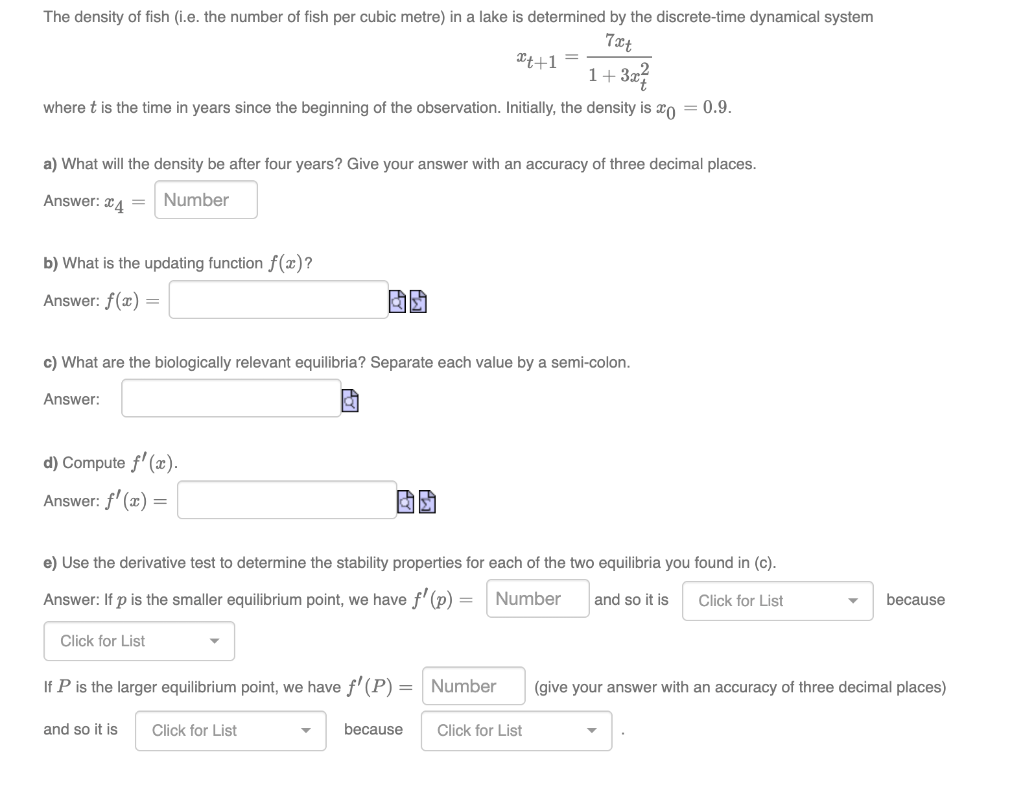 ‘The density of fish (i.e. the number of fish per cubic metre) in a lake is determined by the discrete-time dynamical system
Tay
1 = TT
14327
where t is the time in years since the beginning of the observation. Initially, the density is 2 = 0.9.
a) What will the density be after four years? Give your answer with an accuracy of three decimal places.
Answer: z4 = | Number
b) What is the updating function f(z)?
Answer: f(z) = 5)
©) What are the biologically relevant equilibria? Separate each value by a semi-colon.
Answer:
d) Compute f(z).
Answer: f(z) = B
€) Use the derivative test to determine the stability properties for each of the two equilibria you found in (c).
Answer: If p is the smaller equilibrium point, we have f/(p) = | Number and soitis | Click for List ~ | because
Click for List -
If P is the larger equilibrium point, we have f/(P) = | Number (give your answer with an accuracy of three decimal places)
and soitis | Click for List ~ | because | Click for List vl.