 VIPSolutions
give answer in 2 step with explanation at the end of each step and final answer at the end:3
Question:
give answer in 2 step with explanation at the end of each step and final answer at the end: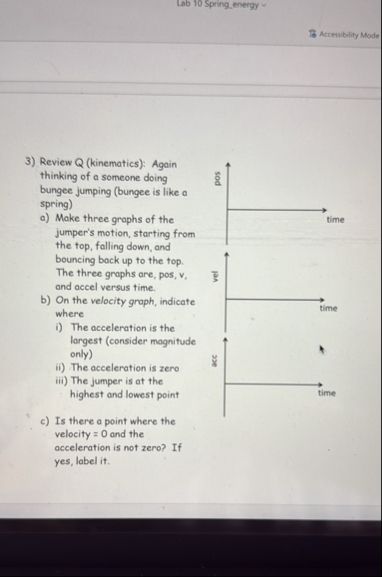 3
This is AI generated Response.
Asked by: Rahul
Created at: 2025-11-09 03:58:01
Asked by: Rahul
Created at: 2025-11-09 03:58:01
Final Answer:
Rendered
Raw Text
Did you like this answer?
## Step 1: Understanding the Problem
You are asked to analyze the motion of a bungee jumper, using three graphs:
- **Position vs. time**
- **Velocity vs. time**
- **Acceleration vs. time**
You need to identify these on the **velocity graph**:
1. Where acceleration is the largest (in magnitude)
2. Where acceleration is zero
3. Where the jumper is at the highest and lowest points
You are also asked if there is a point where velocity = and acceleration ≠ .
**Explanation:**
A bungee jumper falls, speeds up, slows down as the cord stretches, reverses direction, and oscillates. The motion resembles a mass on a spring (simple harmonic motion).
---
## Step 2: Answering Each Part
### (a) Sketching the Graphs
- **Position (pos) vs. time:**
Starts high, drops steeply (as jumper falls), bottoms out, then rises and oscillates, gradually settling.
- **Velocity (vel) vs. time:**
Starts at zero, becomes negative (downward), reaches max negative, crosses zero as jumper changes direction, becomes positive (upward), oscillates and damps.
- **Acceleration (acc) vs. time:**
Starts at -g (gravity), becomes more negative as cord stretches, reverses as cord pulls jumper up, oscillates, and damps.
**Explanation:**
The graphs represent simple harmonic motion, but are damped due to air resistance and energy loss.
---
### (b) Marking Points on the Velocity Graph
i) **Where is the acceleration the largest (in magnitude)?**
- At the **lowest point** (most stretched cord), the force (and thus acceleration) is greatest upward.
ii) **Where is the acceleration zero?**
- When passing through the **equilibrium point** (neither stretched nor compressed), the cord force is zero and only gravity acts (if we define acceleration as net force, it's zero at the midpoint if gravity and cord cancel).
iii) **Where is the jumper at the highest and lowest point?**
- **Highest point:** Where velocity crosses zero from positive to negative (top of the bounce).
- **Lowest point:** Where velocity crosses zero from negative to positive (bottom of the bounce).
**Explanation:**
Velocity is zero at the turnaround points (top and bottom). Acceleration is largest at the bottom due to maximum cord stretch.
---
### (c) Is there a point where velocity = and acceleration ≠ ?
**Yes.**
At the **highest and lowest points** (turnarounds), **velocity = ** but **acceleration ≠ ** (since the cord or gravity is acting to reverse motion).
---
## **Final Answers (Concise)**
- **(a):** Sketch the three graphs as explained above.
- **(b):**
1. Acceleration is largest (in magnitude) at the **lowest point**.
2. Acceleration is zero at the **equilibrium (mid) point**.
3. The jumper is at the **highest and lowest points** when velocity is zero (turnarounds).
- **(c):**
**Yes,** at the highest and lowest points, velocity is zero and acceleration is not zero. Label these on the velocity graph.
Question:
Please solve correct answer
This is AI generated Response.
Asked by: Rahul
Created at: 2025-11-09 03:58:31
Asked by: Rahul
Created at: 2025-11-09 03:58:31
Final Answer:
Rendered
Raw Text
Did you like this answer?
# Analyzing Bungee Jumper Motion
## Step 1: Understanding the Problem
The motion of a bungee jumper is characterized by three key graphs:
- **Position vs. time**
- **Velocity vs. time**
- **Acceleration vs. time**
We need to:
1. Identify where acceleration is largest (in magnitude).
2. Identify where acceleration is zero.
3. Determine where the jumper is at the highest and lowest points.
4. Assess if there is a point where velocity = 0 and acceleration ≠ 0.
**Explanation:**
The bungee jumper's motion involves free fall, cord stretching, and oscillation, resembling simple harmonic motion.
---
## Step 2: Answering Each Part
### (a) Sketching the Graphs
- **Position vs. Time:**
- Starts high, steep drop (falling), levels out at the lowest point, then rises and oscillates.
- **Velocity vs. Time:**
- Starts at zero, becomes negative (fall), reaches maximum negative, crosses zero (changes direction), becomes positive (rising), oscillates and dampens.
- **Acceleration vs. Time:**
- Starts at -g (gravity), increases negatively as the cord stretches, reverses to positive as the cord pulls the jumper up, oscillates and dampens.
**Explanation:**
These graphs illustrate damped oscillations due to the effects of gravity and air resistance.
---
### (b) Marking Points on the Velocity Graph
1. **Where is the acceleration largest (in magnitude)?**
- **At the lowest point** (maximum stretch of the cord), the upward force is greatest, leading to maximum acceleration.
2. **Where is the acceleration zero?**
- At the **equilibrium point** (midpoint of the bounce), where the forces balance out, resulting in zero net acceleration.
3. **Where is the jumper at the highest and lowest points?**
- **Highest point:** Velocity crosses zero from positive to negative (top of the bounce).
- **Lowest point:** Velocity crosses zero from negative to positive (bottom of the bounce).
**Explanation:**
Velocity is zero at the turnaround points, while acceleration peaks at the lowest point due to maximum force exerted by the cord.
---
### (c) Is there a point where velocity = 0 and acceleration ≠ 0?
**Yes.**
At the **highest and lowest points**, velocity is zero while acceleration is not zero due to the forces acting on the jumper (gravity and the bungee cord).
---
## Final Answers
- **(a):** Sketch the graphs as described.
- **(b):**
1. Acceleration is largest (in magnitude) at the **lowest point**.
2. Acceleration is zero at the **equilibrium (mid) point**.
3. The jumper is at the **highest and lowest points** when velocity is zero.
- **(c):**
**Yes,** at the highest and lowest points, velocity = 0 and acceleration ≠ 0.
📢 Instructions:
- Ask anything relatd to above question only.
- For new Question goto :