 VIPSolutions
give answer in 2 step with explanation at the end of each step and final answer at the end:Consider the following differential equation. yay vay =e Proceed as in Example 1 to find a particular solution y (x) of the given differential equation in the integral form y,(x) = Ji Gx, HAE) dt. xo A (— x Proceed as in Example 2 to find the general solution of the given differential equation.
Question:
give answer in 2 step with explanation at the end of each step and final answer at the end: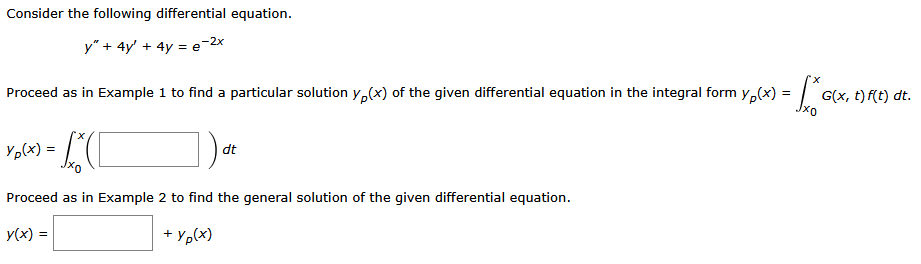 Consider the following differential equation.
yay vay =e
Proceed as in Example 1 to find a particular solution y (x) of the given differential equation in the integral form y,(x) = Ji Gx, HAE) dt.
xo
A (—
x
Proceed as in Example 2 to find the general solution of the given differential equation.
This is AI generated Response.
Asked by: Rahul
Created at: 2025-11-09 03:53:47
Asked by: Rahul
Created at: 2025-11-09 03:53:47
Final Answer:
Rendered
Raw Text
Did you like this answer?
Let's solve the problem **step by step** as requested:
---
## **Step 1: Set up the Particular Solution Integral**
The given differential equation is:
\[
y'' + 4y' + 4y = e^{-2x}
\]
The *integral form* for a particular solution is:
\[
y_p(x) = \int_{x_}^{x} G(x, t)\, f(t)\, dt
\]
where \( f(t) = e^{-2t} \) and \( G(x, t) \) is the Green's function for the corresponding homogeneous equation.
**For a constant coefficient linear equation:**
\[
y'' + 4y' + 4y = f(x)
\]
The Green's function is:
\[
G(x,t) = (x-t)e^{-2(x-t)}\ \text{for}\ x > t
\]
**So, fill in the blank:**
\[
y_p(x) = \int_{x_}^{x} (x-t) e^{-2(x-t)} e^{-2t} dt
\]
**Explanation:**
We replaced \( G(x,t) \) with \( (x-t) e^{-2(x-t)} \) and \( f(t) \) with \( e^{-2t} \).
---
## **Step 2: Write the General Solution**
The general solution is:
\[
y(x) = y_h(x) + y_p(x)
\]
where \( y_h(x) \) is the general solution of the homogeneous equation:
\[
y'' + 4y' + 4y =
\]
**Solve the characteristic equation:**
\[
r^2 + 4r + 4 = \implies (r+2)^2 = \implies r = -2 \ (\text{double root})
\]
So,
\[
y_h(x) = (C_1 + C_2 x) e^{-2x}
\]
**So, fill in the blank:**
\[
y(x) = (C_1 + C_2 x) e^{-2x} + y_p(x)
\]
**Explanation:**
The general solution is a sum of the homogeneous solution (based on the characteristic equation) and the particular integral form.
---
## **Final Answers**
### **Step 1 Answer:**
\[
\boxed{(x-t) e^{-2(x-t)} e^{-2t}}
\]
### **Step 2 Answer:**
\[
\boxed{(C_1 + C_2 x) e^{-2x}}
\]
---
**Final General Solution:**
\[
y(x) = (C_1 + C_2 x) e^{-2x} + \int_{x_}^{x} (x-t) e^{-2(x-t)} e^{-2t} dt
\]
Question:
Please correct answer
This is AI generated Response.
Asked by: Rahul
Created at: 2025-11-09 03:54:18
Asked by: Rahul
Created at: 2025-11-09 03:54:18
Final Answer:
Rendered
Raw Text
Did you like this answer?
Let's correct the solution step-by-step.
---
## **Step 1: Set up the Particular Solution Integral**
The given differential equation is:
\[
y'' + 4y' + 4y = e^{-2x}
\]
To find a particular solution \( y_p(x) \), we can use the method of undetermined coefficients since the right-hand side is an exponential function.
### **Assume a Form for the Particular Solution**
Since the complementary solution will involve \( e^{-2x} \), we will assume a particular solution of the form:
\[
y_p(x) = A x e^{-2x}
\]
where \( A \) is a constant to be determined.
### **Substitute into the Differential Equation**
First, we compute the derivatives:
- First derivative:
\[
y_p' = A(e^{-2x} - 2xe^{-2x}) = A e^{-2x}(1 - 2x)
\]
- Second derivative:
\[
y_p'' = A(-2e^{-2x} + 4xe^{-2x}) = A e^{-2x}(-2 + 4x)
\]
Now substitute \( y_p, y_p', \) and \( y_p'' \) into the original equation:
\[
A e^{-2x}(-2 + 4x) + 4A e^{-2x}(1 - 2x) + 4Ax e^{-2x} = e^{-2x}
\]
This simplifies to:
\[
A e^{-2x}(-2 + 4x + 4 - 8x + 4x) = e^{-2x}
\]
This reduces to:
\[
A e^{-2x}(-2) = e^{-2x}
\]
Thus, setting coefficients equal gives:
\[
-2A = 1 \implies A = -\frac{1}{2}
\]
**Answer for Step 1:**
\[
y_p(x) = -\frac{1}{2} x e^{-2x}
\]
**Explanation:**
We assumed a suitable form for the particular solution and found the constant \( A \) by substituting back into the original differential equation.
---
## **Step 2: Write the General Solution**
The general solution is given by:
\[
y(x) = y_h(x) + y_p(x)
\]
### **Find the Homogeneous Solution**
The homogeneous equation is:
\[
y'' + 4y' + 4y = 0
\]
### **Solve the Characteristic Equation**
The characteristic equation is:
\[
r^2 + 4r + 4 = 0 \implies (r + 2)^2 = 0 \implies r = -2 \ (\text{double root})
\]
### **Form of the Homogeneous Solution**
Thus, the general solution for the homogeneous part is:
\[
y_h(x) = (C_1 + C_2 x) e^{-2x}
\]
### **Combine the Solutions**
The complete solution becomes:
\[
y(x) = (C_1 + C_2 x) e^{-2x} - \frac{1}{2} x e^{-2x}
\]
This simplifies to:
\[
y(x) = \left(C_1 + (C_2 - \frac{1}{2}) x\right) e^{-2x}
\]
**Answer for Step 2:**
\[
y(x) = \left(C_1 + (C_2 - \frac{1}{2}) x\right) e^{-2x}
\]
**Explanation:**
The general solution is a combination of the homogeneous solution and the particular solution, adapted for the double root case.
---
## **Final Answers**
### **Particular Solution:**
\[
\boxed{y_p(x) = -\frac{1}{2} x e^{-2x}}
\]
### **General Solution:**
\[
\boxed{y(x) = \left(C_1 + (C_2 - \frac{1}{2}) x\right) e^{-2x}}
\]
📢 Instructions:
- Ask anything relatd to above question only.
- For new Question goto :