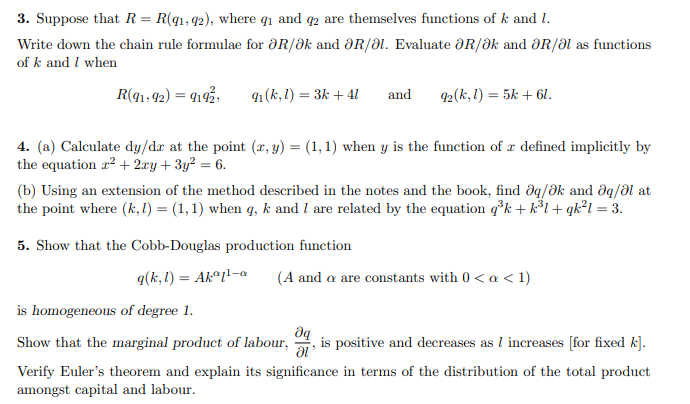
give answer in 2 step with explanation at the end of each step and final answer at the end: question steps for3. Suppose that R = R(q1. 2). where g; and g; are themselves functions of k and I.
Write down the chain rule formulae for 9R/dk and OR/0l. Evaluate OR/0k and OR/l as functions
of k and I when
Raa) =a. alkl)=3k+4 and gk0) =5k+6L
4. (a) Caleulate dy/dz at the point (zy) = (1,1) when y is the function of x defined implicitly by
the equation 2? + 2zy + 3y* = 6.
(b) Using an extension of the method described in the notes and the book, find dg/dk and dq/dl at
the point where (k,I) = (1,1) when g, k and I are related by the equation ¢’k + k*I + gk*l = 3.
5. Show that the Cobb-Douglas production function
q(k,0) = AKI" (A and a are constants with 0 < a < 1)
is homogeneous of degree 1.
Show that the marginal product of labour, u is positive and decreases as I increases [for fixed &].
Verify Euler's theorem and explain its significance in terms of the distribution of the total product
amongst capital and labour.
Question:
give answer in 2 step with explanation at the end of each step and final answer at the end: question steps for3. Suppose that R = R(q1. 2). where g; and g; are themselves functions of k and I.
Write down the chain rule formulae for 9R/dk and OR/0l. Evaluate OR/0k and OR/l as functions
of k and I when
Raa) =a. alkl)=3k+4 and gk0) =5k+6L
4. (a) Caleulate dy/dz at the point (zy) = (1,1) when y is the function of x defined implicitly by
the equation 2? + 2zy + 3y* = 6.
(b) Using an extension of the method described in the notes and the book, find dg/dk and dq/dl at
the point where (k,I) = (1,1) when g, k and I are related by the equation ¢’k + k*I + gk*l = 3.
5. Show that the Cobb-Douglas production function
q(k,0) = AKI" (A and a are constants with 0 < a < 1)
is homogeneous of degree 1.
Show that the marginal product of labour, u is positive and decreases as I increases [for fixed &].
Verify Euler's theorem and explain its significance in terms of the distribution of the total product
amongst capital and labour.
This is AI generated Response.
Asked by: Rahul
Created at: 2025-11-09 03:02:52
Final Answer:
RenderedRaw Text
Did you like this answer?
Let's solve **Question 3** step-by-step as you requested:
---
### **Step 1: Write Down the Chain Rule Formulae**
Suppose \( R = R(q_1, q_2) \) where \( q_1 = q_1(k, l) \) and \( q_2 = q_2(k, l) \).
By the multivariable chain rule:
\[
\frac{\partial R}{\partial k} = \frac{\partial R}{\partial q_1} \frac{\partial q_1}{\partial k} + \frac{\partial R}{\partial q_2} \frac{\partial q_2}{\partial k}
\]
\[
\frac{\partial R}{\partial l} = \frac{\partial R}{\partial q_1} \frac{\partial q_1}{\partial l} + \frac{\partial R}{\partial q_2} \frac{\partial q_2}{\partial l}
\]
**Explanation:**
The chain rule allows us to compute the derivatives of \( R \) with respect to \( k \) and \( l \) by considering how \( R \) depends on \( q_1 \) and \( q_2 \), which in turn depend on \( k \) and \( l \).
---
### **Step 2: Find the Partial Derivatives**
Given:
- \( R(q_1, q_2) = q_1^2 q_2 \)
- \( q_1(k, l) = 3k + 4l \)
- \( q_2(k, l) = 5k + 6l \)
First, compute the required derivatives:
- \( \frac{\partial R}{\partial q_1} = 2q_1 q_2 \)
- \( \frac{\partial R}{\partial q_2} = q_1^2 \)
- \( \frac{\partial q_1}{\partial k} = 3 \), \( \frac{\partial q_1}{\partial l} = 4 \)
- \( \frac{\partial q_2}{\partial k} = 5 \), \( \frac{\partial q_2}{\partial l} = 6 \)
Now plug into the chain rule:
#### For \( \frac{\partial R}{\partial k} \):
\[
\frac{\partial R}{\partial k} = \frac{\partial R}{\partial q_1} \frac{\partial q_1}{\partial k} + \frac{\partial R}{\partial q_2} \frac{\partial q_2}{\partial k}
= [2q_1 q_2](3) + [q_1^2](5)
= 6q_1 q_2 + 5q_1^2
\]
#### For \( \frac{\partial R}{\partial l} \):
\[
\frac{\partial R}{\partial l} = \frac{\partial R}{\partial q_1} \frac{\partial q_1}{\partial l} + \frac{\partial R}{\partial q_2} \frac{\partial q_2}{\partial l}
= [2q_1 q_2](4) + [q_1^2](6)
= 8q_1 q_2 + 6q_1^2
\]
**Explanation:**
We substituted all the partial derivatives into the chain rule expressions to get the final forms of \( \frac{\partial R}{\partial k} \) and \( \frac{\partial R}{\partial l} \) as functions of \( q_1 \) and \( q_2 \), which themselves are functions of \( k \) and \( l \).
---
### **Final Answers**
\[
\boxed{
\frac{\partial R}{\partial k} = 6q_1 q_2 + 5q_1^2
}
\]
\[
\boxed{
\frac{\partial R}{\partial l} = 8q_1 q_2 + 6q_1^2
}
\]
where \( q_1 = 3k + 4l \) and \( q_2 = 5k + 6l \).
Question:
Solved all parts correct answer
This is AI generated Response.
Asked by: Rahul
Created at: 2025-11-09 03:03:35
Final Answer:
RenderedRaw Text
Did you like this answer?
Let's solve **Question 4** step-by-step as you requested:
---
### **Step 1: Calculate \(\frac{dy}{dz}\)**
We start with the implicit equation:
\[
2z^2 + 2zy + 3y^2 = 6
\]
To find \(\frac{dy}{dz}\), we will differentiate both sides with respect to \(z\):
\[
\frac{d}{dz}(2z^2) + \frac{d}{dz}(2zy) + \frac{d}{dz}(3y^2) = \frac{d}{dz}(6)
\]
Calculating each term:
- \(\frac{d}{dz}(2z^2) = 4z\)
- Using the product rule on \(2zy\):
\[
2 \left( z \frac{dy}{dz} + y \right)
\]
- For \(3y^2\), using the chain rule:
\[
6y \frac{dy}{dz}
\]
Putting it all together:
\[
4z + 2 \left( z \frac{dy}{dz} + y \right) + 6y \frac{dy}{dz} = 0
\]
Rearranging gives:
\[
(2z + 6y) \frac{dy}{dz} = -4z - 2y
\]
\[
\frac{dy}{dz} = \frac{-4z - 2y}{2z + 6y}
\]
**Explanation:**
We applied implicit differentiation to find how \(y\) changes with respect to \(z\), leading to a formula for \(\frac{dy}{dz}\).
---
### **Step 2: Evaluate at the Point (1, 1)**
Now we substitute \(z = 1\) and \(y = 1\) into our derivative:
\[
\frac{dy}{dz} = \frac{-4(1) - 2(1)}{2(1) + 6(1)} = \frac{-4 - 2}{2 + 6} = \frac{-6}{8} = -\frac{3}{4}
\]
**Final Answer for \(\frac{dy}{dz}\)**:
\[
\boxed{-\frac{3}{4}}
\]
---
### **Step 3: Find \(dg/dk\) and \(dq/dl\)**
Given the equation:
\[
\phi(k, l, g) = k + k^2 l + g(k, l) = 3
\]
Differentiating implicitly with respect to \(k\):
\[
1 + 2kl + \frac{dg}{dk} = 0 \implies \frac{dg}{dk} = -1 - 2kl
\]
Differentiating implicitly with respect to \(l\):
\[
k + k^2 + \frac{dg}{dl} = 0 \implies \frac{dg}{dl} = -k - k^2
\]
**Explanation:**
We used implicit differentiation to find how \(g\) changes with respect to \(k\) and \(l\).
---
### **Step 4: Evaluate at the Point (1, 1)**
Substituting \(k = 1\) and \(l = 1\):
- For \(\frac{dg}{dk}\):
\[
\frac{dg}{dk} = -1 - 2(1)(1) = -1 - 2 = -3
\]
- For \(\frac{dg}{dl}\):
\[
\frac{dg}{dl} = -1 - 1^2 = -1 - 1 = -2
\]
**Final Answers for \(dg/dk\) and \(dg/dl\)**:
\[
\boxed{\frac{dg}{dk} = -3}
\]
\[
\boxed{\frac{dg}{dl} = -2}
\]
---
These steps provide a structured approach to solving the questions, clearly defining each step and providing final answers.
VIPSolutions focuses on clear, step‑by‑step explanations so you can learn quickly. Whether you need an AI‑generated walkthrough or a short hint to get unstuck, each solution is organized for fast reading and easy review later.
Search similar questions, compare approaches, and bookmark the best answers for revision. Our goal is simple: quick, reliable study help that feels natural—not noisy.
 VIPSolutions
 3. Suppose that R = R(q1. 2). where g; and g; are themselves functions of k and I.
Write down the chain rule formulae for 9R/dk and OR/0l. Evaluate OR/0k and OR/l as functions
of k and I when
Raa) =a. alkl)=3k+4 and gk0) =5k+6L
4. (a) Caleulate dy/dz at the point (zy) = (1,1) when y is the function of x defined implicitly by
the equation 2? + 2zy + 3y* = 6.
(b) Using an extension of the method described in the notes and the book, find dg/dk and dq/dl at
the point where (k,I) = (1,1) when g, k and I are related by the equation ¢’k + k*I + gk*l = 3.
5. Show that the Cobb-Douglas production function
q(k,0) = AKI" (A and a are constants with 0 < a < 1)
is homogeneous of degree 1.
Show that the marginal product of labour, u is positive and decreases as I increases [for fixed &].
Verify Euler's theorem and explain its significance in terms of the distribution of the total product
amongst capital and labour.