 VIPSolutions
give answer in 2 step with explanation at the end of each step and final answer at the end:1. Provide the chemical structure of the predicted product fo the reaction below? (7.5 pts) OT waco] 2. Provide the sructure of the reactants necessary to prepare the following enamine? (7.5 points). 0 Qo Please review the reactions of Secondary amines. 3. Provide the structure of the reactants necessary 10 prepare the following compound? (7.5 points) | ( _— | Please review the Witig reaction. -7.5 4. Provide the chemical structure of the predicted product for the reaction below? (7.5 points) ° Q ad LC] Please review Baeyer Viliger oxidation. -7.5
Question:
give answer in 2 step with explanation at the end of each step and final answer at the end: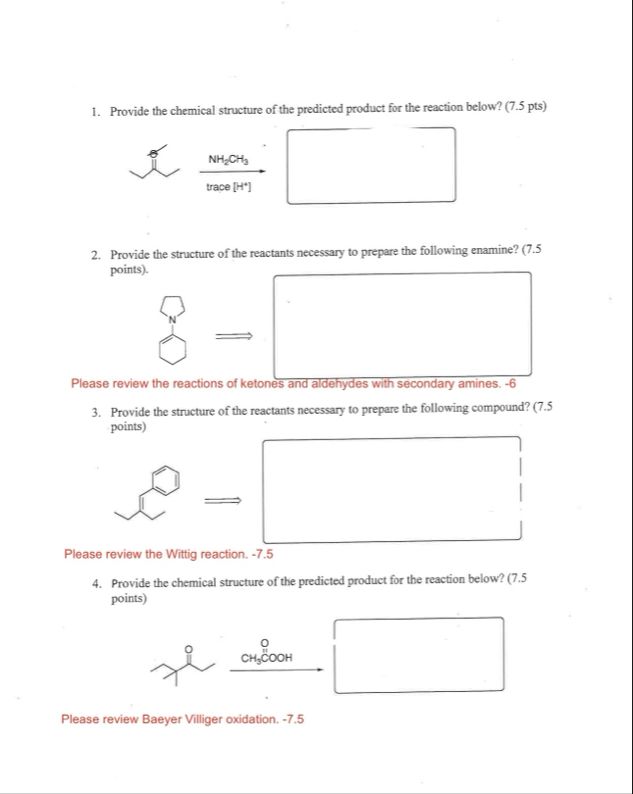 1. Provide the chemical structure of the predicted product fo the reaction below? (7.5 pts)
OT
waco]
2. Provide the sructure of the reactants necessary to prepare the following enamine? (7.5
points).
0
Qo
Please review the reactions of Secondary amines.
3. Provide the structure of the reactants necessary 10 prepare the following compound? (7.5
points)
|
( _— |
Please review the Witig reaction. -7.5
4. Provide the chemical structure of the predicted product for the reaction below? (7.5
points)
° Q
ad LC]
Please review Baeyer Viliger oxidation. -7.5
This is AI generated Response.
Asked by: Rahul
Created at: 2025-11-08 15:57:00
Asked by: Rahul
Created at: 2025-11-08 15:57:00
Final Answer:
Rendered
Raw Text
Did you like this answer?
Let's solve each question step-by-step and provide explanations:
---
## 1. Imine Formation with a Secondary Amine
### Step 1: Identify Reactants and Reaction Type
- Starting material: Ketone (2-pentanone)
- Reagent: Methylamine (CH₃NH₂), trace acid
- Reaction: Ketone + secondary amine → **enamine** (since secondary amines form enamines, not imines).
**Explanation:** Secondary amines react with ketones to form enamines via nucleophilic addition-elimination.
---
### Step 2: Draw the Product Structure
- The enamine forms at the α-carbon (adjacent to the carbonyl).
- The product: The double bond forms between the α-carbon and the β-carbon; the methylamino group is attached to the nitrogen.
**Explanation:** Proton removal from the α-carbon leads to enamine formation.
**Final Answer:**
The product is:
```
CH3
|
CH3—C=CH—N—CH3
|
CH2CH3
```
or, in line structure:
```
CH3
|
/-----N—CH3
| |
| CH2CH3
|
CH3
```
---
## 2. Enamine Formation (Reverse Reaction)
### Step 1: Identify the Enamine Structure
- Target: Cyclohexanone enamine (five-membered ring with N attached to cyclopentyl group).
**Explanation:** Enamines are made by reacting a ketone/aldehyde with a secondary amine.
---
### Step 2: Identify the Reactants
- The enamine is formed from **cyclohexanone** and **pyrrolidine** (a five-membered secondary amine).
**Explanation:** The carbonyl of cyclohexanone reacts with the nitrogen of pyrrolidine.
**Final Answer:**
Reactants are:
- Cyclohexanone
- Pyrrolidine
```
O N
/ \ + /-----\
| | | |
\ / \-----/
```
---
## 3. Wittig Reaction
### Step 1: Identify the Product Structure
- Target: An alkene where phenyl (benzyl) group is attached to the double bond (styrene derivative).
**Explanation:** Wittig reaction forms alkenes from aldehydes/ketones and phosphonium ylides.
---
### Step 2: Identify the Reactants
- Reactants:
- The corresponding aldehyde (butanal)
- The ylide (Ph₃P=CHPh, triphenylphosphonium benzylide)
**Explanation:** The ylide reacts with the carbonyl carbon to form the desired alkene.
**Final Answer:**
Reactants are:
- Butanal (CH₃CH₂CH₂CHO)
- Benzyl triphenylphosphonium ylide (Ph₃P=CHPh)
---
## 4. Baeyer–Villiger Oxidation
### Step 1: Recognize the Reaction
- Starting material: Ketone (2,2-dimethyl-3-pentanone)
- Reagent: Peracid (CH₃CO₃H, peracetic acid)
- Reaction: Baeyer–Villiger oxidation (inserts an oxygen next to the carbonyl, converting ketone to ester).
**Explanation:** The more substituted alkyl migrates to the oxygen.
---
### Step 2: Predict the Product Structure
- Oxygen is inserted between the carbonyl and the more substituted (tert-butyl) group.
**Explanation:** The tert-butyl group migrates, forming tert-butyl acetate.
**Final Answer:**
Product is:
- tert-butyl acetate
```
O
||
CH3-C-O-C(CH3)3
```
---
### **Summary Table**
| # | Step 1 | Step 2 | Final Answer |
|---|--------|--------|--------------|
| 1 | Ketone + MeNH₂ | Enamine | Enamine structure |
| 2 | Target enamine | Ketone + 2° amine | Cyclohexanone + pyrrolidine |
| 3 | Alkene (styrene) | Aldehyde + ylide | Butanal + Ph₃P=CHPh |
| 4 | Ketone + peracid | Ester | tert-butyl acetate |
Let me know if you want structures in a different style or more detailed mechanisms!
📢 Instructions:
- Ask anything relatd to above question only.
- For new Question goto :