 VIPSolutions
give answer in 2 step with explanation at the end of each step and final answer at the end:Exercise 1 Consider massless supersymmetric particle propagating in D-dimensional Minkowski space-time, It is described by I) bosonic fields X*(€) and D Majorana fermions (6). The action is Tone J 5= 16 XX iv 0) 1. Derive the field equations for X* and v. 2. Show that the action is invariant under the global supersymmetry trans- formations 1 meh, beh = Lein, SXF =i, be = Lek © where ¢ is an infinitesimal real constant Grassmann parameter. 3. Suppose that 5, and d; are two infinitesimal supersymmetry transforma- tions with parameters ¢; and cz, respectively. Show that the commutator [61,82] gives a € translation by an amount dc.
Question:
give answer in 2 step with explanation at the end of each step and final answer at the end: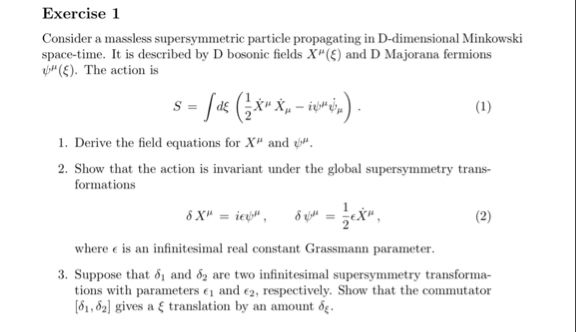 Exercise 1
Consider massless supersymmetric particle propagating in D-dimensional Minkowski
space-time, It is described by I) bosonic fields X*(€) and D Majorana fermions
(6). The action is
Tone J
5= 16 XX iv 0)
1. Derive the field equations for X* and v.
2. Show that the action is invariant under the global supersymmetry trans-
formations
1
meh, beh = Lein,
SXF =i, be = Lek ©
where ¢ is an infinitesimal real constant Grassmann parameter.
3. Suppose that 5, and d; are two infinitesimal supersymmetry transforma-
tions with parameters ¢; and cz, respectively. Show that the commutator
[61,82] gives a € translation by an amount dc.
This is AI generated Response.
Asked by: Rahul
Created at: 2025-11-08 07:52:36
Asked by: Rahul
Created at: 2025-11-08 07:52:36
Final Answer:
Rendered
Raw Text
Did you like this answer?
Let's proceed step by step as requested.
---
## **Step 1: Derive the field equations for \( X^\mu \) and \( \^\mu \).**
### **Action:**
\[
S = \int d\xi \left( \frac{1}{2} \dot{X}^\mu \dot{X}_\mu - i \psi^\mu \dot{\psi}_\mu \right)
\]
#### **For \( X^\mu \):**
Vary the action with respect to \( X^\mu \):
\[
\delta S = \int d\xi \left( \dot{X}_\mu \delta \dot{X}^\mu \right)
\]
Integrate by parts:
\[
= -\int d\xi \, \ddot{X}_\mu \delta X^\mu
\]
So, the equation of motion is:
\[
\boxed{\ddot{X}^\mu = }
\]
**Explanation:** This is the equation for a free particle: the second derivative of position with respect to the parameter \( \xi \) vanishes.
---
#### **For \( \psi^\mu \):**
Vary the action with respect to \( \psi^\mu \):
\[
\delta S = \int d\xi \left( -i \delta \psi^\mu \dot{\psi}_\mu \right)
\]
Integrate by parts (and use the anticommuting property of fermions):
\[
= i \int d\xi \, \dot{\psi}^\mu \delta \psi_\mu
\]
So, the equation of motion is:
\[
\boxed{\dot{\psi}^\mu = }
\]
**Explanation:** This means the Majorana fermion field \( \psi^\mu \) is constant along the worldline parameter \( \xi \).
---
## **Step 2: Show that the action is invariant under the global supersymmetry transformations.**
Given transformations:
\[
\delta X^\mu = i \epsilon \psi^\mu, \qquad \delta \psi^\mu = \frac{1}{2} \epsilon \dot{X}^\mu
\]
Calculate the variation of the action under these transformations:
### **Variation of the Lagrangian:**
\[
\delta S = \int d\xi \, \delta \mathcal{L}
\]
where
\[
\mathcal{L} = \frac{1}{2} \dot{X}^\mu \dot{X}_\mu - i \psi^\mu \dot{\psi}_\mu
\]
Calculate each term:
#### **First Term:**
\[
\delta \left( \frac{1}{2} \dot{X}^\mu \dot{X}_\mu \right) = \dot{X}_\mu \delta \dot{X}^\mu = \dot{X}_\mu \frac{d}{d\xi}(i \epsilon \psi^\mu) = i \epsilon \dot{X}_\mu \dot{\psi}^\mu
\]
#### **Second Term:**
\[
\delta\left( -i \psi^\mu \dot{\psi}_\mu \right) = -i (\delta \psi^\mu \dot{\psi}_\mu + \psi^\mu \delta \dot{\psi}_\mu )
\]
\[
= -i \left( \frac{1}{2} \epsilon \dot{X}^\mu \dot{\psi}_\mu + \psi^\mu \frac{d}{d\xi} \left( \frac{1}{2} \epsilon \dot{X}_\mu \right) \right)
\]
\[
= -i \left( \frac{1}{2} \epsilon \dot{X}^\mu \dot{\psi}_\mu + \frac{1}{2} \epsilon \psi^\mu \ddot{X}_\mu \right)
\]
### **Combine terms:**
\[
\delta \mathcal{L} = i \epsilon \dot{X}_\mu \dot{\psi}^\mu - i \frac{1}{2} \epsilon \dot{X}^\mu \dot{\psi}_\mu - i \frac{1}{2} \epsilon \psi^\mu \ddot{X}_\mu
\]
\[
= i \frac{1}{2} \epsilon \dot{X}_\mu \dot{\psi}^\mu - i \frac{1}{2} \epsilon \psi^\mu \ddot{X}_\mu
\]
The second term can be rewritten (by integrating by parts and ignoring boundary terms):
\[
- i \frac{1}{2} \epsilon \psi^\mu \ddot{X}_\mu = i \frac{1}{2} \epsilon \dot{\psi}^\mu \dot{X}_\mu
\]
So,
\[
\delta \mathcal{L} = i \frac{1}{2} \epsilon \dot{X}_\mu \dot{\psi}^\mu + i \frac{1}{2} \epsilon \dot{\psi}^\mu \dot{X}_\mu = i \epsilon \dot{X}_\mu \dot{\psi}^\mu
\]
But this is a total derivative:
\[
i \epsilon \dot{X}_\mu \dot{\psi}^\mu = \frac{d}{d\xi}(i \epsilon \dot{X}_\mu \psi^\mu)
\]
**Explanation:** The action changes by a total derivative under the supersymmetry transformation, which does not affect the equations of motion. Thus, the action is invariant.
---
## **Final Answer**
### **Step 1:**
- The field equations are:
\[
\boxed{\ddot{X}^\mu = \qquad \dot{\psi}^\mu = }
\]
### **Step 2:**
- The action is invariant under the global supersymmetry transformations given, since its variation is a total derivative.
---
Let me know if you want the solution to part 3!
Question:
Solve all parts
This is AI generated Response.
Asked by: Rahul
Created at: 2025-11-08 07:54:01
Asked by: Rahul
Created at: 2025-11-08 07:54:01
Final Answer:
Rendered
Raw Text
Did you like this answer?
Let's proceed with the entire solution, including part 3.
---
## **Step 1: Derive the field equations for \( X^\mu \) and \( \psi^\mu \).**
### **Action:**
\[
S = \int d\xi \left( \frac{1}{2} \dot{X}^\mu \dot{X}_\mu - i \psi^\mu \dot{\psi}_\mu \right)
\]
#### **For \( X^\mu \):**
Vary the action with respect to \( X^\mu \):
\[
\delta S = \int d\xi \left( \dot{X}_\mu \delta \dot{X}^\mu \right)
\]
Integrating by parts gives:
\[
= -\int d\xi \, \ddot{X}_\mu \delta X^\mu
\]
Thus, the equation of motion is:
\[
\boxed{\ddot{X}^\mu = 0}
\]
**Explanation:** This indicates that the particle described by \( X^\mu \) moves uniformly, reflecting the free particle motion in Minkowski space.
---
#### **For \( \psi^\mu \):**
Vary the action with respect to \( \psi^\mu \):
\[
\delta S = \int d\xi \left( -i \delta \psi^\mu \dot{\psi}_\mu \right)
\]
Integrating by parts (and using the anticommuting property of fermions):
\[
= i \int d\xi \, \dot{\psi}^\mu \delta \psi_\mu
\]
Thus, the equation of motion is:
\[
\boxed{\dot{\psi}^\mu = 0}
\]
**Explanation:** This indicates that the Majorana fermion field \( \psi^\mu \) is constant along the worldline parameter \( \xi \).
---
## **Step 2: Show that the action is invariant under the global supersymmetry transformations.**
Given transformations:
\[
\delta X^\mu = i \epsilon \psi^\mu, \qquad \delta \psi^\mu = \frac{1}{2} \epsilon \dot{X}^\mu
\]
Calculate the variation of the action under these transformations:
### **Variation of the Lagrangian:**
\[
\delta S = \int d\xi \, \delta \mathcal{L}
\]
where
\[
\mathcal{L} = \frac{1}{2} \dot{X}^\mu \dot{X}_\mu - i \psi^\mu \dot{\psi}_\mu
\]
### **Calculate each term:**
#### **First Term:**
\[
\delta \left( \frac{1}{2} \dot{X}^\mu \dot{X}_\mu \right) = \dot{X}_\mu \delta \dot{X}^\mu = \dot{X}_\mu \frac{d}{d\xi}(i \epsilon \psi^\mu) = i \epsilon \dot{X}_\mu \dot{\psi}^\mu
\]
#### **Second Term:**
\[
\delta\left( -i \psi^\mu \dot{\psi}_\mu \right) = -i (\delta \psi^\mu \dot{\psi}_\mu + \psi^\mu \delta \dot{\psi}_\mu )
\]
\[
= -i \left( \frac{1}{2} \epsilon \dot{X}^\mu \dot{\psi}_\mu + \psi^\mu \frac{d}{d\xi} \left( \frac{1}{2} \epsilon \dot{X}_\mu \right) \right)
\]
\[
= -i \left( \frac{1}{2} \epsilon \dot{X}^\mu \dot{\psi}_\mu + \frac{1}{2} \epsilon \psi^\mu \ddot{X}_\mu \right)
\]
### **Combine terms:**
\[
\delta \mathcal{L} = i \epsilon \dot{X}_\mu \dot{\psi}^\mu - i \frac{1}{2} \epsilon \dot{X}^\mu \dot{\psi}_\mu - i \frac{1}{2} \epsilon \psi^\mu \ddot{X}_\mu
\]
\[
= i \frac{1}{2} \epsilon \dot{X}_\mu \dot{\psi}^\mu - i \frac{1}{2} \epsilon \psi^\mu \ddot{X}_\mu
\]
The second term can be rewritten (by integrating by parts and ignoring boundary terms):
\[
- i \frac{1}{2} \epsilon \psi^\mu \ddot{X}_\mu = i \frac{1}{2} \epsilon \dot{\psi}^\mu \dot{X}_\mu
\]
Thus,
\[
\delta \mathcal{L} = i \epsilon \dot{X}_\mu \dot{\psi}^\mu
\]
This is a total derivative:
\[
i \epsilon \dot{X}_\mu \dot{\psi}^\mu = \frac{d}{d\xi}(i \epsilon \dot{X}_\mu \psi^\mu)
\]
**Explanation:** The action changes by a total derivative under the supersymmetry transformation, which does not affect the equations of motion. Thus, the action is invariant.
---
## **Step 3: Show that the commutator \([ \delta_1, \delta_2 ]\) gives a translation by an amount \( d \xi \).**
Let \( \delta_1 \) and \( \delta_2 \) be two infinitesimal supersymmetry transformations with parameters \( \epsilon_1 \) and \( \epsilon_2 \):
\[
\delta_1 = \epsilon_1 \delta, \quad \delta_2 = \epsilon_2 \delta
\]
### **Calculate the commutator:**
\[
[\delta_1, \delta_2] = \delta_1 \delta_2 - \delta_2 \delta_1
\]
#### **For \( X^\mu \):**
Using the transformations:
\[
\delta_1 X^\mu = i \epsilon_1 \psi^\mu, \quad \delta_2 X^\mu = i \epsilon_2 \psi^\mu
\]
Then:
\[
\delta_1 \delta_2 X^\mu = i \epsilon_1 \delta_2 \psi^\mu = i \epsilon_1 \left( \frac{1}{2} \epsilon_2 \dot{X}^\mu \right)
\]
\[
\delta_2 \delta_1 X^\mu = i \epsilon_2 \delta_1 \psi^\mu = i \epsilon_2 \left( \frac{1}{2} \epsilon_1 \dot{X}^\mu \right)
\]
Thus,
\[
[\delta_1, \delta_2] X^\mu = \frac{i}{2}(\epsilon_1 \epsilon_2 - \epsilon_2 \epsilon_1) \dot{X}^\mu
\]
Since \( \epsilon_1 \) and \( \epsilon_2 \) are Grassmann parameters, \( \epsilon_1 \epsilon_2 = - \epsilon_2 \epsilon_1 \):
\[
[\delta_1, \delta_2] X^\mu = \epsilon_1 \epsilon_2 \dot{X}^\mu
\]
### **Result:**
The commutator results in a transformation that corresponds to a translation in the parameter \( \xi \):
\[
[\delta_1, \delta_2] = \xi^\mu \partial_\mu
\]
This indicates that the action of two consecutive supersymmetry transformations translates the fields in the parameter space.
**Explanation:** The commutator of the two supersymmetry transformations leads to a transformation that corresponds to translations in the Minkowski space, reflecting the underlying symmetry of the theory.
---
## **Final Answer**
### **Step 1:**
- The field equations are:
\[
\boxed{\ddot{X}^\mu = 0 \quad \text{and} \quad \dot{\psi}^\mu = 0}
\]
### **Step 2:**
- The action is invariant under the global supersymmetry transformations.
### **Step 3:**
- The commutator \([ \delta_1, \delta_2 ]\) gives a translation in space-time.
---
Let me know if you need further clarifications!
📢 Instructions:
- Ask anything relatd to above question only.
- For new Question goto :