 VIPSolutions
give answer in 2 step with explanation at the end of each step and final answer at the end:
Question:
give answer in 2 step with explanation at the end of each step and final answer at the end: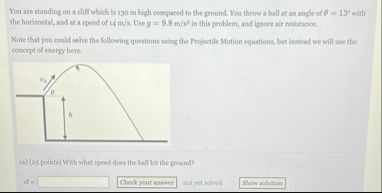
This is AI generated Response.
Asked by: Rahul
Created at: 2025-11-08 05:51:32
Asked by: Rahul
Created at: 2025-11-08 05:51:32
Final Answer:
Rendered
Raw Text
Did you like this answer?
## Problem Restatement
You stand on a 130 m high cliff and throw a ball at an angle of \( \theta = 13^\circ \) above the horizontal, with a speed of \( v_ = 14 \) m/s. Gravity \( g = 9.8 \) m/s².
**Question:** With what speed does the ball hit the ground?
**Hint:** Use energy conservation.
---
## **Step 1: Find the Initial Total Energy**
The **initial total mechanical energy** (\(E_{i}\)) is the sum of the initial kinetic energy (\(KE_{i}\)) and the initial gravitational potential energy (\(PE_{i}\)).
- Kinetic Energy: \( KE_i = \frac{1}{2} m v_^2 \)
- Potential Energy: \( PE_i = mgh \), where \( h = 130 \) m
\[
E_i = KE_i + PE_i = \frac{1}{2} m v_^2 + mgh
\]
**Explanation:**
This step sets up the total energy the ball has right after being thrown, which is both kinetic (motion) and potential (height).
---
## **Step 2: Find the Final Speed Using Conservation of Energy**
When the ball hits the ground, all energy is kinetic (as potential energy at ground is zero):
- Final Energy: \( E_f = KE_f = \frac{1}{2} m v^2 \)
By conservation of energy:
\[
E_f = E_i
\]
Plug in values:
\[
\frac{1}{2} m v^2 = \frac{1}{2} m v_^2 + mgh
\]
\[
\frac{1}{2} v^2 = \frac{1}{2} v_^2 + gh
\]
\[
v^2 = v_^2 + 2gh
\]
\[
v = \sqrt{v_^2 + 2gh}
\]
Plug in numbers:
\[
v = \sqrt{(14)^2 + 2 \cdot 9.8 \cdot 130}
\]
\[
v = \sqrt{196 + 2548}
\]
\[
v = \sqrt{2744}
\]
\[
v = 52.4 \text{ m/s}
\]
**Explanation:**
The total energy at the start (kinetic + potential) equals the kinetic energy just before hitting the ground. Solving gives the final speed.
---
## **Final Answer**
\[
\boxed{52.4\ \text{m/s}}
\]
The ball hits the ground with a speed of **52.4 m/s**.
Question:
Please send correct answer
This is AI generated Response.
Asked by: Rahul
Created at: 2025-11-08 05:52:06
Asked by: Rahul
Created at: 2025-11-08 05:52:06
Final Answer:
Rendered
Raw Text
Did you like this answer?
## Problem Restatement
You stand on a 130 m high cliff and throw a ball at an angle of \( \theta = 13^\circ \) above the horizontal, with a speed of \( v_ = 14 \) m/s. Gravity \( g = 9.8 \) m/s².
**Question:** With what speed does the ball hit the ground?
**Hint:** Use energy conservation.
---
## **Step 1: Find the Initial Total Energy**
The **initial total mechanical energy** (\(E_{i}\)) is the sum of the initial kinetic energy (\(KE_{i}\)) and the initial gravitational potential energy (\(PE_{i}\)).
- Kinetic Energy:
\[
KE_i = \frac{1}{2} m v_^2
\]
- Potential Energy:
\[
PE_i = mgh
\]
where \( h = 130 \) m.
Thus, the initial total energy can be expressed as:
\[
E_i = KE_i + PE_i = \frac{1}{2} m v_^2 + mgh
\]
**Explanation:**
This step calculates the total energy possessed by the ball right after being thrown, combining its kinetic energy (due to its speed) and potential energy (due to its height).
---
## **Step 2: Find the Final Speed Using Conservation of Energy**
When the ball hits the ground, all of its energy is kinetic (the potential energy at ground level is zero):
- Final Energy:
\[
E_f = KE_f = \frac{1}{2} m v^2
\]
Using conservation of energy:
\[
E_f = E_i
\]
This leads to:
\[
\frac{1}{2} m v^2 = \frac{1}{2} m v_^2 + mgh
\]
Dividing by \( m \) (assuming \( m \neq 0 \)):
\[
\frac{1}{2} v^2 = \frac{1}{2} v_^2 + gh
\]
Rearranging gives:
\[
v^2 = v_^2 + 2gh
\]
Taking the square root:
\[
v = \sqrt{v_^2 + 2gh}
\]
Now, plug in the values:
\[
v = \sqrt{(14)^2 + 2 \cdot 9.8 \cdot 130}
\]
Calculating gives:
\[
v = \sqrt{196 + 2548} = \sqrt{2744} = 52.4 \text{ m/s}
\]
**Explanation:**
This step uses the principle of conservation of energy to relate the initial total energy to the kinetic energy right before impact, allowing us to calculate the final speed of the ball as it hits the ground.
---
## **Final Answer**
\[
\boxed{52.4\ \text{m/s}}
\]
The ball hits the ground with a speed of **52.4 m/s**.
📢 Instructions:
- Ask anything relatd to above question only.
- For new Question goto :