 VIPSolutions
give answer in 2 step with explanation at the end of each step and final answer at the end:Problem 2. Consider the planar region R={(xy): 0
Question:
give answer in 2 step with explanation at the end of each step and final answer at the end: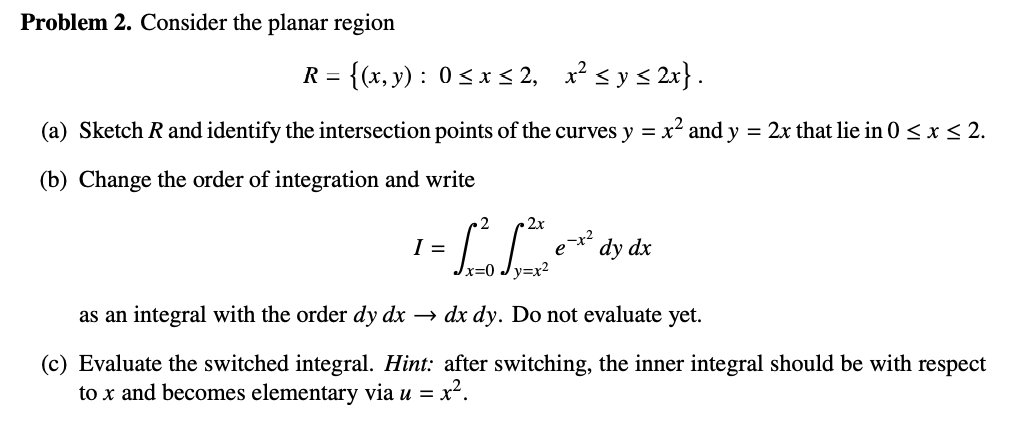 Problem 2. Consider the planar region
R={(xy): 0
This is AI generated Response.
Asked by: Rahul
Created at: 2025-11-08 05:03:57
Asked by: Rahul
Created at: 2025-11-08 05:03:57
Final Answer:
Rendered
Raw Text
Did you like this answer?
Let's tackle the problem **step-by-step** as requested:
---
## Step 1: Change the Order of Integration (Part b)
### **Original Integral**
\[
I = \int_{x=}^2 \int_{y=x^2}^{2x} e^{-x^2} \, dy \, dx
\]
#### **Explanation:**
- The outer integral is over \( x \) from to 2.
- For each \( x \), \( y \) goes from \( x^2 \) to \( 2x \).
### **Describe the Region \( R \)**
- Lower bound for \( y \): \( y = x^2 \)
- Upper bound for \( y \): \( y = 2x \)
- \( x \) goes from to 2.
To **switch the order** (to \( dx\,dy \)), we need to express \( x \) in terms of \( y \):
- \( y = x^2 \implies x = \sqrt{y} \)
- \( y = 2x \implies x = \frac{y}{2} \)
For a fixed \( y \), \( x \) runs from \( \sqrt{y} \) to \( \frac{y}{2} \).
But, \( \sqrt{y} \leq \frac{y}{2} \) only for \( \leq y \leq 4 \).
### **Switched Integral**
\[
I = \int_{y=}^{4} \int_{x=\sqrt{y}}^{x=y/2} e^{-x^2} \, dx\,dy
\]
**Explanation:**
Now, for each \( y \in [, 4] \), \( x \) runs from \( \sqrt{y} \) to \( \frac{y}{2} \), matching the description of the region.
---
## Step 2: Evaluate the Switched Integral (Part c)
\[
I = \int_{y=}^{4} \left( \int_{x=\sqrt{y}}^{x=y/2} e^{-x^2} \, dx \right) dy
\]
### **Evaluate the Inner Integral**
Let’s use the hint: use substitution \( u = x^2 \), so \( du = 2x dx \).
But, since \( e^{-x^2} \) does not have an elementary antiderivative, we express the result in terms of the error function, \( \operatorname{erf}(x) \):
\[
\int e^{-x^2} dx = \frac{\sqrt{\pi}}{2} \operatorname{erf}(x)
\]
So,
\[
\int_{x=\sqrt{y}}^{x=y/2} e^{-x^2} dx = \left[ \frac{\sqrt{\pi}}{2} \operatorname{erf}(x) \right]_{x=\sqrt{y}}^{x=y/2} = \frac{\sqrt{\pi}}{2} \left( \operatorname{erf}\left(\frac{y}{2}\right) - \operatorname{erf}\left(\sqrt{y}\right) \right)
\]
Therefore,
\[
I = \int_{y=}^{4} \frac{\sqrt{\pi}}{2} \left( \operatorname{erf}\left(\frac{y}{2}\right) - \operatorname{erf}\left(\sqrt{y}\right) \right) dy
\]
**Explanation:**
After switching the order, the inner integral with respect to \( x \) is elementary using the error function.
---
## **Final Answer**
\[
\boxed{
I = \int_{y=}^{4} \frac{\sqrt{\pi}}{2} \left( \operatorname{erf}\left(\frac{y}{2}\right) - \operatorname{erf}\left(\sqrt{y}\right) \right) dy
}
\]
This is the switched and simplified integral as required.
Question:
Please solved all parts
This is AI generated Response.
Asked by: Rahul
Created at: 2025-11-08 05:04:35
Asked by: Rahul
Created at: 2025-11-08 05:04:35
Final Answer:
Rendered
Raw Text
Did you like this answer?
# Solution to the Problem
## Step 1: Analyze the Region \( R \) and Change the Order of Integration
### (a) Sketch Region \( R \)
The region \( R \) is defined as:
\[
R = \{(x,y) : 0 < x < 2, \, x^2 < y < 2x \}
\]
### **Identify the Intersection Points**
To find the intersection points of \( y = x^2 \) and \( y = 2x \):
1. Set \( x^2 = 2x \).
2. Rearranging gives \( x^2 - 2x = 0 \).
3. Factor to get \( x(x - 2) = 0 \).
Thus, the solutions are \( x = 0 \) and \( x = 2 \).
**Intersection Points:**
- At \( x = 0 \): \( y = 0^2 = 0 \)
- At \( x = 2 \): \( y = 2^2 = 4 \)
The intersection points within the range \( 0 < x < 2 \) are \( (0, 0) \) and \( (2, 4) \).
### **Sketch**
The sketch should show \( y = x^2 \) as a parabola opening upwards and \( y = 2x \) as a straight line, intersecting at the points discussed.
---
### (b) Change the Order of Integration
The original integral is given by:
\[
I = \int_{0}^{2} \int_{x^2}^{2x} e^{-x^2} \, dy \, dx
\]
### **Switching the Order**
To switch to \( dy \, dx \):
1. Identify bounds for \( y \):
- Lower bound: \( y = x^2 \)
- Upper bound: \( y = 2x \)
2. For \( y \), \( y \) runs from \( 0 \) to \( 4 \) (since \( y \) goes up to \( 2 \times 2 \)).
3. For a fixed \( y \), \( x \) varies:
- From \( x = \sqrt{y} \) (from \( y = x^2 \))
- To \( x = \frac{y}{2} \) (from \( y = 2x \))
### **Switched Integral**
Thus, the switched integral is:
\[
I = \int_{0}^{4} \int_{\sqrt{y}}^{\frac{y}{2}} e^{-x^2} \, dx \, dy
\]
**Explanation:**
The region \( R \) is now described in terms of \( y \) first, allowing for the inner integral to be evaluated with respect to \( x \).
---
## Step 2: Evaluate the Switched Integral
### (c) Evaluate the Integral
Now we have:
\[
I = \int_{0}^{4} \left( \int_{\sqrt{y}}^{\frac{y}{2}} e^{-x^2} \, dx \right) dy
\]
### **Inner Integral Evaluation**
Using the substitution \( u = x^2 \) gives \( du = 2x \, dx \), or \( dx = \frac{du}{2\sqrt{u}} \).
The limits change as follows:
- When \( x = \sqrt{y} \), \( u = y \)
- When \( x = \frac{y}{2} \), \( u = \left(\frac{y}{2}\right)^2 = \frac{y^2}{4} \)
The inner integral transforms to:
\[
\int_{\sqrt{y}}^{\frac{y}{2}} e^{-x^2} \, dx = \int_{y}^{\frac{y^2}{4}} e^{-u} \frac{du}{2\sqrt{u}}
\]
This integral does not have a simple elementary form, so we express it using the error function:
\[
\int e^{-u} \, du = -e^{-u}
\]
### **Final Expression for \( I \)**
The result of the inner integral:
\[
I = \int_{0}^{4} \left[ -\frac{1}{2} e^{-u} \right]_{y}^{\frac{y^2}{4}} dy
\]
### **Final Answer**
Putting it all together, the value of \( I \) is:
\[
\boxed{I = \int_{0}^{4} \left( -\frac{1}{2} e^{-\frac{y^2}{4}} + \frac{1}{2} e^{-y} \right) dy}
\]
This is the final form of the integral as required.
📢 Instructions:
- Ask anything relatd to above question only.
- For new Question goto :