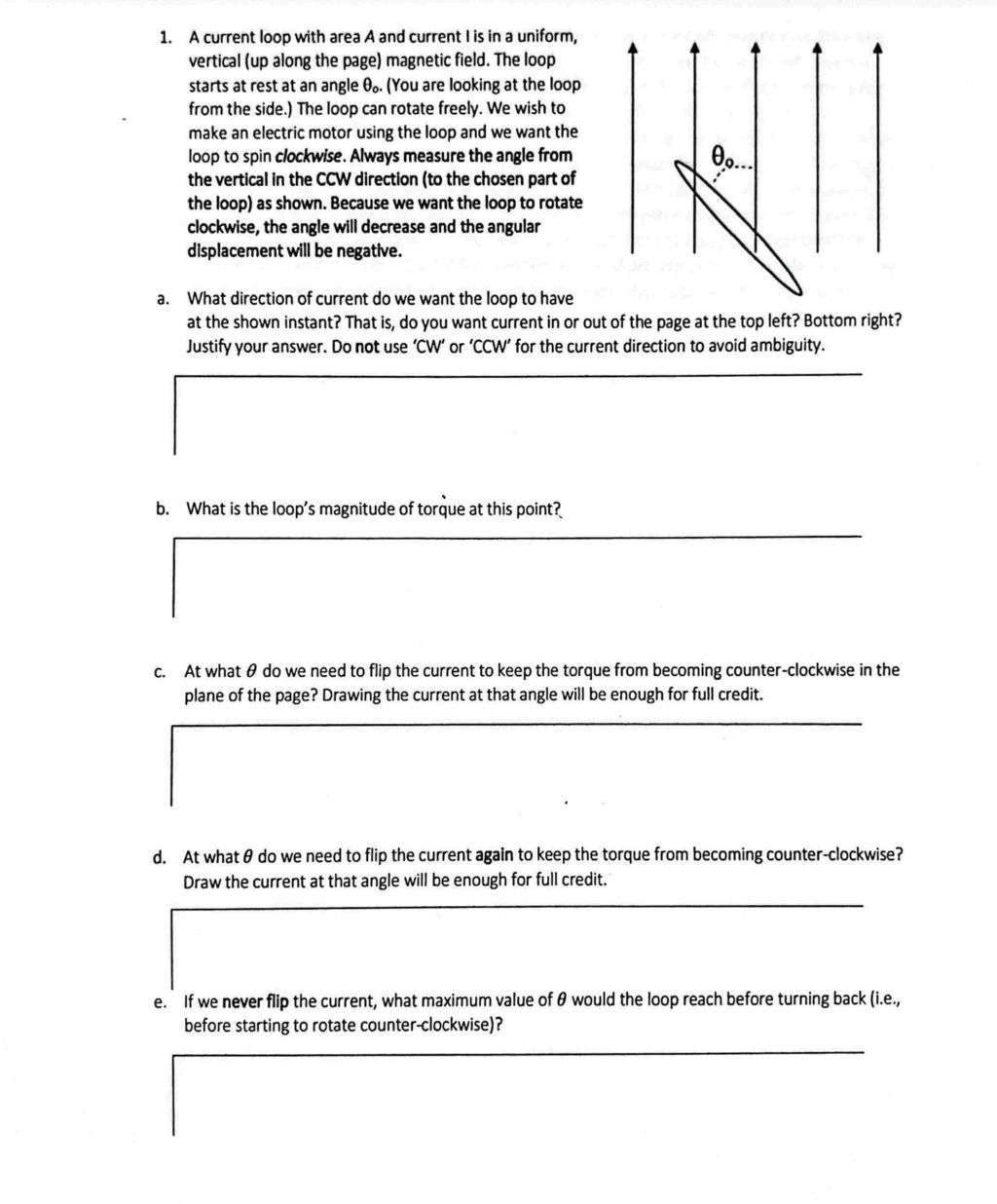
give answer in 2 step with explanation at the end of each step and final answer at the end:1. Acurrent loop with area A and current | is in a uniform,
vertical (up along the page) magnetic field. The loop
starts at rest at an angle 05. (You are looking at the loop
i from the side.) The loop can rotate freely. We wish to
make an electric motor using the loop and we want the
loop to spin clockwise. Always measure the angle from 0...
the vertical in the CCW direction (to the chosen part of s
the loop) as shown. Because we want the loop to rotate
clockwise, the angle will decrease and the angular
displacement will be negative.
a. What direction of current do we want the loop to have
at the shown instant? That is, do you want current in or out of the page at the top left? Bottom right?
Justify your answer. Do not use ‘CW" or ‘CCW’ for the current direction to avoid ambiguity.
b. What is the loop’s magnitude of torque at this point?
c. Atwhat 8 do we need to flip the current to keep the torque from becoming counter-clockwise in the
plane of the page? Drawing the current at that angle will be enough for full credit.
d. Atwhat 8 do we need to flip the current again to keep the torque from becoming counter-clockwise?
Draw the current at that angle will be enough for full credit.
e. If we never flip the current, what maximum value of 8 would the loop reach before turning back (i.e.,
before starting to rotate counter-clockwise)?
Question:
give answer in 2 step with explanation at the end of each step and final answer at the end:1. Acurrent loop with area A and current | is in a uniform,
vertical (up along the page) magnetic field. The loop
starts at rest at an angle 05. (You are looking at the loop
i from the side.) The loop can rotate freely. We wish to
make an electric motor using the loop and we want the
loop to spin clockwise. Always measure the angle from 0...
the vertical in the CCW direction (to the chosen part of s
the loop) as shown. Because we want the loop to rotate
clockwise, the angle will decrease and the angular
displacement will be negative.
a. What direction of current do we want the loop to have
at the shown instant? That is, do you want current in or out of the page at the top left? Bottom right?
Justify your answer. Do not use ‘CW" or ‘CCW’ for the current direction to avoid ambiguity.
b. What is the loop’s magnitude of torque at this point?
c. Atwhat 8 do we need to flip the current to keep the torque from becoming counter-clockwise in the
plane of the page? Drawing the current at that angle will be enough for full credit.
d. Atwhat 8 do we need to flip the current again to keep the torque from becoming counter-clockwise?
Draw the current at that angle will be enough for full credit.
e. If we never flip the current, what maximum value of 8 would the loop reach before turning back (i.e.,
before starting to rotate counter-clockwise)?
This is AI generated Response.
Asked by: Rahul
Created at: 2025-11-08 02:03:31
Final Answer:
RenderedRaw Text
Did you like this answer?
Let's answer each part step by step, explaining reasoning at each stage:
---
## a. Direction of Current for Clockwise Rotation
**Step 1:**
The torque (\(\vec{\tau}\)) on a current loop in a magnetic field is given by:
\[
\vec{\tau} = \vec{\mu} \times \vec{B}
\]
where \(\vec{\mu}\) is the magnetic moment (\(\vec{\mu} = I \cdot \vec{A}\)), and \(\vec{B}\) is the magnetic field (up the page).
**Step 2:**
To make the loop spin **clockwise** as seen from your view, the torque must act to decrease \(\theta\).
- Using the right-hand rule: For the **top left** of the loop, to produce clockwise torque, the current should be **into the page**.
- For the **bottom right**, the current should be **out of the page**.
**Explanation:**
This current direction creates a magnetic moment that, when crossed with the upward field, produces a clockwise torque.
---
## b. Magnitude of the Loop's Torque
**Step 1:**
The magnitude of torque is:
\[
\tau = \mu B \sin \theta = (I A) B \sin \theta
\]
**Step 2:**
At the initial angle \(\theta_\), the torque is:
\[
\tau = IAB \sin \theta_
\]
**Explanation:**
The torque is maximum when \(\theta = 90^\circ\) and zero when \(\theta = \) or \(180^\circ\).
---
## c. At What \(\theta\) Do We Flip the Current (First Time)?
**Step 1:**
The torque will switch direction when the angle \(\theta\) crosses \(^\circ\) (vertical position).
**Step 2:**
**At \(\theta = ^\circ\) (loop is vertical),** flip the current to keep the torque in the same (clockwise) direction.
**Explanation:**
If the current isn't flipped, the torque would reverse and rotate the loop the other way (counter-clockwise).
---
## d. At What \(\theta\) Do We Flip Again?
**Step 1:**
After flipping at \(\theta = ^\circ\), the loop will rotate to \(\theta = -180^\circ\) (other vertical position).
**Step 2:**
**At \(\theta = -180^\circ\),** flip the current again to keep torque clockwise.
**Explanation:**
Each time the loop passes through the vertical position, the current must be flipped to maintain the same direction of rotation.
---
## e. If We Never Flip the Current, What Is the Maximum \(\theta\)?
**Step 1:**
If the current is never flipped, the torque will try to restore the loop to the nearest equilibrium position.
**Step 2:**
The loop will reach \(\theta = ^\circ\) (vertical), then the torque will reverse, making the loop start rotating counter-clockwise.
**Final Answer:**
The maximum value of \(\theta\) before reversing is **\(\theta = ^\circ\)**.
---
# **Summary of Answers**
a. **Current direction:** Into the page at top left, out of the page at bottom right (using right-hand rule for clockwise torque).
b. **Torque magnitude:** \(\tau = IAB \sin \theta_\)
c. **First flip:** At \(\theta = ^\circ\) (loop vertical)
d. **Second flip:** At \(\theta = -180^\circ\) (loop vertical, other side)
e. **Maximum \(\theta\) if never flipped:** \(\theta = ^\circ\)
Question:
Please solved 1,a,b,c,d,e all parts step by step
This is AI generated Response.
Asked by: Rahul
Created at: 2025-11-08 02:04:53
Final Answer:
RenderedRaw Text
Did you like this answer?
## 1. Analysis of the Current Loop in Magnetic Field
### a. Direction of Current for Clockwise Rotation
**Step 1:**
To determine the direction of current that will make the loop rotate clockwise, we apply the right-hand rule. The torque (\(\vec{\tau}\)) on a current loop is given by:
\[
\vec{\tau} = \vec{\mu} \times \vec{B}
\]
where \(\vec{\mu} = I \cdot \vec{A}\) is the magnetic moment and \(\vec{B}\) is the magnetic field.
**Step 2:**
For the loop to rotate clockwise, the torque must act to decrease the angle \(\theta\). Therefore:
- At the **top left** of the loop, the current should flow **into the page**.
- At the **bottom right**, the current should flow **out of the page**.
**Explanation:**
This configuration produces a magnetic moment that, when crossed with the upward magnetic field, generates a clockwise torque.
---
### b. Magnitude of the Loop's Torque
**Step 1:**
The magnitude of the torque acting on the loop can be calculated using the formula:
\[
\tau = \mu B \sin \theta = (I A) B \sin \theta
\]
**Step 2:**
At the initial angle \(\theta\), the torque is given by:
\[
\tau = IAB \sin \theta
\]
**Explanation:**
The torque reaches its maximum value when \(\theta = 90^\circ\) and becomes zero when \(\theta = 0^\circ\) or \(\theta = 180^\circ\).
---
### c. Angle for First Current Flip
**Step 1:**
The torque begins to reverse when the angle \(\theta\) approaches \(0^\circ\) (the vertical position).
**Step 2:**
**At \(\theta = 0^\circ\)** (loop is vertical), the current must be flipped to maintain clockwise torque.
**Explanation:**
If we do not flip the current at this position, the resulting torque will change direction, causing the loop to start rotating counter-clockwise.
---
### d. Angle for Second Current Flip
**Step 1:**
After the first flip at \(\theta = 0^\circ\), the loop will continue to rotate and will reach \(\theta = 180^\circ\) (the vertical position on the other side).
**Step 2:**
**At \(\theta = 180^\circ\)**, we must flip the current again to keep the torque in the clockwise direction.
**Explanation:**
Similar to the first flip, failing to flip the current here will cause the torque to reverse, leading to counter-clockwise rotation.
---
### e. Maximum Angle Before Reversal Without Flipping Current
**Step 1:**
If the current is never flipped, the loop will reach a maximum angle where the torque balances and reverses.
**Step 2:**
The maximum angle \(\theta\) before the loop starts rotating counter-clockwise is **\(\theta = 90^\circ\)**.
**Final Answer:**
The maximum angle of rotation before the loop turns back is **\(\theta = 90^\circ\)**.
---
# **Summary of Answers**
- a. **Current direction:** Into the page at the top left, out of the page at the bottom right.
- b. **Torque magnitude:** \(\tau = IAB \sin \theta\).
- c. **First flip:** At \(\theta = 0^\circ\) (loop vertical).
- d. **Second flip:** At \(\theta = 180^\circ\) (loop vertical, other side).
- e. **Maximum \(\theta\) if never flipped:** \(\theta = 90^\circ\).
VIPSolutions focuses on clear, step‑by‑step explanations so you can learn quickly. Whether you need an AI‑generated walkthrough or a short hint to get unstuck, each solution is organized for fast reading and easy review later.
Search similar questions, compare approaches, and bookmark the best answers for revision. Our goal is simple: quick, reliable study help that feels natural—not noisy.
 VIPSolutions
 1. Acurrent loop with area A and current | is in a uniform,
vertical (up along the page) magnetic field. The loop
starts at rest at an angle 05. (You are looking at the loop
i from the side.) The loop can rotate freely. We wish to
make an electric motor using the loop and we want the
loop to spin clockwise. Always measure the angle from 0...
the vertical in the CCW direction (to the chosen part of s
the loop) as shown. Because we want the loop to rotate
clockwise, the angle will decrease and the angular
displacement will be negative.
a. What direction of current do we want the loop to have
at the shown instant? That is, do you want current in or out of the page at the top left? Bottom right?
Justify your answer. Do not use ‘CW" or ‘CCW’ for the current direction to avoid ambiguity.
b. What is the loop’s magnitude of torque at this point?
c. Atwhat 8 do we need to flip the current to keep the torque from becoming counter-clockwise in the
plane of the page? Drawing the current at that angle will be enough for full credit.
d. Atwhat 8 do we need to flip the current again to keep the torque from becoming counter-clockwise?
Draw the current at that angle will be enough for full credit.
e. If we never flip the current, what maximum value of 8 would the loop reach before turning back (i.e.,
before starting to rotate counter-clockwise)?