 VIPSolutions
give answer in 2 step with explanation at the end of each step and final answer at the end:w § gs Ad Jd = x F a fii T Hi i HAH : i O HEHE is / HHL § = {HE 8H] hn HEH EE: fn i = RE 2 lig Eo Li E i I] il id Ee H lt
Question:
give answer in 2 step with explanation at the end of each step and final answer at the end: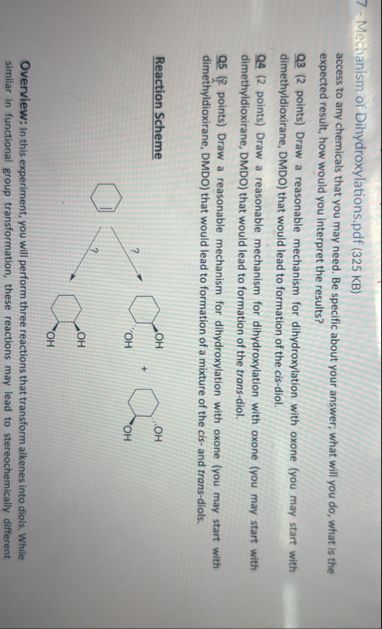 w §
gs Ad
Jd = x F
a fii
T Hi
i HAH :
i O HEHE
is / HHL
§ = {HE 8H]
hn HEH
EE: fn
i = RE
2 lig
Eo Li
E i I]
il id
Ee H
lt
This is AI generated Response.
Asked by: Roshan
Created at: 2025-11-07 18:36:24
Asked by: Roshan
Created at: 2025-11-07 18:36:24
Final Answer:
Rendered
Raw Text
Did you like this answer?
# Stepwise: Dihydroxylation Mechanism
## **Step 1: Draw a Reasonable Mechanism for cis-Dihydroxylation with Osmium Tetroxide (OsO₄)**
**Mechanism:**
1. **Formation of Cyclic Osmate Ester:**
The alkene reacts with OsO₄ in a concerted [3+2] cycloaddition to form a cyclic osmate ester intermediate.
- This step occurs in a *syn* manner, so both oxygens add to the same face of the alkene.
**Explanation:**
OsO₄ approaches the alkene, and the π electrons of the double bond interact with the osmium to form a five-membered ring intermediate. This locks both oxygens on the same side.
---
## **Step 2: Hydrolysis of the Osmate Ester to Give the cis-Diol**
**Mechanism:**
2. **Hydrolysis (Work-up Step):**
The cyclic osmate ester is hydrolyzed (often with H₂O₂ or water), breaking the Os–O bonds and releasing the *cis*-diol, while OsO₄ is regenerated.
**Explanation:**
Water (or another oxidant) cleaves the osmate ester, resulting in vicinal diol formation with both hydroxyl groups on the same side (*syn* addition, giving the *cis*-diol).
---
## **Final Answer**
- The overall mechanism with OsO₄ gives the **cis-diol** via a syn addition mechanism involving a cyclic osmate ester intermediate, followed by hydrolysis to yield the cis (syn) diol product.
---
**Summary Diagram:**
```
Step 1: Alkene + OsO₄ → Cyclic osmate ester (syn addition)
Step 2: Cyclic osmate ester + H₂O₂/H₂O → cis-Diol + regenerated OsO₄
```
**Key Point:**
Both oxygens add to the same side of the double bond, giving a cis-diol.
Question:
Solved all parts
This is AI generated Response.
Asked by: Roshan
Created at: 2025-11-07 18:36:50
Asked by: Roshan
Created at: 2025-11-07 18:36:50
Final Answer:
Rendered
Raw Text
Did you like this answer?
# Dihydroxylation Mechanism Using Osmium Tetroxide
## **Step 1: Formation of Cyclic Osmate Ester**
**Mechanism:**
1. **Cyclic Osmate Ester Formation:**
The alkene undergoes a reaction with OsO₄, resulting in the formation of a cyclic osmate ester intermediate through a concerted [3+2] cycloaddition.
- The addition occurs in a *syn* manner, meaning both oxygen atoms from OsO₄ add to the same side of the alkene.
**Explanation:**
In this step, OsO₄ approaches the alkene, and the π electrons from the double bond interact with osmium. This interaction results in the formation of a five-membered cyclic intermediate, ensuring that both oxygens are added to the same face of the alkene.
---
## **Step 2: Hydrolysis to Produce cis-Diol**
**Mechanism:**
2. **Hydrolysis of Cyclic Osmate Ester:**
The cyclic osmate ester is hydrolyzed, typically using water or hydrogen peroxide, which cleaves the Os–O bonds and results in the formation of a *cis*-diol while regenerating OsO₄.
**Explanation:**
In this hydrolysis step, water or another oxidizing agent breaks the bonds in the osmate ester. This results in the formation of a vicinal diol with both hydroxyl groups positioned on the same side of the original alkene, confirming that a syn addition occurred, leading to the formation of the cis-diol.
---
## **Final Answer**
- The mechanism results in the formation of a **cis-diol** through a syn addition mechanism. The process involves:
- Step 1: Alkene reacts with OsO₄ to form a cyclic osmate ester.
- Step 2: Hydrolysis of the cyclic osmate ester yields the cis-diol.
---
**Summary Diagram:**
```
Step 1: Alkene + OsO₄ → Cyclic osmate ester (syn addition)
Step 2: Cyclic osmate ester + H₂O/H₂O₂ → cis-Diol + regenerated OsO₄
```
**Key Point:**
Both hydroxyl groups are added to the same side of the double bond, resulting in a cis-diol.
📢 Instructions:
- Ask anything relatd to above question only.
- For new Question goto :