 VIPSolutions
give answer in 2 step with explanation at the end of each step and final answer at the end:RE de 2 U0 roc rest comme 00) Broce hemes cormatens cr rm a mmr 2. Gs ost Matec et cpl actos shot 3 AF ) (on eal CL, | or" 0 How 5s
Question:
give answer in 2 step with explanation at the end of each step and final answer at the end: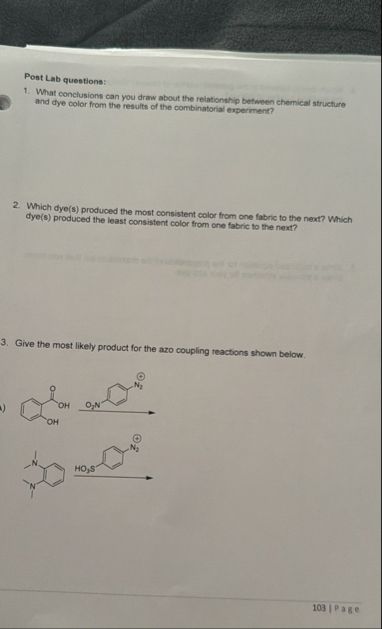 RE de
2 U0 roc rest comme
00) Broce hemes cormatens cr rm a mmr
2. Gs ost Matec et cpl actos shot
3 AF
) (on eal
CL,
| or"
0 How
5s
This is AI generated Response.
Asked by: Roshan
Created at: 2025-11-07 14:53:12
Asked by: Roshan
Created at: 2025-11-07 14:53:12
Final Answer:
Rendered
Raw Text
Did you like this answer?
Let's answer each question step-by-step as requested:
---
### 1. Relationship between Chemical Structure and Dye Color
**Step 1:**
Review the results of the combinatorial experiment, focusing on how different chemical structures of dyes correspond to the colors observed.
**Explanation:**
Different substituents (like -OH, -SO₃H, -NO₂) and the length of conjugation in the dye molecule influence the wavelength of light absorbed, which determines the observed color. Electron-donating groups (e.g., -OH) and electron-withdrawing groups (e.g., -NO₂) shift the absorption wavelength, changing the dye color.
---
### 2. Consistency of Dye Color Across Fabrics
**Step 2:**
Identify which dyes gave the most uniform color across various fabrics, and which ones varied the most.
**Explanation:**
Dyes with sulfonic acid groups (-SO₃H) tend to bind more consistently to different fabrics due to their enhanced water solubility and strong ionic interactions with fabric fibers, leading to more consistent color. Dyes lacking such groups or with bulky substituents may interact differently with each fabric, resulting in less consistency.
---
### 3. Most Likely Product for Azo Coupling Reactions
#### (I)
- **Step 3A:**
The phenol group (OH) on the benzene ring activates the ring towards electrophilic substitution at the ortho and para positions. The diazonium ion reacts primarily at the para position (unless blocked).
**Explanation:**
The coupling occurs at the para position relative to the -OH group of the first molecule, forming an azo bond (-N=N-) linking the two rings.
#### (II)
- **Step 3B:**
Similarly, the amine group (NH₂ or its derivatives) activates the ring at ortho and para positions, but para is favored unless occupied.
**Explanation:**
The coupling also occurs at the para position to the amino group, forming another azo bond.
---
## **Final Answers**
1. **Conclusion:**
The chemical structure, especially the presence and position of electron-donating or withdrawing groups and the extent of conjugation, strongly influences the dye color observed.
2. **Most Consistent Dye:**
Dyes containing sulfonic acid groups (-SO₃H) showed the most consistent color across fabrics. Dyes without these groups or with large substituents were the least consistent.
3. **Azo Coupling Products:**
- **(I):** The product is formed by coupling at the para position of the phenol ring with the diazonium group.
- **(II):** The product is formed by coupling at the para position of the amino ring with the diazonium group.
If you want the exact structures drawn out, let me know!
Question:
Solved this question step by step full any
This is AI generated Response.
Asked by: Roshan
Created at: 2025-11-07 14:53:44
Asked by: Roshan
Created at: 2025-11-07 14:53:44
Final Answer:
Rendered
Raw Text
Did you like this answer?
## Step-by-Step Solution to the Azo Coupling Reactions
### Step 1: Understanding Azo Coupling Mechanism
**What is Azo Coupling?**
Azo coupling is a reaction between a diazonium compound and an activated aromatic compound (like phenols or amines) that results in the formation of an azo compound, which contains the -N=N- linkage.
#### Key Points:
- **Diazonium Ion:** A positively charged ion derived from aromatic amines (e.g., aniline).
- **Electrophilic Substitution:** The mechanism by which the diazonium ion attacks the aromatic system.
**Example Reaction:**
- **Diazonium Ion Formation:**
\[ \text{C}_6\text{H}_5\text{NH}_2 + \text{NaNO}_2 + \text{HCl} \rightarrow \text{C}_6\text{H}_5\text{N}_2^+ \text{Cl}^- \]
### Step 2: Reaction Positions in Aromatic Compounds
**Positioning of Substitution:**
- **Phenol Group (OH):** Activates the aromatic ring, making it more reactive towards electrophiles.
- **Amine Group (NH₂):** Also activates the ring, making it prone to electrophilic attack.
#### Product Formation:
- **For Phenol:**
- The diazonium ion will couple primarily at the **para** position relative to the -OH group.
- **For Amine:**
- Similarly, the reaction occurs at the **para** position relative to the -NH₂ group.
### Final Answer
1. **Azo Coupling Product with Phenol:**
The product is formed by coupling the diazonium ion at the **para** position to the phenolic -OH group, resulting in an azo compound.
2. **Azo Coupling Product with Amine:**
The product is formed by coupling the diazonium ion at the **para** position to the amine -NH₂ group, resulting in another azo compound.
These reactions illustrate how the presence of -OH and -NH₂ groups enhance the reactivity of the aromatic system and dictate the position of azo coupling.
📢 Instructions:
- Ask anything relatd to above question only.
- For new Question goto :