 VIPSolutions
give answer in 2 step with explanation at the end of each step and final answer at the end:€.Pre-Lab Questions. 1. bockdonare 0.008) ychmton wager Pal ies axclort cto, S500 ewe nh rest ol Scr, hm mary Sr a var Ean 2. Pesos mechs ot oc Bh ae Todt 0 st eck RT Wo ec hen wd 5. rn oo me or rs br eo 4 1 shew cig pron nnn rc Peps Ee
Question:
give answer in 2 step with explanation at the end of each step and final answer at the end: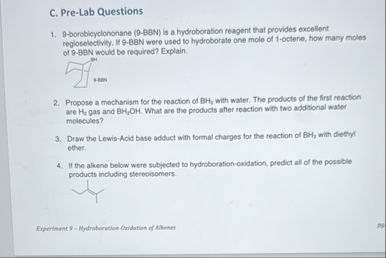 €.Pre-Lab Questions.
1. bockdonare 0.008) ychmton wager Pal ies axclort
cto, S500 ewe nh rest ol Scr, hm mary
Sr a var Ean
2. Pesos mechs ot oc Bh ae Todt 0 st eck
RT Wo ec hen wd
5. rn oo me or rs br eo 4
1 shew cig pron nnn rc Peps
Ee
This is AI generated Response.
Asked by: Roshan
Created at: 2025-11-07 14:49:13
Asked by: Roshan
Created at: 2025-11-07 14:49:13
Final Answer:
Rendered
Raw Text
Did you like this answer?
Certainly! Here’s a **stepwise answer** for each question, with explanations at each step and final answers at the end.
---
## 1. 9-BBN and 1-Octene
### **Step 1:** Understand the reaction stoichiometry
- 9-BBN hydroborates alkenes in a **1:1 molar ratio** (one molecule of 9-BBN adds across one double bond of the alkene).
- 1-Octene has one double bond per molecule.
**Explanation:**
Each molecule of 9-BBN can react with one molecule of 1-octene.
---
### **Step 2:** Relate to the amount given
- To hydroborate **one mole** of 1-octene, you need **one mole** of 9-BBN.
**Explanation:**
Since the reaction is 1:1, one mole of 9-BBN will hydroborate one mole of 1-octene.
---
**Final Answer:**
**You would need one mole of 9-BBN to hydroborate one mole of 1-octene.**
---
## 2. BH₄⁻ Reaction with Water (Mechanism)
### **Step 1:** First reaction with water
- **BH₄⁻ + H₂O → BH₃ + H₂ + OH⁻**
- BH₄⁻ donates a hydride ion (H⁻) to the water, producing hydrogen gas and BH₃.
**Explanation:**
Borohydride acts as a nucleophile, attacking the proton of water, releasing H₂ gas.
---
### **Step 2:** Further reaction with two more water molecules
- **BH₃ + 3H₂O → B(OH)₃ + 3H₂**
- Each water molecule reacts with boron, fully hydrolyzing it.
**Explanation:**
BH₃ is hydrolyzed stepwise by water, eventually forming boric acid (B(OH)₃) and more hydrogen gas.
---
**Final Answer:**
**Products after full hydrolysis: B(OH)₃ (boric acid) and H₂ gas.**
---
## 3. Lewis Acid-Base Adduct: BH₃ and Diethyl Ether
### **Step 1:** Draw the Lewis structures
- **BH₃**: Boron has 3 valence electrons, forming 3 single bonds with H, has an empty p orbital (Lewis acid).
- **Diethyl ether (Et₂O):** Oxygen has two lone pairs (Lewis base).
**Explanation:**
Boron is electron-deficient and accepts a lone pair from oxygen.
---
### **Step 2:** Show formal charges
- Oxygen donates a lone pair to boron, forming a coordinate bond.
- Both atoms remain neutral, as no electrons are lost or gained, just shared.
**Explanation:**
The adduct is neutral, as the donation is a coordinate covalent bond, not ionization.
---
**Final Answer:**
**The adduct is Et₂O→BH₃, with a coordinate bond from O (Et₂O) to B (BH₃); all atoms are neutral.**
---
## 4. Hydroboration-Oxidation of the Given Alkene (Stereochemistry)
### **Step 1:** Identify the alkene and hydroboration product
- The alkene is 3-methyl-1-butene.
- Hydroboration-oxidation (BH₃, then H₂O₂/NaOH) adds **OH to the less substituted carbon** (anti-Markovnikov) and **H to the more substituted**.
**Explanation:**
Hydroboration-oxidation proceeds via syn addition, both H and OH add on the same face.
---
### **Step 2:** Predict products and stereochemistry
- The **alcohol** will be at the terminal carbon (position 1), giving **3-methyl-1-butanol**.
- **Stereochemistry:** Since the product is a primary alcohol (no chiral center at C-1), there’s **no stereoisomerism** in this case.
**Explanation:**
With no new chiral center, only one product is formed.
---
**Final Answer:**
**The only product is 3-methyl-1-butanol; no stereoisomers are formed because there is no chiral center.**
---
Let me know if you want the full mechanisms or structures drawn out!
Question:
Solved all parts please full question
This is AI generated Response.
Asked by: Roshan
Created at: 2025-11-07 14:50:04
Asked by: Roshan
Created at: 2025-11-07 14:50:04
Final Answer:
Rendered
Raw Text
Did you like this answer?
Certainly! Below is the structured Markdown response addressing all parts of the question based on the provided information.
---
# Pre-Lab Questions Solutions
## 1. Hydroboration of 1-Octene with 9-BBN
### **Step 1:** Reaction Stoichiometry
- **Reaction Type:** Hydroboration
- **Molar Ratio:** 9-BBN reacts with 1-octene in a **1:1** ratio.
**Explanation:**
Each molecule of 9-BBN can react with one molecule of 1-octene due to the presence of one double bond in 1-octene.
### **Step 2:** Amount Required
- To hydroborate **one mole** of 1-octene, you need **one mole** of 9-BBN.
**Explanation:**
Since the reaction is 1:1, the total amount of 9-BBN required is equal to the amount of 1-octene.
**Final Answer:**
**You would need one mole of 9-BBN to hydroborate one mole of 1-octene.**
---
## 2. Reaction of BH₄⁻ with Water
### **Step 1:** Initial Reaction
- **Reaction:** BH₄⁻ + H₂O → BH₃ + H₂ + OH⁻
**Explanation:**
Borohydride (BH₄⁻) donates a hydride ion (H⁻) to water, resulting in the formation of hydrogen gas (H₂) and borane (BH₃).
### **Step 2:** Hydrolysis of Borane
- **Further Reaction:** BH₃ + 3H₂O → B(OH)₃ + 3H₂
**Explanation:**
BH₃ reacts with water in a stepwise manner to produce boric acid (B(OH)₃) and additional hydrogen gas.
**Final Answer:**
**After full hydrolysis, the products are B(OH)₃ (boric acid) and H₂ gas.**
---
## 3. Lewis Acid-Base Adduct of BH₃ and Diethyl Ether
### **Step 1:** Lewis Structures
- **BH₃:** Boron has 3 valence electrons, forming three bonds with hydrogen atoms, and has an empty p orbital.
- **Diethyl Ether (Et₂O):** Oxygen has two lone pairs of electrons.
**Explanation:**
Boron, being electron-deficient, acts as a Lewis acid and can accept a lone pair from the oxygen in diethyl ether.
### **Step 2:** Formation of the Adduct
- The lone pair from the oxygen forms a coordinate bond with the boron atom.
**Explanation:**
The adduct (Et₂O→BH₃) comprises a coordinate bond without changing the formal charges of the involved atoms.
**Final Answer:**
**The adduct formed is Et₂O→BH₃, with a coordinate bond from O (Et₂O) to B (BH₃); all atoms remain neutral.**
---
## 4. Hydroboration-Oxidation of 3-Methyl-1-Butene
### **Step 1:** Hydroboration Reaction
- The alkene is **3-methyl-1-butene**.
- Hydroboration results in the addition of **OH to the less substituted carbon** (anti-Markovnikov).
**Explanation:**
The hydroboration-oxidation process involves syn addition, where both H and OH add to the same side of the double bond.
### **Step 2:** Predicting Stereochemistry
- The product after hydroboration-oxidation is **3-methyl-1-butanol**.
- There is **no stereoisomerism** as no new chiral centers are generated.
**Explanation:**
The product formed is a primary alcohol without chiral centers leading to only one possible structure.
**Final Answer:**
**The only product is 3-methyl-1-butanol; no stereoisomers are formed because there is no chiral center.**
---
This concludes the solutions to the pre-lab questions. Let me know if you need further details or explanations!
📢 Instructions:
- Ask anything relatd to above question only.
- For new Question goto :