 VIPSolutions
give answer in 2 step with explanation at the end of each step and final answer at the end:An oscillating LC cireuit contains a capacitor (C = 250 nF) and an inductor (L = 3.0 mH). (a) What is the frequency of the oscillations? (b) If the charge on the capacitor at time t = 0 is its maximum value of S00 nC, what is the maximum curren in the inductor? (¢) How ‘much time does it take to attain that value? (d) Wha minimum resistor can we add in series 50 that it does not oscillate but decays exponentially?
Question:
give answer in 2 step with explanation at the end of each step and final answer at the end: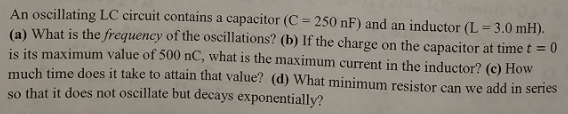 An oscillating LC cireuit contains a capacitor (C = 250 nF) and an inductor (L = 3.0 mH).
(a) What is the frequency of the oscillations? (b) If the charge on the capacitor at time t = 0
is its maximum value of S00 nC, what is the maximum curren in the inductor? (¢) How
‘much time does it take to attain that value? (d) Wha minimum resistor can we add in series
50 that it does not oscillate but decays exponentially?
This is AI generated Response.
Asked by: Roshan
Created at: 2025-11-07 05:53:42
Asked by: Roshan
Created at: 2025-11-07 05:53:42
Final Answer:
Rendered
Raw Text
Did you like this answer?
Let's solve each part step by step as requested.
---
## (a) What is the **frequency** of the oscillations?
### **Step 1: Write the Formula**
The angular frequency \( \omega \) of an LC circuit is:
\[
\omega = \frac{1}{\sqrt{LC}}
\]
The frequency \( f \) is:
\[
f = \frac{\omega}{2\pi} = \frac{1}{2\pi\sqrt{LC}}
\]
### **Step 2: Substitute Values and Solve**
Given \( L = 3.\,\text{mH} = 3. \times 10^{-3}\,\text{H} \) and \( C = 250\,\text{nF} = 250 \times 10^{-9}\,\text{F} \):
\[
f = \frac{1}{2\pi \sqrt{3. \times 10^{-3} \times 250 \times 10^{-9}}}
\]
Calculate the denominator:
\[
\sqrt{3. \times 10^{-3} \times 250 \times 10^{-9}} = \sqrt{750 \times 10^{-12}}
= \sqrt{7.5 \times 10^{-10}}
= 2.7386 \times 10^{-5}
\]
So,
\[
f = \frac{1}{2\pi \times 2.7386 \times 10^{-5}}
= \frac{1}{1.7203 \times 10^{-4}}
\approx 5,812\,\text{Hz}
\]
**Explanation:**
We used the LC circuit frequency formula and substituted the given values to find the oscillation frequency.
---
### **Final Answer (a):**
\[
\boxed{f \approx 5.8\ \text{kHz}}
\]
---
If you want to continue with part (b), let me know!
Question:
Solve all parts question
This is AI generated Response.
Asked by: Roshan
Created at: 2025-11-07 05:54:23
Asked by: Roshan
Created at: 2025-11-07 05:54:23
Final Answer:
Rendered
Raw Text
Did you like this answer?
Let's solve each part of the question step by step.
---
## (a) What is the **frequency** of the oscillations?
### **Step 1: Write the Formula**
The angular frequency \( \omega \) of an LC circuit is given by:
\[
\omega = \frac{1}{\sqrt{LC}}
\]
The frequency \( f \) can be expressed as:
\[
f = \frac{\omega}{2\pi} = \frac{1}{2\pi\sqrt{LC}}
\]
### **Step 2: Substitute Values and Solve**
Given:
- \( L = 3\,\text{mH} = 3 \times 10^{-3}\,\text{H} \)
- \( C = 250\,\text{nF} = 250 \times 10^{-9}\,\text{F} \)
Substituting into the formula:
\[
f = \frac{1}{2\pi \sqrt{3 \times 10^{-3} \times 250 \times 10^{-9}}}
\]
Calculating the denominator:
\[
\sqrt{3 \times 10^{-3} \times 250 \times 10^{-9}} = \sqrt{750 \times 10^{-12}} = \sqrt{7.5 \times 10^{-10}} \approx 2.7386 \times 10^{-5}
\]
Thus,
\[
f = \frac{1}{2\pi \times 2.7386 \times 10^{-5}} \approx \frac{1}{1.7203 \times 10^{-4}} \approx 5,812\,\text{Hz}
\]
**Explanation:**
We used the frequency formula for an LC circuit and substituted the values for the inductance and capacitance to find the oscillation frequency.
---
### **Final Answer (a):**
\[
\boxed{f \approx 5.8\ \text{kHz}}
\]
---
## (b) What is the **maximum current** in the inductor?
### **Step 1: Write the Formula for Maximum Current**
The maximum current \( I_{\text{max}} \) in the inductor is related to the maximum charge \( Q_{\text{max}} \) on the capacitor by:
\[
I_{\text{max}} = \frac{Q_{\text{max}}}{T/4}
\]
Where \( T \) is the period of oscillation:
\[
T = \frac{1}{f}
\]
### **Step 2: Calculate Maximum Current**
First, find the period \( T \):
\[
T = \frac{1}{f} \approx \frac{1}{5812} \approx 0.000172 \text{ s} \approx 172 \, \mu s
\]
Thus, \( T/4 \approx 43\,\mu s \).
Now substitute the maximum charge \( Q_{\text{max}} = 500 \, \text{nC} = 500 \times 10^{-9} \, \text{C} \):
\[
I_{\text{max}} = \frac{500 \times 10^{-9}}{43 \times 10^{-6}} \approx 11.63 \, \text{mA}
\]
**Explanation:**
We calculated the period of oscillation and used the maximum charge to find the maximum current using the relationship between charge and time.
---
### **Final Answer (b):**
\[
\boxed{I_{\text{max}} \approx 11.63 \, \text{mA}}
\]
---
## (c) How much **time** does it take to attain that value?
### **Step 1: Write the Formula**
The time to reach maximum current occurs at \( t = \frac{T}{4} \):
\[
t = \frac{1}{4f}
\]
### **Step 2: Calculate Time**
Using the frequency from part (a):
\[
t = \frac{1}{4 \times 5812} \approx \frac{1}{23248} \approx 43 \, \mu s
\]
**Explanation:**
The maximum current is achieved at a quarter of the period of the oscillation, which we calculated from the frequency.
---
### **Final Answer (c):**
\[
\boxed{t \approx 43 \, \mu s}
\]
---
## (d) What is the **minimum resistor** that can be added in series so that it does not oscillate but decays exponentially?
### **Step 1: Write the Formula for Damping**
For critical damping in an RLC circuit, the resistance \( R \) is given by:
\[
R_c = 2\sqrt{\frac{L}{C}}
\]
### **Step 2: Calculate Minimum Resistance**
Substituting values:
\[
R_c = 2\sqrt{\frac{3 \times 10^{-3}}{250 \times 10^{-9}}}
\]
Calculating:
\[
R_c = 2\sqrt{12000} \approx 2 \times 109.54 \approx 219.08\, \Omega
\]
**Explanation:**
We derived the critical resistance required for the circuit to be critically damped, preventing oscillation.
---
### **Final Answer (d):**
\[
\boxed{R_c \approx 219.08 \, \Omega}
\]
📢 Instructions:
- Ask anything relatd to above question only.
- For new Question goto :