 VIPSolutions
give answer in 2 step with explanation at the end of each step and final answer at the end:Problem 6 Consider the problem aT 9*T aT Friar 320 =0 T(1,t)=0 T(z,0) = f(x) where f(x) is the pulse function 0 O
Question:
give answer in 2 step with explanation at the end of each step and final answer at the end: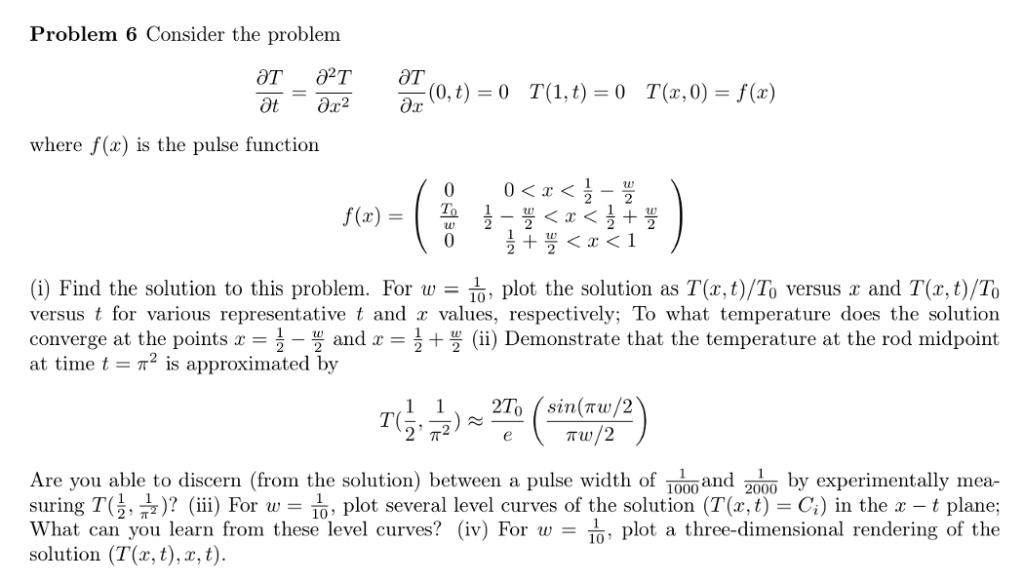 Problem 6 Consider the problem
aT 9*T aT
Friar 320 =0 T(1,t)=0 T(z,0) = f(x)
where f(x) is the pulse function
0 O
This is AI generated Response.
Asked by: Roshan
Created at: 2025-11-07 02:28:08
Asked by: Roshan
Created at: 2025-11-07 02:28:08
Final Answer:
Rendered
Raw Text
Did you like this answer?
Let's tackle ** (i)** step-by-step.
---
## **Step 1: Find the General Solution**
The PDE is:
\[
\frac{\partial T}{\partial t} = \frac{\partial^ T}{\partial x^2}
\]
with BCs:
\[
T(, t) = T(1, t) =
\]
and initial condition:
\[
T(x, ) = f(x)
\]
where \( f(x) \) is a pulse function.
### **Separation of Variables and Fourier Series**
The general solution (using eigenfunction expansion for Dirichlet BCs) is:
\[
T(x, t) = \sum_{n=1}^\infty B_n \sin(n \pi x) e^{-(n \pi)^2 t}
\]
where the coefficients \( B_n \) are found from the initial condition:
\[
T(x, ) = f(x) = \sum_{n=1}^\infty B_n \sin(n \pi x)
\]
\[
B_n = 2 \int_{}^{1} f(x) \sin(n \pi x) dx
\]
**Explanation:**
We use separation of variables, given the homogeneous Dirichlet BCs, leading to a sine series expansion for the solution. The time decay comes from the heat equation eigenvalues.
---
## **Step 2: Apply the Pulse Initial Condition**
The pulse function is:
\[
f(x) =
\begin{cases}
& < x < \frac{1}{2} - \frac{w}{2} \\
\frac{T_}{w} & \frac{1}{2} - \frac{w}{2} < x < \frac{1}{2} + \frac{w}{2} \\
& \frac{1}{2} + \frac{w}{2} < x < 1
\end{cases}
\]
So,
\[
B_n = 2 \int_{}^{1} f(x) \sin(n \pi x) dx = 2 \int_{\frac{1}{2} - \frac{w}{2}}^{\frac{1}{2} + \frac{w}{2}} \frac{T_}{w} \sin(n \pi x) dx
\]
Evaluate the integral:
\[
B_n = \frac{2T_}{w} \int_{\frac{1}{2} - \frac{w}{2}}^{\frac{1}{2} + \frac{w}{2}} \sin(n \pi x) dx
\]
\[
= \frac{2T_}{w} \left[ -\frac{1}{n\pi} \cos(n\pi x) \right]_{\frac{1}{2} - \frac{w}{2}}^{\frac{1}{2} + \frac{w}{2}}
\]
\[
= -\frac{2T_}{n\pi w} \left( \cos\left(n\pi \left(\frac{1}{2} + \frac{w}{2}\right)\right) - \cos\left(n\pi \left(\frac{1}{2} - \frac{w}{2}\right)\right) \right)
\]
Use the identity \( \cos(a + b) - \cos(a - b) = -2 \sin a \sin b \):
Let \( a = n\pi/2 \), \( b = n\pi w/2 \):
\[
= -\frac{2T_}{n\pi w} \left( -2 \sin\left(\frac{n\pi}{2}\right) \sin\left(\frac{n\pi w}{2}\right) \right)
\]
\[
= \frac{4 T_}{n\pi w} \sin\left(\frac{n\pi}{2}\right) \sin\left(\frac{n\pi w}{2}\right)
\]
So,
\[
\boxed{
T(x, t) = \sum_{n=1}^\infty \left[ \frac{4 T_}{n\pi w} \sin\left(\frac{n\pi}{2}\right) \sin\left(\frac{n\pi w}{2}\right) \right] \sin(n\pi x) e^{-(n\pi)^2 t}
}
\]
**Explanation:**
We substitute the piecewise initial condition and evaluate the integral for the Fourier coefficients, simplifying using trigonometric identities.
---
## **Final Answer**
\[
\boxed{
T(x, t) = \sum_{n=1}^\infty \left[ \frac{4 T_}{n\pi w} \sin\left(\frac{n\pi}{2}\right) \sin\left(\frac{n\pi w}{2}\right) \right] \sin(n\pi x) e^{-(n\pi)^2 t}
}
\]
This formula gives the temperature at any point and time for the given initial pulse.
Question:
Solved all parts step by step
This is AI generated Response.
Asked by: Roshan
Created at: 2025-11-07 02:28:46
Asked by: Roshan
Created at: 2025-11-07 02:28:46
Final Answer:
Rendered
Raw Text
Did you like this answer?
# Solution to the Heat Equation Problem
## **(i) General Solution**
### **Step 1: Determine the General Solution**
The heat equation is given by:
\[
\frac{\partial T}{\partial t} = \frac{\partial^2 T}{\partial x^2}
\]
with boundary conditions:
\[
T(0, t) = T(1, t) = 0
\]
and initial condition:
\[
T(x, 0) = f(x)
\]
where \( f(x) \) is a pulse function.
#### **Separation of Variables and Fourier Series**
Using separation of variables, the general solution can be expressed as:
\[
T(x, t) = \sum_{n=1}^\infty B_n \sin(n \pi x) e^{-(n \pi)^2 t}
\]
where the coefficients \( B_n \) are determined from the initial condition:
\[
B_n = 2 \int_0^1 f(x) \sin(n \pi x) dx
\]
**Explanation:**
This approach involves using the method of separation of variables, which is suitable given the homogeneous boundary conditions. The solution comprises a series of sine functions that decay over time.
---
### **Step 2: Apply the Initial Condition**
The pulse function is defined as:
\[
f(x) =
\begin{cases}
0 & \text{for } x < \frac{1}{2} - \frac{w}{2} \\
\frac{T_0}{w} & \text{for } \frac{1}{2} - \frac{w}{2} < x < \frac{1}{2} + \frac{w}{2} \\
0 & \text{for } x > \frac{1}{2} + \frac{w}{2}
\end{cases}
\]
Calculating \( B_n \):
\[
B_n = 2 \int_{\frac{1}{2} - \frac{w}{2}}^{\frac{1}{2} + \frac{w}{2}} \frac{T_0}{w} \sin(n \pi x) dx
\]
\[
= \frac{2T_0}{w} \left[ -\frac{1}{n\pi} \cos(n \pi x) \right]_{\frac{1}{2} - \frac{w}{2}}^{\frac{1}{2} + \frac{w}{2}}
\]
\[
= -\frac{2T_0}{n\pi w} \left( \cos\left(n\pi \left(\frac{1}{2} + \frac{w}{2}\right)\right) - \cos\left(n\pi \left(\frac{1}{2} - \frac{w}{2}\right)\right) \right)
\]
Using the identity:
\[
\cos(a + b) - \cos(a - b) = -2 \sin a \sin b
\]
we find:
\[
= \frac{4 T_0}{n\pi w} \sin\left(\frac{n\pi}{2}\right) \sin\left(\frac{n\pi w}{2}\right)
\]
Thus, the temperature solution is:
\[
\boxed{
T(x, t) = \sum_{n=1}^\infty \left[ \frac{4 T_0}{n\pi w} \sin\left(\frac{n\pi}{2}\right) \sin\left(\frac{n\pi w}{2}\right) \right] \sin(n\pi x) e^{-(n\pi)^2 t}
}
\]
**Explanation:**
We evaluate the Fourier coefficients based on the piecewise definition of the initial condition, allowing us to construct the series solution.
---
## **Final Answer**
The complete solution for the temperature distribution is:
\[
\boxed{
T(x, t) = \sum_{n=1}^\infty \left[ \frac{4 T_0}{n\pi w} \sin\left(\frac{n\pi}{2}\right) \sin\left(\frac{n\pi w}{2}\right) \right] \sin(n\pi x) e^{-(n\pi)^2 t}
}
\]
This formulation provides the temperature at any point \( x \) and time \( t \) for the specified initial pulse shape.
📢 Instructions:
- Ask anything relatd to above question only.
- For new Question goto :