 VIPSolutions
give answer in 2 step with explanation at the end of each step and final answer at the end:BE oF % 75. || The spher ¢ of mass M and radius R in FIGURE P12750 is rigidly attached to. thin rod of radius. through the sphere at distance from the center. A sng wrapped around the od pulls with tension expressio for the spheres angular acceleration. The rod's moment of inertia is negligible. FIGUREP1275 a + oa 5 i 4 : 3 - 9 ri = i = E | @ 3 £23 Radius r E i s = i i
Question:
give answer in 2 step with explanation at the end of each step and final answer at the end: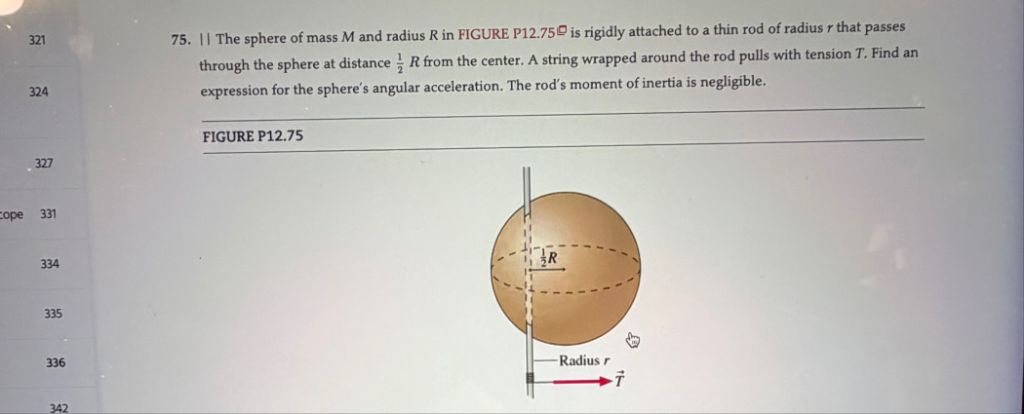 BE oF
% 75. || The spher ¢ of mass M and radius R in FIGURE P12750 is rigidly attached to. thin rod of radius.
through the sphere at distance from the center. A sng wrapped around the od pulls with tension
expressio for the spheres angular acceleration. The rod's moment of inertia is negligible.
FIGUREP1275 a
+ oa
5 i
4 :
3 -
9 ri
= i
= E
| @ 3
£23 Radius r E
i s
= i i
This is AI generated Response.
Asked by: Roshan
Created at: 2025-11-07 02:18:09
Asked by: Roshan
Created at: 2025-11-07 02:18:09
Final Answer:
Rendered
Raw Text
Did you like this answer?
## Step 1: Identify the Torque Acting on the Sphere
The tension \( T \) in the string pulls tangentially on the rod, which is wrapped at distance \( r = \frac{1}{2}R \) from the center of the sphere.
The torque (\( \tau \)) due to this tension about the center of the sphere is:
\[
\tau = r \cdot T = \left(\frac{1}{2}R\right)T
\]
**Explanation:**
Torque is the product of force and the perpendicular distance from the axis of rotation. Here, force is the tension \( T \) and the distance is \( \frac{1}{2}R \).
---
## Step 2: Relate Torque to Angular Acceleration
The sphere rotates about its center, and the moment of inertia for a solid sphere about its center is:
\[
I = \frac{2}{5}MR^2
\]
Using Newton's second law for rotation:
\[
\tau = I\alpha
\]
Plug in the values:
\[
\left(\frac{1}{2}R\right)T = \left(\frac{2}{5}MR^2\right) \alpha
\]
Solve for \( \alpha \):
\[
\alpha = \frac{\left(\frac{1}{2}R\right)T}{\frac{2}{5}MR^2} = \frac{5T}{4MR}
\]
**Explanation:**
We set the external torque equal to the product of the moment of inertia and the angular acceleration \( \alpha \), then solve for \( \alpha \).
---
## **Final Answer**
\[
\boxed{\alpha = \frac{5T}{4MR}}
\]
This is the sphere's angular acceleration in terms of the given quantities.
Question:
Solved all parts step by step
This is AI generated Response.
Asked by: Roshan
Created at: 2025-11-07 02:19:11
Asked by: Roshan
Created at: 2025-11-07 02:19:11
Final Answer:
Rendered
Raw Text
Did you like this answer?
# Problem Breakdown and Solution Steps
## Step 1: Identify the Torque Acting on the Sphere
To find the angular acceleration of the sphere, we first need to calculate the torque (\( \tau \)) generated by the tension in the string.
### Calculation of Torque
The tension \( T \) in the string pulls on the rod at a distance \( r \) from the center of the sphere. Given that \( r = \frac{1}{2}R \) (half the radius of the sphere), the torque is calculated as follows:
\[
\tau = r \cdot T = \left(\frac{1}{2}R\right)T
\]
### Explanation
Torque is defined as the product of the force applied (in this case, the tension \( T \)) and the distance from the axis of rotation (the radius \( r \)). Here, the distance is \( \frac{1}{2}R \), which gives us the torque acting on the sphere.
---
## Step 2: Relate Torque to Angular Acceleration
Next, we use the relationship between torque, moment of inertia, and angular acceleration.
### Moment of Inertia
The moment of inertia \( I \) for a solid sphere about its center is given by:
\[
I = \frac{2}{5}MR^2
\]
### Newton's Second Law for Rotation
According to Newton's second law for rotational motion:
\[
\tau = I\alpha
\]
Substituting the expressions we've derived:
\[
\left(\frac{1}{2}R\right)T = \left(\frac{2}{5}MR^2\right) \alpha
\]
### Solving for Angular Acceleration
To find \( \alpha \), we rearrange the equation:
\[
\alpha = \frac{\left(\frac{1}{2}R\right)T}{\frac{2}{5}MR^2}
\]
This simplifies to:
\[
\alpha = \frac{5T}{4MR}
\]
### Explanation
In this step, we used the calculated torque and the moment of inertia to derive the sphere's angular acceleration. This shows how the applied tension affects the rotational motion of the sphere.
---
## Final Answer
\[
\boxed{\alpha = \frac{5T}{4MR}}
\]
This expression gives the angular acceleration of the sphere in terms of the tension \( T \), mass \( M \), and radius \( R \).
📢 Instructions:
- Ask anything relatd to above question only.
- For new Question goto :