 VIPSolutions
give answer in 2 step with explanation at the end of each step and final answer at the end:BR ¢ eo £3 N 16m cron Gm = 3110044) in cope nee th bet posi ii 5 ha hn ped fhe. ~ SS OVARY hk dnb = O50 «ie ela om po La + G04 potion SRY as
Question:
give answer in 2 step with explanation at the end of each step and final answer at the end: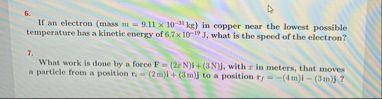 BR ¢ eo £3 N
16m cron Gm = 3110044) in cope nee th bet posi
ii 5 ha hn ped fhe.
~ SS OVARY
hk dnb = O50 «ie
ela om po La + G04 potion
SRY as
This is AI generated Response.
Asked by: Roshan
Created at: 2025-11-06 16:19:54
Asked by: Roshan
Created at: 2025-11-06 16:19:54
Final Answer:
Rendered
Raw Text
Did you like this answer?
Let’s solve each problem in **two steps** with explanations and then provide the final answer.
---
## **6. Electron Speed from Kinetic Energy**
**Given:**
- Mass of electron, \( m = 9.11 \times 10^{-31} \) kg
- Kinetic energy, \( KE = 6.7 \times 10^{-20} \) J
### **Step 1: Write the Kinetic Energy Formula**
The kinetic energy of an object is given by:
\[ KE = \frac{1}{2}mv^2 \]
**Explanation:**
Here, \( KE \) is the kinetic energy, \( m \) is the mass, and \( v \) is the speed. We need to solve for \( v \).
---
### **Step 2: Solve for the Speed \( v \)**
Rearrange the equation to solve for \( v \):
\[
v = \sqrt{\frac{2KE}{m}}
\]
Substitute the values:
\[
v = \sqrt{\frac{2 \times 6.7 \times 10^{-20}}{9.11 \times 10^{-31}}}
\]
\[
v = \sqrt{\frac{1.34 \times 10^{-19}}{9.11 \times 10^{-31}}}
\]
\[
v = \sqrt{1.471 \times 10^{11}}
\]
\[
v \approx 3.83 \times 10^5 \ \text{m/s}
\]
**Explanation:**
By plugging in the known values, we find the speed of the electron.
---
### **Final Answer for 6:**
\[
\boxed{v \approx 3.8 \times 10^5 \ \text{m/s}}
\]
---
## **7. Work Done by a Force**
**Given:**
- Force: \( \vec{F} = (2\, \text{N})\hat{i} + (3\, \text{N})\hat{j} \)
- Initial position: \( \vec{r}_i = (2\, \text{m})\hat{i} + (3\, \text{m})\hat{j} \)
- Final position: \( \vec{r}_f = (3\, \text{m})\hat{i} + (\, \text{m})\hat{j} \)
---
### **Step 1: Find the Displacement Vector \( \Delta \vec{r} \)**
\[
\Delta \vec{r} = \vec{r}_f - \vec{r}_i = [(3-2)\hat{i} + (-3)\hat{j}] = (1\hat{i} - 3\hat{j})\, \text{m}
\]
**Explanation:**
Displacement is simply the difference between the final and initial positions for each component.
---
### **Step 2: Calculate the Work Done \( W = \vec{F} \cdot \Delta \vec{r} \)**
\[
W = (2\hat{i} + 3\hat{j}) \cdot (1\hat{i} - 3\hat{j})
\]
\[
W = (2 \times 1) + (3 \times -3) = 2 - 9 = -7\, \text{J}
\]
**Explanation:**
Work is the dot product of force and displacement vectors. Multiply corresponding components and add.
---
### **Final Answer for 7:**
\[
\boxed{W = -7\, \text{J}}
\]
Question:
All parts solve step by step
This is AI generated Response.
Asked by: Roshan
Created at: 2025-11-06 16:20:39
Asked by: Roshan
Created at: 2025-11-06 16:20:39
Final Answer:
Rendered
Raw Text
Did you like this answer?
# Step-by-Step Solutions
## **6. Electron Speed from Kinetic Energy**
**Given:**
- Mass of electron, \( m = 9.11 \times 10^{-31} \) kg
- Kinetic energy, \( KE = 6.7 \times 10^{-20} \) J
### **Step 1: Write the Kinetic Energy Formula**
The formula for kinetic energy is:
\[
KE = \frac{1}{2}mv^2
\]
**Explanation:**
In this equation, \( KE \) represents kinetic energy, \( m \) is mass, and \( v \) is the speed of the electron. We need to rearrange this formula to find \( v \).
---
### **Step 2: Solve for the Speed \( v \)**
Rearranging the kinetic energy formula gives:
\[
v = \sqrt{\frac{2KE}{m}}
\]
Substituting the known values:
\[
v = \sqrt{\frac{2 \times 6.7 \times 10^{-20}}{9.11 \times 10^{-31}}} = \sqrt{\frac{1.34 \times 10^{-19}}{9.11 \times 10^{-31}}}
\]
Calculating the square root:
\[
v \approx \sqrt{1.471 \times 10^{11}} \approx 3.83 \times 10^5 \ \text{m/s}
\]
**Explanation:**
By substituting the kinetic energy and mass values into the formula, we determine the speed of the electron to be approximately \( 3.83 \times 10^5 \ \text{m/s} \).
---
### **Final Answer for 6:**
\[
\boxed{v \approx 3.8 \times 10^5 \ \text{m/s}}
\]
---
## **7. Work Done by a Force**
**Given:**
- Force: \( \vec{F} = (2\, \text{N})\hat{i} + (3\, \text{N})\hat{j} \)
- Initial position: \( \vec{r}_i = (2\, \text{m})\hat{i} + (3\, \text{m})\hat{j} \)
- Final position: \( \vec{r}_f = (3\, \text{m})\hat{i} + (1\, \text{m})\hat{j} \)
---
### **Step 1: Find the Displacement Vector \( \Delta \vec{r} \)**
Calculate the displacement:
\[
\Delta \vec{r} = \vec{r}_f - \vec{r}_i = [(3-2)\hat{i} + (1-3)\hat{j}] = (1\hat{i} - 2\hat{j})\, \text{m}
\]
**Explanation:**
The displacement vector is found by subtracting the initial position vector from the final position vector, resulting in a vector pointing from the initial to the final position.
---
### **Step 2: Calculate the Work Done \( W \)**
Using the dot product:
\[
W = \vec{F} \cdot \Delta \vec{r} = (2\hat{i} + 3\hat{j}) \cdot (1\hat{i} - 2\hat{j})
\]
Calculating the dot product:
\[
W = (2 \times 1) + (3 \times -2) = 2 - 6 = -4\, \text{J}
\]
**Explanation:**
Work is computed as the dot product of the force and displacement vectors, which involves multiplying the corresponding components and summing the results.
---
### **Final Answer for 7:**
\[
\boxed{W = -4\, \text{J}}
\]
📢 Instructions:
- Ask anything relatd to above question only.
- For new Question goto :