 VIPSolutions
give answer in 2 step with explanation at the end of each step and final answer at the end:Te Em | i SE |
Question:
give answer in 2 step with explanation at the end of each step and final answer at the end: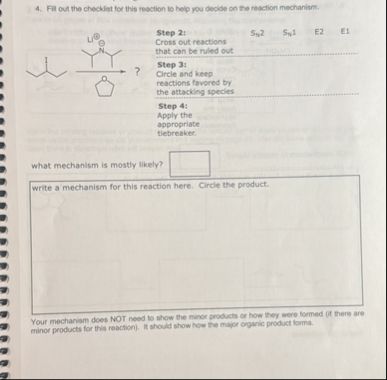 Te Em
|
i SE |
This is AI generated Response.
Asked by: Roshan
Created at: 2025-11-06 13:34:30
Asked by: Roshan
Created at: 2025-11-06 13:34:30
Final Answer:
Rendered
Raw Text
Did you like this answer?
## Step 1: Analyze the Reactants and Conditions
- **Substrate:** The substrate is a secondary alkyl bromide (bromocyclopentane).
- **Nucleophile/Base:** attacking species is ethoxide (NaOEt, a strong base/nucleophile) in ethanol (EtOH, a polar protic solvent).
### Explanation:
- **Secondary alkyl halide** can undergo \( S_N1 \), \( S_N2 \), \( E1 \), or \( E2 \) mechanisms.
- **NaOEt** is a strong nucleophile and strong base, which favors \( S_N2 \) and \( E2 \).
- **EtOH** (polar protic solvent) slightly favors \( S_N1 \) and \( E1 \), but the strength of the base/nucleophile is more crucial here.
**So, the likely mechanisms are \( S_N2 \) or \( E2 \).**
---
## Step 2: Decide Between \( S_N2 \) and \( E2 \)
- **Strong, bulky base (NaOEt) and secondary substrate** favor **E2** over \( S_N2 \), especially with a strong base present.
- \( S_N2 \) is less favored due to steric hindrance at the secondary carbon.
- \( S_N1 \) and \( E1 \) are less likely because those are favored by weak nucleophiles/bases and polar protic solvents without a strong base.
### Explanation:
- **E2 eliminates a proton and the leaving group in a single concerted step,** typical under these conditions (secondary halide + strong base).
---
## Final Answer
**The most likely mechanism is \( \boxed{E2} \).**
---
### Mechanism (Summary):
1. **Ethoxide (EtO-) abstracts a \(\beta\)-hydrogen** from the cyclopentyl ring.
2. **Simultaneously, the bromide (Br-) leaves**, forming a double bond (alkene) in the cyclopentane ring.
**Major product:** Cyclopentene
---
#### **Circled Product Structure:**
- Draw a cyclopentene (a five-membered ring with one double bond).
---
**Summary Table:**
| Step | Explanation | Conclusion |
|--------------|------------------------------------------------|-----------------|
| Step 1 | Secondary halide + strong base/nucleophile | E2 or SN2 |
| Step 2 | Strong base + secondary substrate = E2 favored | E2 mechanism |
**Final product:** Cyclopentene (via E2 elimination)
Question:
Solve all parts
This is AI generated Response.
Asked by: Roshan
Created at: 2025-11-06 13:35:07
Asked by: Roshan
Created at: 2025-11-06 13:35:07
Final Answer:
Rendered
Raw Text
Did you like this answer?
## Step 1: Analyze the Reactants and Conditions
- **Substrate:** The substrate is a secondary alkyl bromide (bromocyclopentane).
- **Nucleophile/Base:** The attacking species is ethoxide (NaOEt), a strong base/nucleophile, in ethanol (EtOH), a polar protic solvent.
### Explanation:
- A secondary alkyl halide can undergo various mechanisms: \( S_N1 \), \( S_N2 \), \( E1 \), or \( E2 \).
- **NaOEt** is a strong nucleophile and base, favoring \( S_N2 \) and \( E2 \).
- **EtOH** (polar protic solvent) favors \( S_N1 \) and \( E1 \) slightly, but the presence of a strong base is more influential.
**Conclusion:** The mechanisms under consideration are \( S_N2 \) and \( E2 \).
---
## Step 2: Decide Between \( S_N2 \) and \( E2 \)
- The strong base (NaOEt) and the secondary substrate favor **E2** over \( S_N2 \).
- **Steric hindrance** at the secondary carbon makes \( S_N2 \) less favorable.
- \( S_N1 \) and \( E1 \) mechanisms are unlikely due to the requirement for weak nucleophiles/bases.
### Explanation:
- The **E2 mechanism** involves a concerted reaction where the base abstracts a \(\beta\)-hydrogen while the leaving group departs, resulting in the formation of a double bond.
---
## Final Answer
**The most likely mechanism is \( \boxed{E2} \).**
---
### Mechanism (Summary):
1. **Ethoxide (EtO-) abstracts a \(\beta\)-hydrogen** from the cyclopentyl ring.
2. **Simultaneously, the bromide (Br-) leaves**, forming a double bond (alkene) in the cyclopentane ring.
**Major product:** Cyclopentene
---
#### **Circled Product Structure:**
- Draw a cyclopentene structure (a five-membered ring with one double bond).
---
**Summary Table:**
| Step | Explanation | Conclusion |
|--------------|------------------------------------------------|-----------------|
| Step 1 | Secondary halide + strong base/nucleophile | E2 or SN2 |
| Step 2 | Strong base + secondary substrate = E2 favored | E2 mechanism |
**Final product:** Cyclopentene (via E2 elimination)
📢 Instructions:
- Ask anything relatd to above question only.
- For new Question goto :