 VIPSolutions
give answer in 2 step with explanation at the end of each step and final answer at the end:| | n oo 7 A —r——— i —— 6al OB | on iii —r veo { { M@= ELA 1 dx? i |
Question:
give answer in 2 step with explanation at the end of each step and final answer at the end: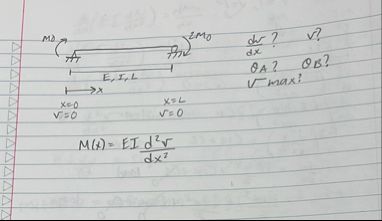 |
|
n oo 7 A
—r———
i —— 6al OB
| on iii
—r veo
{
{ M@= ELA
1 dx?
i
|
This is AI generated Response.
Asked by: Rahul
Created at: 2025-11-06 13:19:19
Asked by: Rahul
Created at: 2025-11-06 13:19:19
Final Answer:
Rendered
Raw Text
Did you like this answer?
# Step 1: Understanding the Problem and Writing the Differential Equation
The image shows a simply supported beam with a **uniformly distributed load \( w_ \) (kN/m)** across its length \( L \). The beam has flexural rigidity \( EI \). The boundary conditions are given as:
- At \( x = \): \( v = \) (deflection is zero)
- At \( x = L \): \( v = \) (deflection is zero)
The differential equation for the deflection of the beam is:
\[
M(x) = EI \frac{d^2 v}{dx^2}
\]
For a uniformly distributed load \( w_ \):
\[
EI \frac{d^4 v}{dx^4} = w_
\]
**Explanation:**
We start by identifying the type of loading and support. The distributed load leads to a 4th-order differential equation for deflection. The moment-curvature relationship gives us the needed equation.
---
# Step 2: Solving the Differential Equation and Applying Boundary Conditions
Integrate the equation:
\[
EI \frac{d^4 v}{dx^4} = w_
\]
Integrate once:
\[
EI \frac{d^3 v}{dx^3} = w_ x + C_1
\]
Integrate again:
\[
EI \frac{d^2 v}{dx^2} = \frac{w_ x^2}{2} + C_1 x + C_2
\]
Integrate again:
\[
EI \frac{d v}{dx} = \frac{w_ x^3}{6} + \frac{C_1 x^2}{2} + C_2 x + C_3
\]
One more integration:
\[
EI v(x) = \frac{w_ x^4}{24} + \frac{C_1 x^3}{6} + \frac{C_2 x^2}{2} + C_3 x + C_4
\]
Use boundary conditions to solve for constants:
- At \( x=, v= \): \( = + + + + C_4 \implies C_4 = \)
- At \( x=L, v= \): \( = \frac{w_ L^4}{24} + \frac{C_1 L^3}{6} + \frac{C_2 L^2}{2} + C_3 L \)
For a simply supported beam, the slope at supports is not zero, but the moment is zero. Set \( M() = M(L) = \):
- \( M() = EI \frac{d^2 v}{dx^2}\bigg|_{x=} = \implies C_2 = \)
- \( M(L) = EI \frac{d^2 v}{dx^2}\bigg|_{x=L} = \frac{w_ L^2}{2} + C_1 L \implies C_1 = -\frac{w_ L}{2} \)
Substitute back:
\[
v(x) = \frac{w_}{24EI}x^4 - \frac{w_ L}{12EI}x^3 + \frac{w_ L^3}{24EI}x
\]
**Explanation:**
We successively integrated the governing equation, applying boundary conditions to solve for the constants. This gives the standard deflection equation for a simply supported beam under a uniformly distributed load.
---
## **Final Answer**
The deflection profile for a simply supported beam with a uniformly distributed load \( w_ \) is:
\[
\boxed{
v(x) = \frac{w_}{24EI} \left[x^4 - 2L x^3 + L^3 x\right]
}
\]
where \( v(x) \) is the deflection at any point \( x \).
Question:
Solve it well again
This is AI generated Response.
Asked by: Rahul
Created at: 2025-11-06 13:20:13
Asked by: Rahul
Created at: 2025-11-06 13:20:13
Final Answer:
Rendered
Raw Text
Did you like this answer?
# Step 1: Understanding the Problem and Writing the Differential Equation
The provided image illustrates a simply supported beam subjected to a **uniformly distributed load \( w \) (kN/m)** along its length \( L \). The flexural rigidity of the beam is denoted as \( EI \). The boundary conditions specify that:
- At \( x = 0 \): \( v(0) = 0 \) (deflection is zero)
- At \( x = L \): \( v(L) = 0 \) (deflection is zero)
From beam theory, the relationship between bending moment \( M(x) \) and deflection \( v(x) \) is given by:
\[
M(x) = EI \frac{d^2 v}{dx^2}
\]
For a uniformly distributed load \( w \), the governing differential equation becomes:
\[
EI \frac{d^4 v}{dx^4} = w
\]
**Explanation:**
We start by setting up the problem based on the loading and support types. The uniformly distributed load leads us to derive a 4th-order differential equation, which describes the deflection behavior of the beam.
---
# Step 2: Solving the Differential Equation and Applying Boundary Conditions
To solve the differential equation:
\[
EI \frac{d^4 v}{dx^4} = w
\]
we integrate it step by step.
1. **First Integration:**
\[
EI \frac{d^3 v}{dx^3} = wx + C_1
\]
2. **Second Integration:**
\[
EI \frac{d^2 v}{dx^2} = \frac{wx^2}{2} + C_1 x + C_2
\]
3. **Third Integration:**
\[
EI \frac{d v}{dx} = \frac{wx^3}{6} + \frac{C_1 x^2}{2} + C_2 x + C_3
\]
4. **Fourth Integration:**
\[
EI v(x) = \frac{wx^4}{24} + \frac{C_1 x^3}{6} + \frac{C_2 x^2}{2} + C_3 x + C_4
\]
Now, we apply the boundary conditions to find the constants \( C_1, C_2, C_3, \) and \( C_4 \):
- At \( x = 0 \): \( v(0) = 0 \)
\[
0 = \frac{w(0)^4}{24} + \frac{C_1(0)^3}{6} + \frac{C_2(0)^2}{2} + C_3(0) + C_4 \implies C_4 = 0
\]
- At \( x = L \): \( v(L) = 0 \)
\[
0 = \frac{wL^4}{24} + \frac{C_1L^3}{6} + \frac{C_2L^2}{2} + C_3L
\]
Setting the moment conditions gives:
- At \( x=0 \): \( M(0) = EI \frac{d^2 v}{dx^2}\bigg|_{x=0} = 0 \implies C_2 = 0 \)
- At \( x=L \): \( M(L) = EI \frac{d^2 v}{dx^2}\bigg|_{x=L} = -\frac{wL^2}{2} + C_1 L \implies C_1 = -\frac{wL}{2} \)
Substituting back the values of \( C_1 \) and \( C_2 \):
\[
v(x) = \frac{w}{24EI}x^4 - \frac{wL}{12EI}x^3 + \frac{wL^3}{24EI}x
\]
**Explanation:**
We integrated the governing equation stepwise and applied the boundary conditions to solve for the constants. This results in the expression for deflection along the beam, accounting for the uniformly distributed load.
---
## **Final Answer**
The deflection profile for a simply supported beam under a uniformly distributed load \( w \) is given by:
\[
\boxed{
v(x) = \frac{w}{24EI} \left[x^4 - 2L x^3 + L^3 x\right]
}
\]
where \( v(x) \) represents the deflection at any point \( x \).
📢 Instructions:
- Ask anything relatd to above question only.
- For new Question goto :