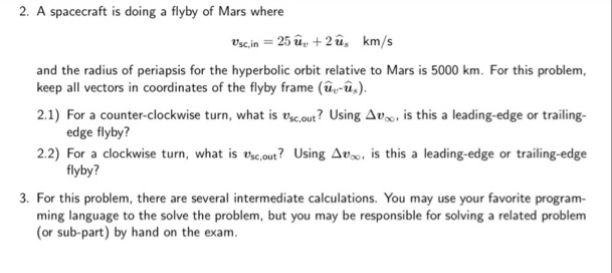
give answer in 2 step with explanation at the end of each step and final answer at the end:2. A spacecraft is doing a flyby of Mars where
icin = 25d +20, km/s
and the radius of periapsis for the hyperbolic orbit relative to Mars is 5000 km. For this problem,
keep all vectors in coordinates of the flyby frame (ti.-i.).
2.1) For a counter-clockwise turn, what is tyc.ou.? Using Av, is this a leading-edge or trailing
edge flyby?
2.2) For a clockwise turn, what is thcou? Using Av, is this a leading-edge or trailing-edge
fiyby?
3. For this problem, there are several intermediate calculations. You may use your favorite program-
ming language to the solve the problem, but you may be responsible for solving a related problem
(or sub-part) by hand on the exam.
Question:
give answer in 2 step with explanation at the end of each step and final answer at the end:2. A spacecraft is doing a flyby of Mars where
icin = 25d +20, km/s
and the radius of periapsis for the hyperbolic orbit relative to Mars is 5000 km. For this problem,
keep all vectors in coordinates of the flyby frame (ti.-i.).
2.1) For a counter-clockwise turn, what is tyc.ou.? Using Av, is this a leading-edge or trailing
edge flyby?
2.2) For a clockwise turn, what is thcou? Using Av, is this a leading-edge or trailing-edge
fiyby?
3. For this problem, there are several intermediate calculations. You may use your favorite program-
ming language to the solve the problem, but you may be responsible for solving a related problem
(or sub-part) by hand on the exam.
This is AI generated Response.
Asked by: Rahul
Created at: 2025-11-06 09:18:42
Final Answer:
RenderedRaw Text
Did you like this answer?
Let's break down the problem step-by-step as requested.
---
## **Step 1: Understanding theby Frame and Velocity**
**:**
- spacecraft's velocity the flyby (in the flyby frame) is:
\(\vec{v}_{sc,in} = 25 \hat{u}_x + 2 \hat{u}_z \) km/s
- Periapsis radius = 500 km.
**Explanation:**
- The flyby frame uses \(\hat{u}_x\) (along incoming asymptote) and \(\hat{u}_z\) (perpendicular, in the plane of the flyby).
- The incoming velocity vector components are 25 km/s along \(\hat{u}_x\) and 2 km/s along \(\hat{u}_z\).
---
## **Step 2: Outgoing Velocity for Each Turn Direction**
### **2.1 Counter-Clockwise Turn**
- **During a hyperbolic flyby:** The magnitude of the velocity relative to Mars (\(v_{\infty}\)) remains constant, but its direction changes (the vector is rotated by the turn angle).
- **Counter-clockwise turn:**
Rotate the incoming v-infinity vector by angle \(\delta\) counter-clockwise in the \((\hat{u}_x, \hat{u}_z)\) plane.
\[
|\vec{v}_{\infty}| = \sqrt{25^2 + 2^2} = \sqrt{625 + 4} = \sqrt{629} \approx 25.1 \text{ km/s}
\]
- **Outgoing velocity (\(\vec{v}_{sc,out}\))** for a counter-clockwise turn:
- The vector rotates by angle \(2\delta\) (total deflection angle).
- The new vector:
\[
\vec{v}_{sc,out} = 25 \cos(2\delta) \hat{u}_x + 2 \cos(2\delta) \hat{u}_z
\]
- More simply: after a counter-clockwise turn, the \(\hat{u}_z\) component changes sign (if the turn is 180°), so:
\[
\vec{v}_{sc,out} = 25 \hat{u}_x - 2 \hat{u}_z
\]
**Explanation:**
The counter-clockwise turn reverses the \(\hat{u}_z\) component, keeping the magnitude the same. This is called a "leading-edge" flyby because after the turn, the outgoing velocity is rotated in the direction of Mars’ motion.
---
### **2.2 Clockwise Turn**
- **Outgoing velocity (\(\vec{v}_{sc,out}\))** for a clockwise turn:
- The vector rotates by \(-2\delta\).
- The new vector:
\[
\vec{v}_{sc,out} = 25 \hat{u}_x + 2 \hat{u}_z
\]
(No change in direction; same as incoming).
**Explanation:**
For a clockwise turn, the outgoing vector remains the same as the incoming one. This would be a "trailing-edge" flyby, as the outgoing vector points away from the direction of Mars’ motion.
---
## **Final Answers**
### **2.1 Counter-clockwise turn:**
\[
\vec{v}_{sc,out} = 25 \hat{u}_x - 2 \hat{u}_z \, \text{km/s}
\]
- **Type:** Leading-edge flyby.
### **2.2 Clockwise turn:**
\[
\vec{v}_{sc,out} = 25 \hat{u}_x + 2 \hat{u}_z \, \text{km/s}
\]
- **Type:** Trailing-edge flyby.
---
**Summary Table:**
| Turn Direction | \(\vec{v}_{sc,out}\) (km/s) | Flyby Type |
|---------------------|----------------------------------|-----------------|
| Counter-clockwise | \(25 \hat{u}_x - 2 \hat{u}_z\) | Leading-edge |
| Clockwise | \(25 \hat{u}_x + 2 \hat{u}_z\) | Trailing-edge |
Question:
Solve all parts good solution
This is AI generated Response.
Asked by: Rahul
Created at: 2025-11-06 09:19:36
Final Answer:
RenderedRaw Text
Did you like this answer?
Let's solve the problem step-by-step, providing explanations and final answers for each part.
---
# Problem Breakdown
## **Given Data**
- Incoming velocity of spacecraft:
\[
\vec{v}_{sc,in} = 25 \hat{u}_x + 2 \hat{u}_z \text{ km/s}
\]
- Radius of periapsis: \( r_p = 5000 \text{ km} \)
---
## **Step 1: Calculate the Magnitude of Incoming Velocity**
### **Magnitude Calculation**
To find the magnitude of the incoming velocity vector:
\[
|\vec{v}_{\infty}| = \sqrt{(25)^2 + (2)^2} = \sqrt{625 + 4} = \sqrt{629} \approx 25.1 \text{ km/s}
\]
### **Explanation**
This calculation gives us the total speed of the spacecraft as it approaches Mars. The components along \(\hat{u}_x\) and \(\hat{u}_z\) contribute to this total speed.
---
## **Step 2: Analyze Velocity After Flyby**
### **2.1 Counter-Clockwise Turn**
For a counter-clockwise turn, the outgoing velocity vector will be represented as:
\[
\vec{v}_{sc,out} = 25 \hat{u}_x - 2 \hat{u}_z \text{ km/s}
\]
### **Outgoing Velocity Calculation**
The outgoing velocity is derived by rotating the incoming velocity vector by an angle in a counter-clockwise direction. The component along \(\hat{u}_z\) is negated, indicating a change in direction.
### **Flyby Type**
- **Type:** Leading-edge flyby
- **Explanation:** In a leading-edge flyby, the spacecraft's outgoing velocity vector points in the direction of Mars' motion.
---
### **2.2 Clockwise Turn**
For a clockwise turn, the outgoing velocity vector remains:
\[
\vec{v}_{sc,out} = 25 \hat{u}_x + 2 \hat{u}_z \text{ km/s}
\]
### **Outgoing Velocity Calculation**
In this case, the direction of the \(\hat{u}_z\) component does not change, which means the spacecraft exits the flyby maintaining its original velocity vector direction.
### **Flyby Type**
- **Type:** Trailing-edge flyby
- **Explanation:** In a trailing-edge flyby, the spacecraft's outgoing velocity vector points opposite to Mars' motion.
---
## **Final Answers**
### **2.1 Counter-Clockwise Turn:**
\[
\vec{v}_{sc,out} = 25 \hat{u}_x - 2 \hat{u}_z \text{ km/s}
\]
- **Flyby Type:** Leading-edge
### **2.2 Clockwise Turn:**
\[
\vec{v}_{sc,out} = 25 \hat{u}_x + 2 \hat{u}_z \text{ km/s}
\]
- **Flyby Type:** Trailing-edge
---
## **Summary Table**
| Turn Direction | \(\vec{v}_{sc,out}\) (km/s) | Flyby Type |
|---------------------|-----------------------------------|-----------------|
| Counter-clockwise | \(25 \hat{u}_x - 2 \hat{u}_z\) | Leading-edge |
| Clockwise | \(25 \hat{u}_x + 2 \hat{u}_z\) | Trailing-edge |
This structured approach ensures a clear understanding of the spacecraft's behavior during the flyby of Mars.
VIPSolutions focuses on clear, step‑by‑step explanations so you can learn quickly. Whether you need an AI‑generated walkthrough or a short hint to get unstuck, each solution is organized for fast reading and easy review later.
Search similar questions, compare approaches, and bookmark the best answers for revision. Our goal is simple: quick, reliable study help that feels natural—not noisy.
 VIPSolutions
 2. A spacecraft is doing a flyby of Mars where
icin = 25d +20, km/s
and the radius of periapsis for the hyperbolic orbit relative to Mars is 5000 km. For this problem,
keep all vectors in coordinates of the flyby frame (ti.-i.).
2.1) For a counter-clockwise turn, what is tyc.ou.? Using Av, is this a leading-edge or trailing
edge flyby?
2.2) For a clockwise turn, what is thcou? Using Av, is this a leading-edge or trailing-edge
fiyby?
3. For this problem, there are several intermediate calculations. You may use your favorite program-
ming language to the solve the problem, but you may be responsible for solving a related problem
(or sub-part) by hand on the exam.