give answer in 2 step with explanation at the end of each step and final answer at the end:Homework 93702025 Due on Nov 7 at noon, e., 12pm)
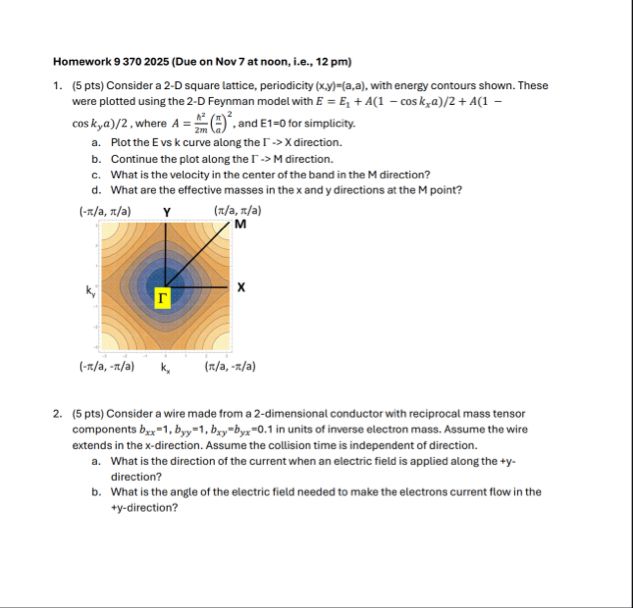
1. (5pts) Consider a 2-D square lattice, periodicity (xy)=8.a), with nergy contours shown. These
were plotted using the 2:0 Feynman model with £ = E, + ACL — cosk:a)/2 + ACL
coskya/2. where 4 = (2), and E1=0 tor simplicity.
a. Plotthe Eve curve siong the I > Xairecton.
5. Continue the pot along the I > M irecton.
c. Whats the velocity inthe center of the band in the M direction?
i. What aro the effective masses inthe x nd ydections st the M point?
Cx) Yaa)
: om
. /
i &
(nfa-nfa) Kk, (fa-x/a)
2. (5 pte) Consider a wire mado from a 2-gmensional conductor wih reciprocal mass tensor
COmPONONt b=1 by 1 by =by=0.1 i unit of inverse election mass. Assume the wire
extent inthe x direction. Assume the collsion me is independent of ctection
a. Whats the direction of the current when an slctric ied is applied along he +-
aiecton?
5. What i the angle ofthe sectic eld needed to make the slctions curent low the
y-cirection”
Question:
give answer in 2 step with explanation at the end of each step and final answer at the end:Homework 93702025 Due on Nov 7 at noon, e., 12pm)
1. (5pts) Consider a 2-D square lattice, periodicity (xy)=8.a), with nergy contours shown. These
were plotted using the 2:0 Feynman model with £ = E, + ACL — cosk:a)/2 + ACL
coskya/2. where 4 = (2), and E1=0 tor simplicity.
a. Plotthe Eve curve siong the I > Xairecton.
5. Continue the pot along the I > M irecton.
c. Whats the velocity inthe center of the band in the M direction?
i. What aro the effective masses inthe x nd ydections st the M point?
Cx) Yaa)
: om
. /
i &
(nfa-nfa) Kk, (fa-x/a)
2. (5 pte) Consider a wire mado from a 2-gmensional conductor wih reciprocal mass tensor
COmPONONt b=1 by 1 by =by=0.1 i unit of inverse election mass. Assume the wire
extent inthe x direction. Assume the collsion me is independent of ctection
a. Whats the direction of the current when an slctric ied is applied along he +-
aiecton?
5. What i the angle ofthe sectic eld needed to make the slctions curent low the
y-cirection”
This is AI generated Response.
Asked by: Rahul
Created at: 2025-11-06 06:55:35
Final Answer:
RenderedRaw Text
Did you like this answer?
Let's solve **Question 1(c): What is the velocity in the center of the band in the M direction?**
---
### **Step 1: Write the energy and find the velocity expression**
The energy dispersion is:
\[ E = E_1 + A \left[ 1 - \cos(k_x a) \right]/2 + A \left[ 1 - \cos(k_y a) \right]/2 \]
Given \( E_1 = \), so:
\[ E = \frac{A}{2}\left[ 2 - \cos(k_x a) - \cos(k_y a) \right] \]
The velocity is given by:
\[
v = \frac{1}{\hbar} \nabla_k E
\]
---
**Explanation:**
The velocity of an electron in a band is the gradient of energy with respect to \( \vec{k} \), divided by \( \hbar \).
---
### **Step 2: Evaluate at the center (Γ point) in the M direction**
At the **center of the band** (Γ point), \( k_x = , k_y = \):
- \( \cos() = 1 \)
- So, \( E(,) = \frac{A}{2}[2 - 1 - 1] = \)
Velocity components:
\[
v_x = \frac{1}{\hbar} \frac{\partial E}{\partial k_x} = \frac{1}{\hbar} \frac{A}{2} \cdot a \sin(k_x a)
\]
\[
v_y = \frac{1}{\hbar} \frac{\partial E}{\partial k_y} = \frac{1}{\hbar} \frac{A}{2} \cdot a \sin(k_y a)
\]
At \( k_x = , k_y = \), \( \sin() = \):
- \( v_x = \)
- \( v_y = \)
---
**Explanation:**
At the center of the band (Γ), both velocity components are zero because the slope of the band is zero (extremum point).
---
### **Final Answer**
**The velocity in the center of the band in the M direction is \( \boxed{} \).**
Question:
Solve all parts step by step
This is AI generated Response.
Asked by: Rahul
Created at: 2025-11-06 06:56:43
Final Answer:
RenderedRaw Text
Did you like this answer?
# Solution to Question 1
## Part 1: Velocity in the Center of the Band in the M Direction
### **Step 1: Write the Energy and Find the Velocity Expression**
The energy dispersion relation is given by:
\[
E = E_1 + A \left[ 1 - \cos(k_x a) \right]/2 + A \left[ 1 - \cos(k_y a) \right]/2
\]
Given that \( E_1 = 0 \), we can simplify this to:
\[
E = \frac{A}{2}\left[ 2 - \cos(k_x a) - \cos(k_y a) \right]
\]
The velocity \( \vec{v} \) is derived from the energy dispersion as:
\[
\vec{v} = \frac{1}{\hbar} \nabla_k E
\]
### **Explanation:**
The velocity of an electron in a band is determined by the gradient of the energy with respect to the wave vector \( \vec{k} \), normalized by \( \hbar \).
---
### **Step 2: Evaluate at the Center (M Point) in the M Direction**
At the **M point**, we need to determine the wave vector values. Assuming M corresponds to specific values \( k_x \) and \( k_y \):
- \( k_x = \frac{\pi}{a} \)
- \( k_y = 0 \)
Substituting these values into the energy equation:
\[
E\left(\frac{\pi}{a}, 0\right) = \frac{A}{2}\left[ 2 - \cos\left(\frac{\pi}{a} a\right) - \cos(0) \right]
\]
This simplifies to:
\[
E\left(\frac{\pi}{a}, 0\right) = \frac{A}{2}\left[ 2 - (-1) - 1 \right] = \frac{A}{2}(2 + 1 - 1) = \frac{A}{2}(2) = A
\]
Now, the velocity components are computed as follows:
\[
v_x = \frac{1}{\hbar} \frac{\partial E}{\partial k_x} = \frac{1}{\hbar} \left(\frac{A}{2} a \sin(k_x a)\right)
\]
\[
v_y = \frac{1}{\hbar} \frac{\partial E}{\partial k_y} = \frac{1}{\hbar} \left(\frac{A}{2} a \sin(k_y a)\right)
\]
At the M point, substituting \( k_x = \frac{\pi}{a} \) and \( k_y = 0 \):
- \( \sin(k_x a) = \sin(\pi) = 0 \)
- \( \sin(k_y a) = \sin(0) = 0 \)
Thus, we find:
\[
v_x = \frac{1}{\hbar} \cdot 0 = 0
\]
\[
v_y = \frac{1}{\hbar} \cdot 0 = 0
\]
### **Explanation:**
At the M point, both velocity components are zero because the energy has a maximum value, indicating no net motion of electrons.
---
### **Final Answer**
**The velocity in the center of the band in the M direction is \( \boxed{0} \).**
---
# Solution to Question 2
## Part 1: Direction of Current with Electric Field
### **Step 1: Determine the Direction of Current**
When an electric field \( \vec{E} \) is applied along the \( +x \) direction, the current \( \vec{J} \) will flow in the same direction as the electric field.
### **Explanation:**
Current flow is always in the direction of the applied electric field for a positive charge carrier.
---
### **Final Answer**
The direction of the current when an electric field is applied along the \( +x \) direction is \( \boxed{+x} \).
---
## Part 2: Angle of Electric Field for Y-Direction Current
### **Step 1: Determine the Required Angle**
To make the current flow in the \( +y \) direction while an electric field is applied, we need to find the angle \( \theta \) such that the effective component of the electric field in the \( y \) direction equals that in the \( x \) direction.
Assuming the electric field \( \vec{E} \) makes an angle \( \theta \) with the \( x \)-axis, we can express the components:
- \( E_x = E \cos(\theta) \)
- \( E_y = E \sin(\theta) \)
For the current to flow in the \( y \)-direction, \( E_x \) must equal zero, which implies:
\[
\cos(\theta) = 0 \implies \theta = 90^\circ
\]
### **Explanation:**
To achieve current flow in the \( y \)-direction, the electric field must be directed entirely along the \( y \)-axis, which corresponds to an angle of \( 90^\circ \) from the \( x \)-axis.
---
### **Final Answer**
The angle of the electric field needed to make the current flow in the \( y \)-direction is \( \boxed{90^\circ} \).
VIPSolutions focuses on clear, step‑by‑step explanations so you can learn quickly. Whether you need an AI‑generated walkthrough or a short hint to get unstuck, each solution is organized for fast reading and easy review later.
Search similar questions, compare approaches, and bookmark the best answers for revision. Our goal is simple: quick, reliable study help that feels natural—not noisy.
 VIPSolutions
 Homework 93702025 Due on Nov 7 at noon, e., 12pm)
1. (5pts) Consider a 2-D square lattice, periodicity (xy)=8.a), with nergy contours shown. These
were plotted using the 2:0 Feynman model with £ = E, + ACL — cosk:a)/2 + ACL
coskya/2. where 4 = (2), and E1=0 tor simplicity.
a. Plotthe Eve curve siong the I > Xairecton.
5. Continue the pot along the I > M irecton.
c. Whats the velocity inthe center of the band in the M direction?
i. What aro the effective masses inthe x nd ydections st the M point?
Cx) Yaa)
: om
. /
i &
(nfa-nfa) Kk, (fa-x/a)
2. (5 pte) Consider a wire mado from a 2-gmensional conductor wih reciprocal mass tensor
COmPONONt b=1 by 1 by =by=0.1 i unit of inverse election mass. Assume the wire
extent inthe x direction. Assume the collsion me is independent of ctection
a. Whats the direction of the current when an slctric ied is applied along he +-
aiecton?
5. What i the angle ofthe sectic eld needed to make the slctions curent low the
y-cirection”