 VIPSolutions
give answer in 2 step with explanation at the end of each step and final answer at the end:J (14.715 + 18sin (10x))dx 0
Question:
give answer in 2 step with explanation at the end of each step and final answer at the end: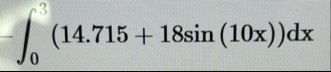 J (14.715 + 18sin (10x))dx
0
This is AI generated Response.
Asked by: Rahul
Created at: 2025-11-06 01:19:13
Asked by: Rahul
Created at: 2025-11-06 01:19:13
Final Answer:
Rendered
Raw Text
Did you like this answer?
## Step 1: Integrate Each Term
We need to integrate the function \( 14.715 + 18\sin(10x) \):
\[
\int (14.715 + 18\sin(10x)) \, dx = \int 14.715 \ dx + \int 18\sin(10x) \, dx
\]
- The integral of \( 14.715 \) with respect to \( x \) is \( 14.715x \).
- The integral of \( 18\sin(10x) \) is \( -\frac{18}{10}\cos(10x) = -1.8\cos(10x) \), using the formula \( \int \sin(ax) dx = -\frac{1}{a}\cos(ax) \).
So, the antiderivative is:
\[
14.715x - 1.8\cos(10x)
\]
**Explanation:**
We integrated each term separately using basic integration rules.
---
## Step 2: Evaluate the Definite Integral from \( x = \) to \( x = 3 \)
Plug in the bounds:
\[
\left[ 14.715x - 1.8\cos(10x) \right]_^3
\]
\[
= \left( 14.715 \times 3 - 1.8\cos(30) \right) - \left( 14.715 \times - 1.8\cos() \right)
\]
\[
= (44.145 - 1.8\cos(30)) - ( - 1.8 \times 1)
\]
\[
= 44.145 - 1.8\cos(30) + 1.8
\]
\[
= 44.145 + 1.8 - 1.8\cos(30)
\]
\[
= 45.945 - 1.8\cos(30)
\]
Since \(\cos(30) = \cos(30^\circ) = \frac{\sqrt{3}}{2} \approx .866\):
\[
1.8 \times .866 \approx 1.5588
\]
So,
\[
45.945 - 1.5588 = 44.3862
\]
---
## Final Answer
\[
\boxed{44.39}
\]
(Rounded to two decimal places)
**Explanation:**
We substituted the upper and lower limits into the antiderivative, simplified using the value of \(\cos(30)\), and calculated the final value.
Question:
Then solve
This is AI generated Response.
Asked by: Rahul
Created at: 2025-11-06 01:20:02
Asked by: Rahul
Created at: 2025-11-06 01:20:02
Final Answer:
Rendered
Raw Text
Did you like this answer?
## Step 1: Integrate Each Term
We need to integrate the function \( 14.715 + 18\sin(10x) \):
\[
\int (14.715 + 18\sin(10x)) \, dx = \int 14.715 \, dx + \int 18\sin(10x) \, dx
\]
- The integral of \( 14.715 \) with respect to \( x \) is \( 14.715x \).
- The integral of \( 18\sin(10x) \) is \( -\frac{18}{10}\cos(10x) = -1.8\cos(10x) \), using the formula \( \int \sin(ax) \, dx = -\frac{1}{a}\cos(ax) \).
Thus, the antiderivative is:
\[
14.715x - 1.8\cos(10x)
\]
**Explanation:**
We integrated each term separately using basic integration rules.
---
## Step 2: Evaluate the Definite Integral from \( x = 0 \) to \( x = 3 \)
Now we evaluate the definite integral:
\[
\left[ 14.715x - 1.8\cos(10x) \right]_{0}^{3}
\]
Substituting the bounds:
\[
= \left( 14.715 \times 3 - 1.8\cos(30) \right) - \left( 14.715 \times 0 - 1.8\cos(0) \right)
\]
Calculating \( \cos(30) = \frac{\sqrt{3}}{2} \approx 0.866 \) and \( \cos(0) = 1 \):
\[
= \left( 44.145 - 1.8 \times 0.866 \right) - (0 - 1.8 \times 1)
\]
\[
= 44.145 - 1.5588 + 1.8
\]
\[
= 44.145 + 0.2412
\]
\[
= 44.3862
\]
---
## Final Answer
\[
\boxed{44.39}
\]
**Explanation:**
We substituted the upper and lower limits into the antiderivative, simplified the expression, and calculated the final value, rounding to two decimal places.
📢 Instructions:
- Ask anything relatd to above question only.
- For new Question goto :