 VIPSolutions
give answer in 2 step with explanation at the end of each step and final answer at the end:y' +16y="7sin(@f)
Question:
give answer in 2 step with explanation at the end of each step and final answer at the end: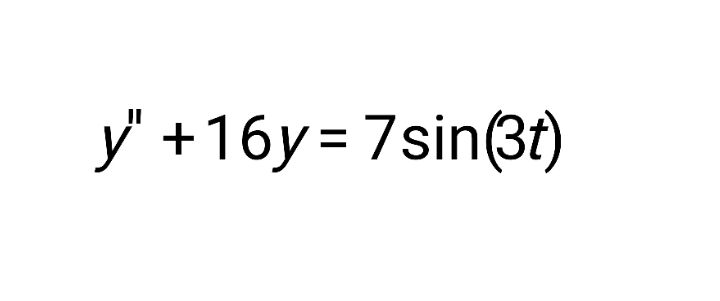 y' +16y="7sin(@f)
This is AI generated Response.
Asked by: Rahul
Created at: 2025-11-05 18:25:07
Asked by: Rahul
Created at: 2025-11-05 18:25:07
Final Answer:
Rendered
Raw Text
Did you like this answer?
# Step 1: Solve the Homogeneous Equation
First, solve the homogeneous part:
\[
y'' + 16y =
\]
The characteristic equation is:
\[
r^2 + 16 = \implies r = \pm4i
\]
So, the general solution to the homogeneous equation is:
\[
y_h(t) = C_1 \cos(4t) + C_2 \sin(4t)
\]
**Explanation:**
This gives us the complementary solution, representing the solution to the equation without the forcing term.
---
# Step 2: Find a Particular Solution
Assume a particular solution of the form:
\[
y_p(t) = A\sin(3t) + B\cos(3t)
\]
Compute derivatives:
\[
y_p' = 3A\cos(3t) - 3B\sin(3t)
\]
\[
y_p'' = -9A\sin(3t) - 9B\cos(3t)
\]
Plug into the original equation:
\[
(-9A\sin(3t) - 9B\cos(3t)) + 16(A\sin(3t) + B\cos(3t)) = 7\sin(3t)
\]
\[
(-9A + 16A)\sin(3t) + (-9B + 16B)\cos(3t) = 7\sin(3t)
\]
\[
(7A)\sin(3t) + (7B)\cos(3t) = 7\sin(3t)
\]
So, \( 7A = 7 \implies A = 1 \) and \( 7B = \implies B = \).
So, \( y_p(t) = \sin(3t) \).
**Explanation:**
We used the method of undetermined coefficients to guess a particular solution, substituted it, and solved for the coefficients.
---
# Final Answer
The general solution is:
\[
\boxed{y(t) = C_1\cos(4t) + C_2\sin(4t) + \sin(3t)}
\]
Question:
Please solve right
This is AI generated Response.
Asked by: Rahul
Created at: 2025-11-05 18:50:25
Asked by: Rahul
Created at: 2025-11-05 18:50:25
Final Answer:
Rendered
Raw Text
Did you like this answer?
# Step 1: Solve the Homogeneous Equation
First, we solve the homogeneous part of the equation:
\[
y'' + 16y = 0
\]
The characteristic equation is:
\[
r^2 + 16 = 0
\]
This simplifies to:
\[
r^2 = -16 \implies r = \pm 4i
\]
So, the general solution to the homogeneous equation is:
\[
y_h(t) = C_1 \cos(4t) + C_2 \sin(4t)
\]
**Explanation:**
This solution represents the complementary function, where \(C_1\) and \(C_2\) are constants determined by initial conditions. The roots being purely imaginary indicates oscillatory behavior.
---
# Step 2: Find a Particular Solution
Next, we find a particular solution to the non-homogeneous equation:
\[
y'' + 16y = 7\sin(3t)
\]
Assume a particular solution of the form:
\[
y_p(t) = A\sin(3t) + B\cos(3t)
\]
Calculating the derivatives:
\[
y_p' = 3A\cos(3t) - 3B\sin(3t)
\]
\[
y_p'' = -9A\sin(3t) - 9B\cos(3t)
\]
Substituting \(y_p\) and its derivatives into the original equation gives:
\[
(-9A\sin(3t) - 9B\cos(3t)) + 16(A\sin(3t) + B\cos(3t)) = 7\sin(3t)
\]
Simplifying, we have:
\[
(-9A + 16A)\sin(3t) + (-9B + 16B)\cos(3t) = 7\sin(3t)
\]
This results in:
\[
(7A)\sin(3t) + (7B)\cos(3t) = 7\sin(3t)
\]
Setting coefficients equal, we find:
\[
7A = 7 \implies A = 1
\]
\[
7B = 0 \implies B = 0
\]
Thus, the particular solution is:
\[
y_p(t) = \sin(3t)
\]
**Explanation:**
We used the method of undetermined coefficients to guess a form for the particular solution, calculated its derivatives, and substituted into the equation to solve for coefficients.
---
# Final Answer
The general solution is:
\[
\boxed{y(t) = C_1\cos(4t) + C_2\sin(4t) + \sin(3t)}
\]
📢 Instructions:
- Ask anything relatd to above question only.
- For new Question goto :