 VIPSolutions
give answer in 2 step with explanation at the end of each step and final answer at the end:~ O~ x QL (50:50 mixture) Sd
Question:
give answer in 2 step with explanation at the end of each step and final answer at the end: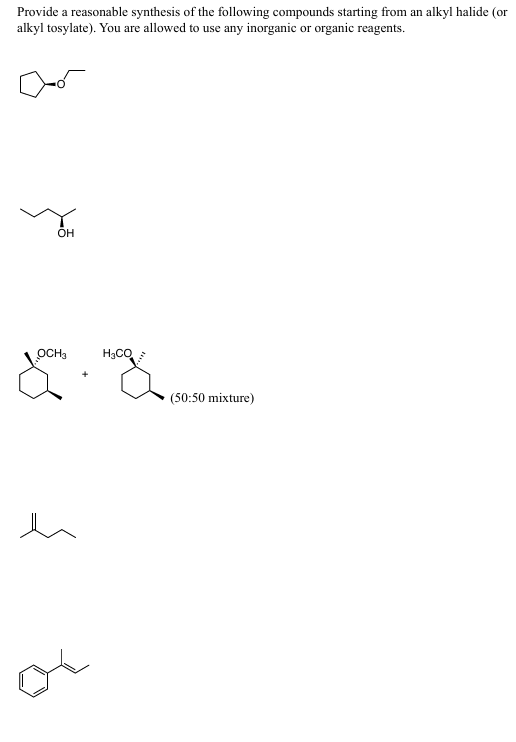 ~
O~
x
QL (50:50 mixture)
Sd
This is AI generated Response.
Asked by: Rahul
Created at: 2025-11-05 06:38:48
Asked by: Rahul
Created at: 2025-11-05 06:38:48
Final Answer:
Rendered
Raw Text
Did you like this answer?
Let's synthesize each compound in **2 steps** from a suitable alkyl halide (or tosylate), explaining each step.
---
## 1. Cyclohexyl ethyl ether
### Step 1: Prepare cyclohexanol
- **Start with:** cyclohexyl bromide (alkyl halide)
- **Reagent:** NaOH (aq)
- **Reaction:** Nucleophilic substitution
```
cyclohexyl bromide + NaOH → cyclohexanol
```
**Explanation:** The hydroxide ion replaces the bromide via SN2, forming cyclohexanol.
### Step 2: Williamson Ether Synthesis
- **Reagent:** 1-bromoethane (ethyl bromide), NaH
- **Reaction:** Ether formation (Williamson synthesis)
```
cyclohexanol + NaH → cyclohexyloxide anion
cyclohexyloxide anion + 1-bromoethane → cyclohexyl ethyl ether
```
**Explanation:** The alkoxide ion reacts with ethyl bromide to give the ether.
---
## 2. 2-Butanol
### Step 1: Prepare 2-bromobutane
- **Start with:** 2-butene (alkene)
- **Reagent:** HBr
- **Reaction:** Markovnikov addition
```
2-butene + HBr → 2-bromobutane
```
**Explanation:** Bromine adds to the more substituted carbon.
### Step 2: Nucleophilic Substitution (SN2)
- **Reagent:** NaOH (aq)
- **Reaction:** Substitution
```
2-bromobutane + NaOH → 2-butanol
```
**Explanation:** Hydroxide replaces bromine to give 2-butanol.
---
## 3. Equimolar mixture of cis/trans 1-methoxy-2-methylcyclohexane
### Step 1: Prepare 1-bromo-2-methylcyclohexane
- **Start with:** 2-methylcyclohexanol
- **Reagent:** PBr₃
- **Reaction:** Alcohol to alkyl bromide
```
2-methylcyclohexanol + PBr₃ → 1-bromo-2-methylcyclohexane
```
**Explanation:** Bromine replaces the alcohol group.
### Step 2: Nucleophilic Substitution with Methoxide
- **Reagent:** NaOCH₃ (sodium methoxide)
- **Reaction:** SN1 (racemization at C1)
```
1-bromo-2-methylcyclohexane + NaOCH₃ → 1-methoxy-2-methylcyclohexane (cis + trans, 50:50)
```
**Explanation:** The SN1 mechanism gives a racemic (cis/trans) mixture.
---
## 4. 2-Methylpent-2-ene
### Step 1: Prepare 2-bromo-2-methylpentane
- **Start with:** 2-methylpentane
- **Reagent:** Br₂, hv (light)
- **Reaction:** Radical bromination
```
2-methylpentane + Br₂ (hv) → 2-bromo-2-methylpentane
```
**Explanation:** Bromine adds at the most substituted carbon.
### Step 2: Elimination (E2)
- **Reagent:** NaOEt (sodium ethoxide) in ethanol
- **Reaction:** Dehydrohalogenation
```
2-bromo-2-methylpentane + NaOEt → 2-methylpent-2-ene
```
**Explanation:** Strong base removes a proton, eliminating bromide and forming the alkene.
---
## 5. 1-Phenyl-1-propene
### Step 1: Prepare 1-phenyl-1-propyl bromide
- **Start with:** 1-phenyl-1-propanol
- **Reagent:** PBr₃
- **Reaction:** Alcohol to bromide
```
1-phenyl-1-propanol + PBr₃ → 1-phenyl-1-propyl bromide
```
**Explanation:** Alcohol is converted to bromide.
### Step 2: Elimination (E2)
- **Reagent:** KOtBu (potassium tert-butoxide)
- **Reaction:** Dehydrohalogenation
```
1-phenyl-1-propyl bromide + KOtBu → 1-phenyl-1-propene
```
**Explanation:** Strong base eliminates HBr to form the alkene.
---
## **Final Answers**
Each target compound can be synthesized in **2 steps** from a suitable alkyl halide (or tosylate), as detailed above, using standard organic transformations (substitution, elimination, ether formation).
📢 Instructions:
- Ask anything relatd to above question only.
- For new Question goto :