 VIPSolutions
give answer in 2 step with explanation at the end of each step and final answer at the end:ni pie the tet it he ion blow wero a B10 E2 chien tn i Je = EN ~< = PL eh Hee |
Question:
give answer in 2 step with explanation at the end of each step and final answer at the end: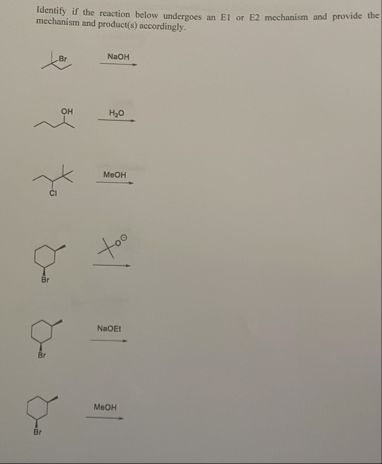 ni pie the
tet it he ion blow wero a B10 E2 chien
tn i
Je =
EN
~< =
PL eh
Hee |
This is AI generated Response.
Asked by: Rahul
Created at: 2025-11-05 06:19:43
Asked by: Rahul
Created at: 2025-11-05 06:19:43
Final Answer:
Rendered
Raw Text
Did you like this answer?
# Reaction Mechanism Identification (E1 or E2) and Products
Let's solve each reaction stepwise, determining the mechanism and giving the product.
---
## **1.**
### **Step 1: Mechanism Identification**
- **Reactant:** 2-bromo-2-methylpropane (tert-butyl bromide)
- **Reagent:** NaOH (strong base, strong nucleophile)
- **Substrate:** Tertiary alkyl halide
**Explanation:**
Tertiary halides with strong bases can go E2, but E1 is favored in polar protic solvents and with weak bases. However, NaOH is a strong base, but because the substrate is tertiary and can form a stable carbocation, both could occur, but E2 is sterically hindered. So, E1 is favored.
### **Step 2: Product**
- **Mechanism:** **E1**
- **Product:** 2-methylpropene (isobutylene)
**Explanation:**
The Br leaves, forming a tertiary carbocation, followed by elimination of a proton to give the alkene.
---
## **2.**
### **Step 1: Mechanism Identification**
- **Reactant:** 2-butanol
- **Reagent:** H₂O (acidic, likely under acidic conditions)
- **Substrate:** Secondary alcohol
**Explanation:**
Secondary alcohols typically undergo E1 elimination under acidic conditions (dehydration), forming a carbocation intermediate.
### **Step 2: Product**
- **Mechanism:** **E1**
- **Product:** 2-butene (major, more substituted alkene)
**Explanation:**
Alcohol is protonated, water leaves, carbocation forms, then elimination gives the alkene.
---
## **3.**
### **Step 1: Mechanism Identification**
- **Reactant:** 2-chloro-2-methylbutane
- **Reagent:** MeOH (methanol, weak base, weak nucleophile)
- **Substrate:** Tertiary alkyl halide
**Explanation:**
Weak base, polar protic solvent, tertiary halide — favors **E1**.
### **Step 2: Product**
- **Mechanism:** **E1**
- **Product:** 2-methyl-2-butene (major, more substituted alkene)
---
## **4.**
### **Step 1: Mechanism Identification**
- **Reactant:** Bromocyclohexane
- **Reagent:** Sodium ethoxide (NaOEt, strong base)
- **Substrate:** Secondary alkyl halide
**Explanation:**
Strong base, secondary halide — **E2** is favored.
### **Step 2: Product**
- **Mechanism:** **E2**
- **Product:** Cyclohexene
---
## **5.**
### **Step 1: Mechanism Identification**
- **Reactant:** Bromocyclohexane
- **Reagent:** Sodium ethoxide (NaOEt, strong base)
- **Substrate:** Secondary alkyl halide
**Explanation:**
Same as above: strong base, secondary halide — **E2**.
### **Step 2: Product**
- **Mechanism:** **E2**
- **Product:** Cyclohexene
---
## **6.**
### **Step 1: Mechanism Identification**
- **Reactant:** 1-bromo-1,2,3,4-tetrahydronaphthalene
- **Reagent:** MeOH (methanol, weak base)
- **Substrate:** Benzylic bromide
**Explanation:**
Benzylic carbocations are stabilized, methanol is a weak base, so **E1** is favored.
### **Step 2: Product**
- **Mechanism:** **E1**
- **Product:** 1,2-dihydronaphthalene (alkene at the benzylic position)
---
## **Summary Table**
| # | Substrate & Reagent | Mechanism | Product |
|---|--------------------------------------|-----------|-------------------------------|
| 1 | tert-butyl bromide + NaOH | E1 | 2-methylpropene |
| 2 | 2-butanol + H₂O | E1 | 2-butene |
| 3 | 2-chloro-2-methylbutane + MeOH | E1 | 2-methyl-2-butene |
| 4 | bromocyclohexane + NaOEt | E2 | cyclohexene |
| 5 | bromocyclohexane + NaOEt | E2 | cyclohexene |
| 6 | 1-bromo-1,2,3,4-tetrahydronaphthalene + MeOH | E1 | 1,2-dihydronaphthalene |
---
### **Final Answer**
- Reactions 1, 2, 3, and 6 proceed via **E1**.
- Reactions 4 and 5 proceed via **E2**.
- The products are the corresponding alkenes as indicated above.
📢 Instructions:
- Ask anything relatd to above question only.
- For new Question goto :