 VIPSolutions
give answer in 2 step with explanation at the end of each step and final answer at the end:We consider the model for the movement of a block on a surface with friction. The friction force consists of three parts: e The constant Coulomb force: F, =1 N, o The viscous force: Fy, = |v] N, where the v is the velocity of the block, and 4 e The Stribeck force: Fs = —— N. lo] +1 Keep in mind that the direction of the frictional force is opposite to the direction of movement. ‘We start pushing the block with a force of 8 N. The block has mass 1 kg and initially was at rest. (a) Find the time needed for the block to reach a velocity of 1 m/sec. (b) What is the limiting velocity, that the block approaches after a long time?
Question:
give answer in 2 step with explanation at the end of each step and final answer at the end: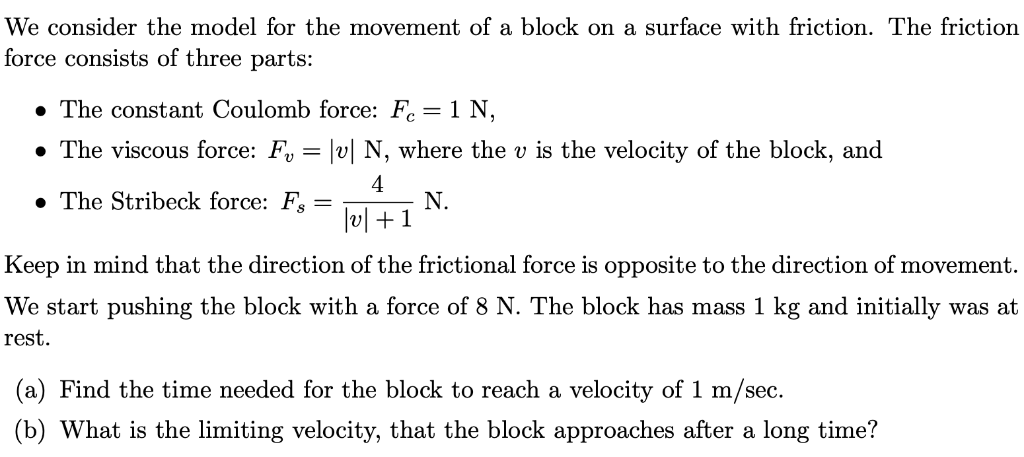 We consider the model for the movement of a block on a surface with friction. The friction
force consists of three parts:
e The constant Coulomb force: F, =1 N,
o The viscous force: Fy, = |v] N, where the v is the velocity of the block, and
4
e The Stribeck force: Fs = —— N.
lo] +1
Keep in mind that the direction of the frictional force is opposite to the direction of movement.
‘We start pushing the block with a force of 8 N. The block has mass 1 kg and initially was at
rest.
(a) Find the time needed for the block to reach a velocity of 1 m/sec.
(b) What is the limiting velocity, that the block approaches after a long time?
This is AI generated Response.
Asked by: Rahul
Created at: 2025-10-10 17:02:28
Asked by: Rahul
Created at: 2025-10-10 17:02:28
Final Answer:
Rendered
Raw Text
Did you like this answer?
Let's solve each step by step---
## () **Find time needed for block to reach velocity of m/s**
###Step 1 Write the equation motion**
The force on the is:
\F_{\text{}} = Ftext{ap}} - (_c + F + F_s\]
Given:
\( F_{\{applied = 8) N
\( F_c 1 \ N
- F_v = || \) N- \( F = \frac4}{|v|+1} \) N
- \( m = 1 \) kg
So,
\[
m \frac{dv}{dt} = 8 - \left(1 + v + \frac{4}{v+1}\right)
\]
\[
\frac{dv}{dt} = 8 - 1 - v - \frac{4}{v+1}
\]
\[
\frac{dv}{dt} = 7 - v - \frac{4}{v+1}
\]
**Explanation:**
We have written the net force acting on the block by subtracting all (velocity-dependent) friction forces from the applied force.
---
### **Step 2: Set up and solve the differential equation**
We want to find the time to reach \( v = 1 \) m/s, starting from rest (\( v = \)).
\[
\frac{dv}{dt} = 7 - v - \frac{4}{v+1}
\]
\[
dt = \frac{dv}{7 - v - \frac{4}{v+1}}
\]
Let's simplify the denominator:
\[
7 - v - \frac{4}{v+1} = \frac{7(v+1) - v(v+1) - 4}{v+1}
= \frac{7v + 7 - v^2 - v - 4}{v+1}
= \frac{-v^2 + 6v + 3}{v+1}
\]
So,
\[
dt = \frac{v+1}{-v^2 + 6v + 3} dv
\]
The time to reach \( v = 1 \) is:
\[
t = \int_{v=}^{v=1} \frac{v+1}{-v^2 + 6v + 3} dv
\]
**Explanation:**
We set up the integral to solve for the time by separating variables and simplifying the expression.
---
#### **Final Answer (a):**
The time required is:
\[
\boxed{
t = \int_{}^{1} \frac{v+1}{-v^2 + 6v + 3}\, dv
}
\]
This can be solved numerically if an explicit answer is needed.
---
## (b) **What is the limiting velocity that the block approaches after a long time?**
### **Step 1: Set acceleration to zero for steady state**
At limiting velocity (\( v_\infty \)), acceleration is zero (\( \frac{dv}{dt} = \)):
\[
= 8 - (1 + v_\infty + \frac{4}{v_\infty+1})
\]
\[
= 7 - v_\infty - \frac{4}{v_\infty+1}
\]
\[
v_\infty + \frac{4}{v_\infty+1} = 7
\]
**Explanation:**
We set the net force to zero to find the terminal (limiting) velocity.
---
### **Step 2: Solve for \( v_\infty \) algebraically**
Multiply both sides by \( v_\infty + 1 \):
\[
v_\infty (v_\infty + 1) + 4 = 7 (v_\infty + 1)
\]
\[
v_\infty^2 + v_\infty + 4 = 7v_\infty + 7
\]
\[
v_\infty^2 - 6v_\infty - 3 =
\]
Solve the quadratic:
\[
v_\infty = \frac{6 \pm \sqrt{36 + 12}}{2} = \frac{6 \pm \sqrt{48}}{2} = \frac{6 \pm 4\sqrt{3}}{2} = 3 \pm 2\sqrt{3}
\]
Since velocity must be positive,
\[
v_\infty = 3 + 2\sqrt{3} \approx 6.464
\]
**Explanation:**
We solved the quadratic equation for the steady-state velocity, keeping only the positive root.
---
#### **Final Answer (b):**
\[
\boxed{
v_\infty = 3 + 2\sqrt{3} \approx 6.464~\text{m/s}
}
\]
Question:
Give me text in correct
This is AI generated Response.
Asked by: Rahul
Created at: 2025-10-10 17:04:36
Asked by: Rahul
Created at: 2025-10-10 17:04:36
Final Answer:
Rendered
Raw Text
Did you like this answer?
# Friction Model for Block Movement
We will solve the problem of a block moving on a surface with friction in two steps: finding the time needed to reach a specified velocity and determining the limiting velocity.
## (a) Find Time Needed for Block to Reach Velocity of 1 m/s
### Step 1: Write the Equation of Motion
The net force acting on the block is given by:
\[
F_{\text{net}} = F_{\text{applied}} - (F_c + F_v + F_s)
\]
Where:
- \( F_{\text{applied}} = 8 \, \text{N} \)
- \( F_c = 1 \, \text{N} \) (Coulomb force)
- \( F_v = |v| \, \text{N} \) (Viscous force)
- \( F_s = \frac{4}{|v| + 1} \, \text{N} \) (Stribeck force)
- Mass \( m = 1 \, \text{kg} \)
The equation of motion becomes:
\[
m \frac{dv}{dt} = 8 - \left(1 + v + \frac{4}{v + 1}\right)
\]
This simplifies to:
\[
\frac{dv}{dt} = 7 - v - \frac{4}{v + 1}
\]
**Explanation:**
We derived the motion equation by subtracting the total frictional forces from the applied force acting on the block.
---
### Step 2: Set Up and Solve the Differential Equation
To find the time to reach \( v = 1 \, \text{m/s} \) from rest, we rearrange the equation:
\[
dt = \frac{dv}{7 - v - \frac{4}{v + 1}}
\]
Next, we simplify the denominator:
\[
7 - v - \frac{4}{v + 1} = \frac{7(v + 1) - v(v + 1) - 4}{v + 1} = \frac{-v^2 + 6v + 3}{v + 1}
\]
Thus, the equation becomes:
\[
dt = \frac{v + 1}{-v^2 + 6v + 3} dv
\]
The total time to reach \( v = 1 \) is:
\[
t = \int_{0}^{1} \frac{v + 1}{-v^2 + 6v + 3} \, dv
\]
**Explanation:**
We set up the integral to compute the time needed by separating the variables and simplifying the expression for integration.
---
#### Final Answer (a):
\[
\boxed{
t = \int_{0}^{1} \frac{v + 1}{-v^2 + 6v + 3} \, dv
}
\]
---
## (b) What is the Limiting Velocity that the Block Approaches After a Long Time?
### Step 1: Set Acceleration to Zero for Steady State
At limiting velocity (\( v_\infty \)), the acceleration equals zero:
\[
0 = 8 - (1 + v_\infty + \frac{4}{v_\infty + 1})
\]
This leads to:
\[
v_\infty + \frac{4}{v_\infty + 1} = 7
\]
**Explanation:**
Setting the net force to zero allows us to find the terminal velocity where the forces balance out.
---
### Step 2: Solve for \( v_\infty \) Algebraically
Multiply both sides by \( v_\infty + 1 \):
\[
v_\infty (v_\infty + 1) + 4 = 7(v_\infty + 1)
\]
Simplifying gives:
\[
v_\infty^2 + v_\infty + 4 = 7v_\infty + 7
\]
\[
v_\infty^2 - 6v_\infty - 3 = 0
\]
Using the quadratic formula:
\[
v_\infty = \frac{6 \pm \sqrt{36 + 12}}{2} = \frac{6 \pm \sqrt{48}}{2} = \frac{6 \pm 4\sqrt{3}}{2} = 3 \pm 2\sqrt{3}
\]
Since velocity must be positive, we take:
\[
v_\infty = 3 + 2\sqrt{3} \approx 6.464 \, \text{m/s}
\]
**Explanation:**
We solved the quadratic equation for the steady-state velocity, discarding the negative root to find the physical solution.
---
#### Final Answer (b):
\[
\boxed{
v_\infty = 3 + 2\sqrt{3} \approx 6.464 \, \text{m/s}
}
\]
📢 Instructions:
- Ask anything relatd to above question only.
- For new Question goto :