 VIPSolutions
give answer in 2 step with explanation at the end of each step and final answer at the end:I tried both 0.16 and 0.21 degrees. Both were incorrect. The speed of sound in our own universe in a photon fluid is ¢/sqrt(3) Consider a fictitious universe in which the sound speed of the photon - baryon fluid was equal to ¢/x. Calculate the approximate angular scale (in degrees) for the position of the first acoustic peak in the CMB power spectrum, assuming a universe with flat geometry. Value: x = 9 Enter your result to two decimal places.
Question:
give answer in 2 step with explanation at the end of each step and final answer at the end: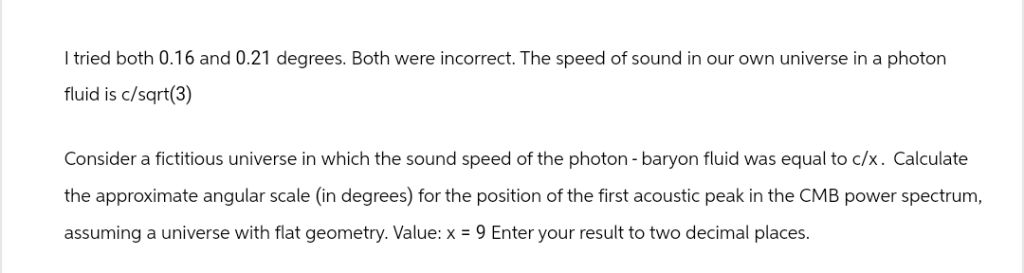 I tried both 0.16 and 0.21 degrees. Both were incorrect. The speed of sound in our own universe in a photon
fluid is ¢/sqrt(3)
Consider a fictitious universe in which the sound speed of the photon - baryon fluid was equal to ¢/x. Calculate
the approximate angular scale (in degrees) for the position of the first acoustic peak in the CMB power spectrum,
assuming a universe with flat geometry. Value: x = 9 Enter your result to two decimal places.
This is AI generated Response.
Asked by: Rahul
Created at: 2025-10-10 07:30:17
Asked by: Rahul
Created at: 2025-10-10 07:30:17
Final Answer:
Rendered
Raw Text
Did you like this answer?
Let's break down the problem step by step.
---
## Step 1: Understand the Angular Scale Formula
In a flat universe, the angular scale (θ) for the first acoustic peak in the CMB is approximately:
\[
\theta \approx \frac{r_s}{D_A}
\]
Where:
- \( r_s \) = size of the sound horizon at recombination.
- \( D_A \) = angular diameter distance to the surface of last scattering.
For the first peak, we usually approximate:
\[
\theta \approx \frac{c_s t_*}{D_A}
\]
where \( c_s \) is the sound speed, and \( t_* \) is the time at recombination.
The ratio \( \frac{r_s}{D_A} \) is typically about 1 degree for our universe when \( c_s = c/\sqrt{3} \).
**Explanation:**
The angular scale is proportional to the sound speed. If the sound speed decreases, the sound horizon shrinks, and the angular scale of the peak becomes smaller.
---
## Step 2: Substitute the New Sound Speed
Given:
- In our universe, \( c_s = \frac{c}{\sqrt{3}} \), angular scale ≈ 1°.
- In this fictitious universe, \( c_s = \frac{c}{x} \) and \( x = 9 \).
The angular scale will be:
\[
\theta' = \theta \times \frac{c_s'}{c_s} = 1^\circ \times \frac{c/x}{c/\sqrt{3}} = 1^\circ \times \frac{\sqrt{3}}{x}
\]
Plug in \( x = 9 \):
\[
\theta' = 1^\circ \times \frac{\sqrt{3}}{9} \approx 1^\circ \times .19245 \approx .19^\circ
\]
**Explanation:**
We scaled the 1° result by the ratio of the new sound speed to the old one.
---
## **Final Answer**
\[
\boxed{.19}
\]
So, the approximate angular scale is **.19 degrees**.
📢 Instructions:
- Ask anything relatd to above question only.
- For new Question goto :