 VIPSolutions
give answer in 2 step with explanation at the end of each step and final answer at the end:3008 From the results of Exercise 3.10.6, show that a, a, ‘and that al other first derivatives of the circular cylindrical unit vectors with respect to the circular cylindrical coordinates vanish.
Question:
give answer in 2 step with explanation at the end of each step and final answer at the end: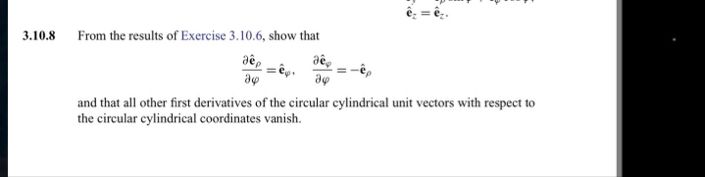 3008 From the results of Exercise 3.10.6, show that
a, a,
‘and that al other first derivatives of the circular cylindrical unit vectors with respect to
the circular cylindrical coordinates vanish.
This is AI generated Response.
Asked by: Rahul
Created at: 2025-10-10 07:04:55
Asked by: Rahul
Created at: 2025-10-10 07:04:55
Final Answer:
Rendered
Raw Text
Did you like this answer?
## Step 1: Express the Unit Vectors in Terms of Cartesian Coordinates
In cylindrical coordinates, the unit vectors are given by:
\[
\hat{e}_\rho = \cos\phi\,\hat{i} + \sin\phi\,\hat{j}
\]
\[
\hat{e}_\phi = -\sin\phi\,\hat{i} + \cos\phi\,\hat{j}
\]
**Explanation:**
This expresses the cylindrical unit vectors \(\hat{e}_\rho\) and \(\hat{e}_\phi\) in terms of Cartesian unit vectors \(\hat{i}\) and \(\hat{j}\). This is necessary because derivatives with respect to \(\phi\) are easier to evaluate in this basis.
---
## Step 2: Compute the Derivatives with Respect to \(\phi\)
Take the partial derivatives with respect to \(\phi\):
\[
\frac{\partial \hat{e}_\rho}{\partial \phi} = -\sin\phi\,\hat{i} + \cos\phi\,\hat{j} = \hat{e}_\phi
\]
\[
\frac{\partial \hat{e}_\phi}{\partial \phi} = -\cos\phi\,\hat{i} - \sin\phi\,\hat{j} = -\hat{e}_\rho
\]
**Explanation:**
Taking derivatives, we see that the derivative of \(\hat{e}_\rho\) with respect to \(\phi\) gives \(\hat{e}_\phi\), and the derivative of \(\hat{e}_\phi\) with respect to \(\phi\) gives \(-\hat{e}_\rho\).
---
## Final Answer
\[
\boxed{
\frac{\partial \hat{e}_\rho}{\partial \phi} = \hat{e}_\phi, \qquad \frac{\partial \hat{e}_\phi}{\partial \phi} = -\hat{e}_\rho
}
\]
All other first derivatives of the cylindrical unit vectors with respect to the coordinates (\(\rho\), \(z\)) are zero.
📢 Instructions:
- Ask anything relatd to above question only.
- For new Question goto :