 VIPSolutions
give answer in 2 step with explanation at the end of each step and final answer at the end:O/3psis Again consider afictitious universe in which the sound speed of the photon-baryon fluid was equal to ¢/z. This time clculate the approximate multipole (¢ value) on the CMB power spectrum of fourth overtone. Recall that maltipoles are related to angular scales 80 (in radians) by £ = /56. For simplicity you can assume that the “overtone” peaks occur atinteger multiples of the fundamental frequency, as in the open pipe example. (in actuality, subtle effects that weave not discussed in class cause the peaks to not be exactly evenly spaced in frequency ~ you can see this in the. Planck power spectrum) Value: 2 = 5.2 Enter your result asa mulipole, in a whole number:
Question:
give answer in 2 step with explanation at the end of each step and final answer at the end: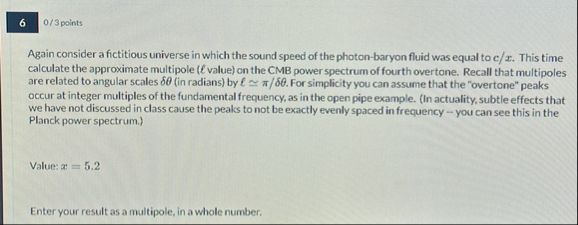 O/3psis
Again consider afictitious universe in which the sound speed of the photon-baryon fluid was equal to ¢/z. This time
clculate the approximate multipole (¢ value) on the CMB power spectrum of fourth overtone. Recall that maltipoles
are related to angular scales 80 (in radians) by £ = /56. For simplicity you can assume that the “overtone” peaks
occur atinteger multiples of the fundamental frequency, as in the open pipe example. (in actuality, subtle effects that
weave not discussed in class cause the peaks to not be exactly evenly spaced in frequency ~ you can see this in the.
Planck power spectrum)
Value: 2 = 5.2
Enter your result asa mulipole, in a whole number:
Asked by: Rahul
Created at: 2025-10-10 06:59:51
Final Answer:
📢 Instructions:
- Ask anything relatd to above question only.
- For new Question goto :