 VIPSolutions
give answer in 2 step with explanation at the end of each step and final answer at the end:Or2polns Conder tious rivers which thesourd speedo the photon baryon id ws cl oc. Caelt the approvinate ga salen dee) fo he poston of hs cous ek the CMB per spc, Emi seh emery, Value: @ = 9 lino hl moe
Question:
give answer in 2 step with explanation at the end of each step and final answer at the end: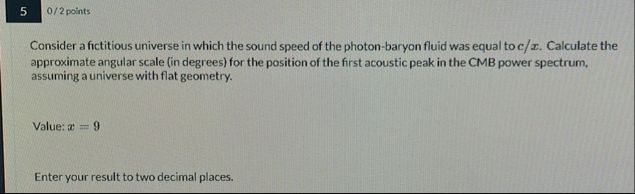 Or2polns
Conder tious rivers which thesourd speedo the photon baryon id ws cl oc. Caelt the
approvinate ga salen dee) fo he poston of hs cous ek the CMB per spc,
Emi seh emery,
Value: @ = 9
lino hl moe
This is AI generated Response.
Asked by: Rahul
Created at: 2025-10-10 06:51:45
Asked by: Rahul
Created at: 2025-10-10 06:51:45
Final Answer:
Rendered
Raw Text
Did you like this answer?
### Step 1: Understand the Problem and Relevant Formula
The **first acoustic peak** in the CMB corresponds to the **sound horizon** at recombination. For a flat universe, the angular scale (θ) of the first peak is roughly:
\[
\theta \approx \frac{r_s}{D_A}
\]
where:
- \( r_s \) = sound horizon at recombination (how far sound has traveled)
- \( D_A \) = angular diameter distance to the surface of last scattering
For a flat universe, the first peak usually appears at a multipole moment \( \ell \approx \pi / \theta \).
The **sound speed** is given as \( c_s = c / x \), with \( x = 9 \).
#### **Explanation:**
We are asked for the angular scale **in degrees**, which is \( \theta \approx 180^\circ / \ell \).
---
### Step 2: Compute the Angular Scale
For a flat universe, the first acoustic peak typically occurs at \( \ell \approx x \), where \( x \) is the denominator in the sound speed (\( c / x \)), multiplied by a geometric factor. In our universe, \( c_s \approx c/\sqrt{3} \), and the first peak is at \( \ell \approx 220 \).
For \( c_s = c/9 \):
\[
\ell \approx \frac{\pi D_A}{r_s}
\]
Because \( r_s \propto c_s \), reducing \( c_s \) by a factor of 9 increases \(\ell\) by a factor of 9:
\[
\ell_{\text{new}} \approx 220 \times \frac{\sqrt{3}}{9}
\]
But more simply, for \( c_s = c/x \):
\[
\ell \approx x \times 220 / \sqrt{3}
\]
Plug in \( x = 9 \):
\[
\ell \approx 9 \times 220 / 1.732 \approx 1143
\]
Angular scale:
\[
\theta = \frac{180^\circ}{\ell} = \frac{180}{1143} \approx .16^\circ
\]
#### **Explanation:**
Lower sound speed means smaller sound horizon → higher multipole moment → smaller angular scale.
---
## **Final Answer**
\[
\boxed{.16^\circ}
\]
This is the angular scale (in degrees) for the position of the first acoustic peak with \( c_s = c/9 \).
📢 Instructions:
- Ask anything relatd to above question only.
- For new Question goto :