give answer in 2 step with explanation at the end of each step and final answer at the end:2. Surface Waves on Water: Here we explore another situation, closely related to blackbody radiation
in hollow cavities, or phonons in crystalline solids, where the low-energy excitations of a system can
be treated classically as harmonically oscillating modes, or quantum mechanically, as non-conserved,
non-interacting bosons.
Consider waves on the surface of a fluid, like (non-breaking) waves in the ocean, or ripples in your
cup of coffee. For sufficiently large wavelengths, the restoring force will be dominated by gravity, while
for sufficiently small wavelengths and/or thin films of liquid, the restoring force is primarily due to
surface tension. (In between, both effects will be important, and the dispersion relation is somewhat
complicated).
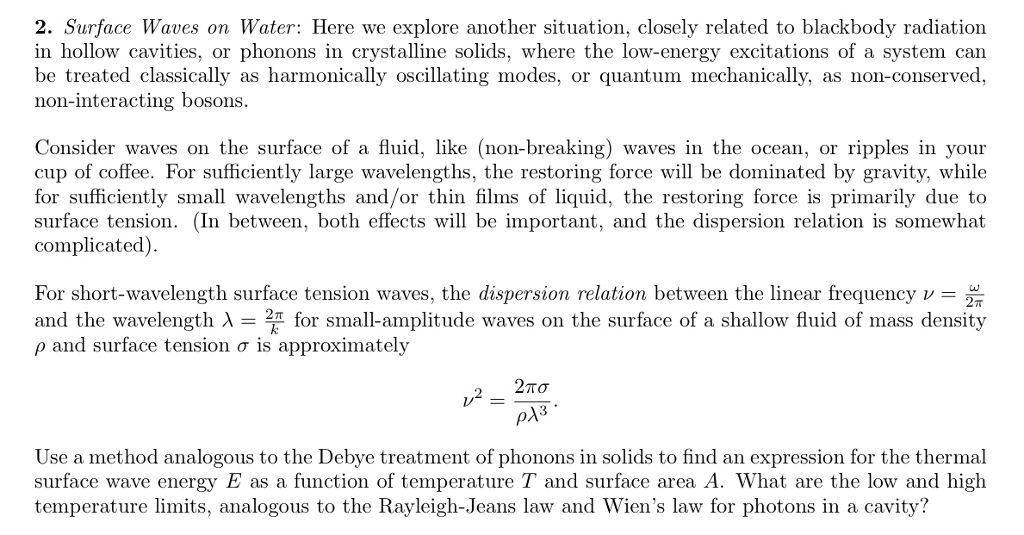
For short-wavelength surface tension waves, the dispersion relation between the linear frequency v = 5
and the wavelength A = 27 for small-amplitude waves on the surface of a shallow fluid of mass density
p and surface tension o is approximately
5 2m0
v="
PAY
Use a method analogous to the Debye treatment of phonons in solids to find an expression for the thermal
surface wave energy E as a function of temperature T° and surface area A. What are the low and high
temperature limits, analogous to the Rayleigh-Jeans law and Wien’s law for photons in a cavity?
Question:
give answer in 2 step with explanation at the end of each step and final answer at the end:2. Surface Waves on Water: Here we explore another situation, closely related to blackbody radiation
in hollow cavities, or phonons in crystalline solids, where the low-energy excitations of a system can
be treated classically as harmonically oscillating modes, or quantum mechanically, as non-conserved,
non-interacting bosons.
Consider waves on the surface of a fluid, like (non-breaking) waves in the ocean, or ripples in your
cup of coffee. For sufficiently large wavelengths, the restoring force will be dominated by gravity, while
for sufficiently small wavelengths and/or thin films of liquid, the restoring force is primarily due to
surface tension. (In between, both effects will be important, and the dispersion relation is somewhat
complicated).
For short-wavelength surface tension waves, the dispersion relation between the linear frequency v = 5
and the wavelength A = 27 for small-amplitude waves on the surface of a shallow fluid of mass density
p and surface tension o is approximately
5 2m0
v="
PAY
Use a method analogous to the Debye treatment of phonons in solids to find an expression for the thermal
surface wave energy E as a function of temperature T° and surface area A. What are the low and high
temperature limits, analogous to the Rayleigh-Jeans law and Wien’s law for photons in a cavity?
This is AI generated Response.
Asked by: Rahul
Created at: 2025-10-09 06:37:58
Final Answer:
RenderedRaw Text
Did you like this answer?
## Step 1: Find the Dispersion Relation and Density of States
The **dispersion relation** for short-wavelength surface tension waves is given as:
\[
\nu^2 = \frac{2\pi \sigma}{\rho \lambda^3}
\]
With \( \nu = \frac{\omega}{2\pi} \) and \( \lambda = \frac{2\pi}{k} \), we have:
\[
\omega = 2\pi \nu = 2\pi \sqrt{\frac{2\pi \sigma}{\rho \lambda^3}}
\]
Substitute \( \lambda = \frac{2\pi}{k} \):
\[
\omega = 2\pi \sqrt{\frac{2\pi \sigma}{\rho} \left(\frac{k}{2\pi}\right)^3}
= 2\pi \sqrt{\frac{2\pi \sigma}{\rho} \frac{k^3}{(2\pi)^3}}
= 2\pi \sqrt{\frac{\sigma}{4\pi^2 \rho} k^3 }
\]
\[
\omega \propto k^{3/2}
\]
For a 2D system of area \(A\), the number of modes with wavenumber less than \(k\) is:
\[
N(k) = \frac{A}{(2\pi)^2} \cdot \pi k^2
\]
The **density of states** per unit frequency:
\[
g(\omega) = \frac{dN}{d\omega}
\]
From \( \omega \propto k^{3/2} \implies k \propto \omega^{2/3} \):
\[
N(\omega) \propto k^2 \propto \omega^{4/3}
\implies g(\omega) = \frac{dN}{d\omega} \propto \omega^{1/3}
\]
**Explanation:**
We calculated the dispersion relation for capillary waves and expressed the density of states as a function of frequency, which is essential for calculating energy.
---
## Step 2: Calculate the Thermal Energy Using Bose-Einstein Statistics
The total thermal energy is:
\[
E = \int_{}^{\infty} d\omega \; g(\omega) \frac{\hbar \omega}{e^{\beta \hbar \omega} - 1}
\]
With \(g(\omega) \propto \omega^{1/3}\), we have:
\[
E \propto \int_{}^{\infty} d\omega \; \omega^{4/3} \frac{1}{e^{\beta \hbar \omega} - 1}
\]
Let \(x = \beta \hbar \omega\):
\[
E \propto (k_B T)^{7/3} \int_{}^{\infty} dx \; \frac{x^{4/3}}{e^x - 1}
\]
Thus,
\[
E = C \cdot A \cdot (k_B T)^{7/3}
\]
where \(C\) involves physical constants and the area \(A\).
**Low temperature limit:**
At low \(T\), the energy is dominated by the lowest-frequency modes, leading to:
\[
E \sim T^{7/3}
\]
(analogous to Wien's law).
**High temperature limit:**
At high \(T\), equipartition applies (\(k_B T\) per mode), so:
\[
E \sim (k_B T) \times \text{number of modes} \sim T
\]
(analogous to the Rayleigh-Jeans law).
**Explanation:**
We used the density of states and Bose-Einstein statistics to derive the temperature dependence of the thermal energy. At low \(T\), energy scales as \(T^{7/3}\); at high \(T\), it scales linearly with \(T\).
---
## **Final Answer**
The thermal energy of surface waves on water (with surface tension as the restoring force) is:
\[
\boxed{
E = C \cdot A \cdot (k_B T)^{7/3}
}
\]
where \(C\) is a constant involving physical parameters of the system.
- **At low temperature:** \(E \sim T^{7/3}\) (Wien-like law)
- **At high temperature:** \(E \sim T\) (Rayleigh-Jeans-like law)
This parallels the behavior of photon energy in a cavity, with modified exponents due to the different dispersion relation.
VIPSolutions focuses on clear, step‑by‑step explanations so you can learn quickly. Whether you need an AI‑generated walkthrough or a short hint to get unstuck, each solution is organized for fast reading and easy review later.
Search similar questions, compare approaches, and bookmark the best answers for revision. Our goal is simple: quick, reliable study help that feels natural—not noisy.
 VIPSolutions
 2. Surface Waves on Water: Here we explore another situation, closely related to blackbody radiation
in hollow cavities, or phonons in crystalline solids, where the low-energy excitations of a system can
be treated classically as harmonically oscillating modes, or quantum mechanically, as non-conserved,
non-interacting bosons.
Consider waves on the surface of a fluid, like (non-breaking) waves in the ocean, or ripples in your
cup of coffee. For sufficiently large wavelengths, the restoring force will be dominated by gravity, while
for sufficiently small wavelengths and/or thin films of liquid, the restoring force is primarily due to
surface tension. (In between, both effects will be important, and the dispersion relation is somewhat
complicated).
For short-wavelength surface tension waves, the dispersion relation between the linear frequency v = 5
and the wavelength A = 27 for small-amplitude waves on the surface of a shallow fluid of mass density
p and surface tension o is approximately
5 2m0
v="
PAY
Use a method analogous to the Debye treatment of phonons in solids to find an expression for the thermal
surface wave energy E as a function of temperature T° and surface area A. What are the low and high
temperature limits, analogous to the Rayleigh-Jeans law and Wien’s law for photons in a cavity?