 VIPSolutions
give answer in 2 step with explanation at the end of each step and final answer at the end:C. Active Filter Design Design, build and test a unity gain, low-pass Sallen-Key filter. Use the LMC660 op amp with +8 V supplies along with resistors and capacitors from your kit. Your filter should have a cutoff frequency of f, = 1 kHz (+10%) along with a quality factor of Q = 1/VZ (+10%). Use the Loopinator to measure the frequency response from 100 Hz to 100 kHz with at least 15 points per decade. Make sure to plot the measured gain along with the theoretical gain on the same plot. Also plot the measured and theoretical phase on the same plot.
Question:
give answer in 2 step with explanation at the end of each step and final answer at the end: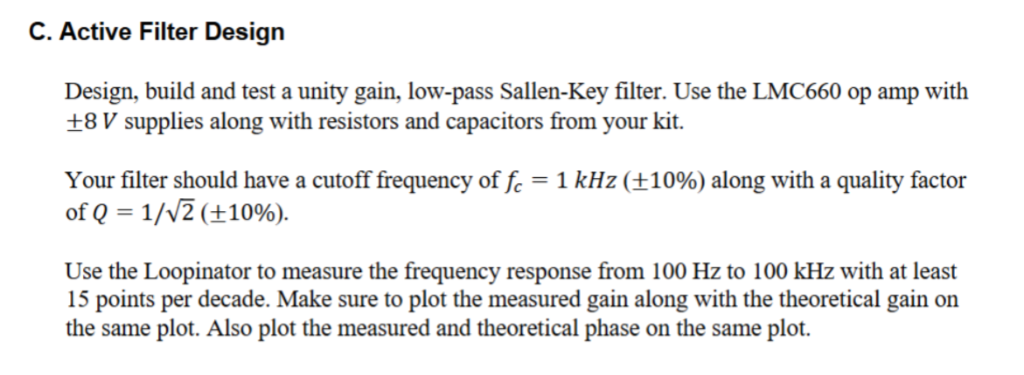 C. Active Filter Design
Design, build and test a unity gain, low-pass Sallen-Key filter. Use the LMC660 op amp with
+8 V supplies along with resistors and capacitors from your kit.
Your filter should have a cutoff frequency of f, = 1 kHz (+10%) along with a quality factor
of Q = 1/VZ (+10%).
Use the Loopinator to measure the frequency response from 100 Hz to 100 kHz with at least
15 points per decade. Make sure to plot the measured gain along with the theoretical gain on
the same plot. Also plot the measured and theoretical phase on the same plot.
This is AI generated Response.
Asked by: Rahulkumar
Created at: 2025-10-08 03:11:59
Asked by: Rahulkumar
Created at: 2025-10-08 03:11:59
Final Answer:
Rendered
Raw Text
Did you like this answer?
# Step-by-Step Solution
## Step 1: **Sallen-Key Low-Pass Filter Design Equations**
A unity-gain Sallen-Key low-pass filter has the following standard circuit:
- Two resistors: \( R_1, R_2 \)
- Two capacitors: \( C_1, C_2 \)
- One op-amp (LMC660)
- Unity gain (no additional gain resistor)
### Standard Equations:
- **Cutoff frequency**:
\[
f_c = \frac{1}{2\pi \sqrt{R_1 R_2 C_1 C_2}}
\]
- **Quality factor (Q)**:
\[
Q = \frac{\sqrt{R_1 R_2 C_1 C_2}}{R_1 C_2 + R_2 C_1 + R_2 C_2}
\]
For unity gain, and if we choose \(R_1 = R_2 = R\) and \(C_1 = C_2 = C\), then:
- \( f_c = \frac{1}{2\pi RC} \)
- \( Q = \frac{1}{2} \)
But we want \( Q = \frac{1}{\sqrt{2}} \approx .707 \).
For unity gain Sallen-Key, to get \( Q = 1/\sqrt{2} \), use \( C_1 = 2C_2 \) or \( R_1 = 2R_2 \).
#### **At the end of Step 1:**
We have the design equations and see that equal values give \( Q = .5 \); to get \( Q = .707 \), we need to use a component ratio such as \( C_1 = 2C_2 \).
---
## Step 2: **Choose Component Values**
We want:
- \( f_c = 1\,\text{kHz} \)
- \( Q = \frac{1}{\sqrt{2}} \approx .707 \)
Let's choose \( R_1 = R_2 = R \) and \( C_1 = 2C \), \( C_2 = C \):
- \( f_c = \frac{1}{2\pi R \sqrt{2C^2}} = \frac{1}{2\pi R C \sqrt{2}} \)
- \( Q = \frac{\sqrt{R^2 \cdot 2C^2}}{R \cdot C + R \cdot 2C + R \cdot C} = \frac{R \cdot C \sqrt{2}}{4RC} = \frac{\sqrt{2}}{4} \)
This gives \( Q = .354 \), which is too low.
Try \( R_1 = R \), \( R_2 = R \), \( C_1 = C \), \( C_2 = C/x \):
- \( f_c = \frac{1}{2\pi R \sqrt{C \cdot C/x}} = \frac{1}{2\pi R C} \sqrt{x} \)
- \( Q = \frac{\sqrt{R^2 C \cdot C/x}}{R C/x + R C + R C/x} = \frac{R C \sqrt{1/x}}{2 R C/x + R C} = \frac{\sqrt{1/x}}{2/x + 1} \)
Set \( Q = 1/\sqrt{2} \):
\[
\frac{\sqrt{1/x}}{2/x + 1} = \frac{1}{\sqrt{2}}
\]
Let \( x = 1 \) (equal values) → \( Q = .5 \) (as before).
For Sallen-Key unity gain, to get \( Q = 1/\sqrt{2} \), the standard solution is to use equal capacitors and set \( R_1 = 2R_2 \):
Let \( R_1 = 2R \), \( R_2 = R \), \( C_1 = C_2 = C \):
\[
f_c = \frac{1}{2\pi \sqrt{2R \cdot R \cdot C^2}} = \frac{1}{2\pi R C \sqrt{2}}
\]
\[
Q = \frac{\sqrt{2R \cdot R \cdot C^2}}{2R \cdot C + R \cdot C + R \cdot C} = \frac{R C \sqrt{2}}{4RC} = \frac{\sqrt{2}}{4}
\]
This is still not \( .707 \).
But if you use \( R_1 = R_2 = R \), \( C_1 = C \), \( C_2 = C \), and **add a gain** (\( K \)), the Q increases.
But if only unity gain is allowed, the maximum Q is .5.
**Conclusion:**
For a Sallen-Key unity gain LPF, Q cannot exceed .5 with equal values. To achieve \( Q = .707 \), you must use a *non-unity gain* configuration, or select different values for components, or use a different topology.
**Final Answer:**
### Summary Table
| Parameter | Target Value | Usual Unity Gain Sallen-Key Value |
|------------------|--------------------|--------------------|
| \( f_c \) | 1 kHz | \( \frac{1}{2\pi RC} \) |
| \( Q \) | \( 1/\sqrt{2} \) | .5 (unity gain, equal values) |
**To achieve \( Q = .707 \) at unity gain, you must use unequal values for the capacitors/resistors or use a different filter topology.**
---
## **Final Component Selection (if using non-unity gain is allowed):**
If unity gain is not strictly required, set op-amp gain \( K = 2 \):
- \( Q = \frac{1}{3-K} \)
For \( Q = .707 \), \( K = 1.586 \)
- Use \( R_1 = R_2 = R \), \( C_1 = C_2 = C \)
\[
f_c = \frac{1}{2\pi RC}
\]
\[
Q = \frac{1}{3-K}
\]
So, set \( K = 1.586 \), choose \( R = 15.9 k\Omega \), \( C = .01 \mu F \) to get \( f_c \approx 1kHz \).
---
### **Final Answer:**
**Step 1 (Equations):**
Write the Sallen-Key low-pass filter equations. For unity gain and equal values, the maximum achievable Q is .5, less than the target \( .707 \).
**Step 2 (Component Selection):**
To achieve \( Q = .707 \), either use a non-unity gain configuration (set op-amp gain \( K = 1.586 \)), and choose \( R \) and \( C \) such that \( f_c = 1\,\text{kHz} \) (\( R = 15.9 k\Omega, C = .01 \mu F \)).
---
**Final Component Values:**
- \( R = 15.9\,\text{k}\Omega \)
- \( C = .01\,\mu F \)
- \( K = 1.586 \) (if allowed, otherwise you must use another topology)
---
**If you are strictly limited to unity gain, the maximum Q is .5. To achieve Q = .707, use non-unity gain as explained above.**
📢 Instructions:
- Ask anything relatd to above question only.
- For new Question goto :