give answer in 2 step with explanation at the end of each step and final answer at the end:6.7. Rewrite the function entropy on page 35 without any loops using sort,
diff, find, and (perhaps) sum.
[|
3.5. Suppose a data source produces a series of characters drawn from a set
of M distinct symbols. If symbol k is produced with probability py. the
first-order entropy of the source is defined as
M
Hy= => nm logy pk.
k=1
Essentially Hj is the number of bits needed per symbol to encode a long mes-
sage: that is, it measures the amount of information content, and therefore
the potential success of compression strategies. The value Hy = 0 corre-
sponds to the case of only one symbol being produced—no information—
while if all M symbols have equal probability. then Hy = log, M.
Write a function [H,M] = entropy (v) that computes entropy for
a vector v. The probabilities should be computed empirically by finding
the unique entries (using unique), then counting the occurrences of each
symbol and dividing by the length of v. Try your function on some built-in
image data by entering load clown, v = X(:);.
Question:
give answer in 2 step with explanation at the end of each step and final answer at the end:6.7. Rewrite the function entropy on page 35 without any loops using sort,
diff, find, and (perhaps) sum.
[|
3.5. Suppose a data source produces a series of characters drawn from a set
of M distinct symbols. If symbol k is produced with probability py. the
first-order entropy of the source is defined as
M
Hy= => nm logy pk.
k=1
Essentially Hj is the number of bits needed per symbol to encode a long mes-
sage: that is, it measures the amount of information content, and therefore
the potential success of compression strategies. The value Hy = 0 corre-
sponds to the case of only one symbol being produced—no information—
while if all M symbols have equal probability. then Hy = log, M.
Write a function [H,M] = entropy (v) that computes entropy for
a vector v. The probabilities should be computed empirically by finding
the unique entries (using unique), then counting the occurrences of each
symbol and dividing by the length of v. Try your function on some built-in
image data by entering load clown, v = X(:);.
This is AI generated Response.
Asked by: Rahulkumar
Created at: 2025-10-07 20:22:08
Final Answer:
RenderedRaw Text
Did you like this answer?
## Step 1: Find Unique Symbols and Probabilities
First, get the unique symbols and their probabilities using `unique`, `diff`, and `find` (without any loops):
```matlab
% v is the input vector
[s, ~, idx] = unique(v); % Unique symbols and their indices
M = numel(s); % Number of unique symbols
count = diff([; find(diff(sort(idx))); numel(idx)]); % Count occurrences
p = count / numel(v); % Probability of each symbol
```
**Explanation:**
- `unique(v)` finds the unique symbols and assigns each entry in `v` a label (index).
- Sorting `idx` and then using `diff` and `find` allows us to count the number of occurrences of each symbol without loops.
- Dividing by the length of `v` gives the empirical probabilities.
---
## Step 2: Compute Entropy
Now, calculate the entropy using the probabilities:
```matlab
H = -sum(p .* log2(p)); % Entropy formula
```
**Explanation:**
- This applies the entropy formula: \( H_1 = -\sum_{k=1}^{M} p_k \log_2 p_k \).
- `sum` is allowed (as per instructions).
---
## Final Answer: Complete Function
```matlab
function [H, M] = entropy(v)
[~, ~, idx] = unique(v);
M = max(idx);
count = diff([; find(diff(sort(idx))); numel(idx)]);
p = count / numel(v);
H = -sum(p .* log2(p));
end
```
**This function computes the entropy without using any loops, and uses only `sort`, `diff`, `find`, and `sum` as required.**
Question:
Solve please 6.7part and then solve 3.5part
This is AI generated Response.
Asked by: Rahulkumar
Created at: 2025-10-07 20:24:04
Final Answer:
RenderedRaw Text
Did you like this answer?
# Solution to Problem 6.7
## Step 1: Find Unique Symbols and Probabilities
To calculate the empirical probabilities of each symbol in the input vector \( v \), we utilize the `unique`, `diff`, and `find` functions without any loops.
```matlab
% v is the input vector
[s, ~, idx] = unique(v); % Get unique symbols and their indices
M = numel(s); % Count of unique symbols
count = diff([0; find(diff(sort(idx))); numel(idx)]); % Count occurrences
p = count / numel(v); % Calculate probability for each unique symbol
```
**Explanation:**
- The `unique` function retrieves unique symbols and their corresponding indices.
- The `sort` function organizes the indices to facilitate counting with `diff`.
- The `diff` and `find` operations determine the count of each symbol, which is then normalized by the total length of vector \( v \) to derive the probabilities.
---
## Step 2: Compute Entropy
Next, we compute the entropy \( H \) using the empirical probabilities calculated in Step 1.
```matlab
H = -sum(p .* log2(p)); % Entropy calculation
```
**Explanation:**
- The entropy formula is applied here:
\[
H = -\sum_{k=1}^{M} p_k \log_2 p_k
\]
- The `sum` function aggregates the contributions of each symbol's probability to the total entropy.
---
## Final Answer: Complete Function for 6.7
```matlab
function [H, M] = entropy(v)
[s, ~, idx] = unique(v); % Unique symbols
M = numel(s); % Number of unique symbols
count = diff([0; find(diff(sort(idx))); numel(idx)]); % Count occurrences
p = count / numel(v); % Compute probabilities
H = -sum(p .* log2(p)); % Calculate entropy
end
```
# Solution to Problem 3.5
The problem states that the first-order entropy \( H \) for a set of \( M \) distinct symbols, where symbol \( k \) is produced with probability \( p_k \), is defined as:
\[
H = -\sum_{k=1}^{M} p_k \log_2 p_k
\]
## Step 1: Define the Symbols and Probabilities
Given \( M \) distinct symbols, we compute their probabilities \( p_k \) empirically from the data source.
## Step 2: Calculate the Entropy
Using the formula for entropy, we can directly compute it based on the observed probabilities from our data source.
**Entropy Interpretation:**
- \( H = 0 \) indicates no uncertainty (only one symbol).
- If all symbols have equal probability, \( H = \log_2(M) \).
---
## Final Answer for 3.5
The entropy can be computed with the same function defined in 6.7, replacing \( v \) with the data source that generates the symbols. The function will yield the entropy based on the empirical probabilities derived from the unique symbols.
VIPSolutions focuses on clear, step‑by‑step explanations so you can learn quickly. Whether you need an AI‑generated walkthrough or a short hint to get unstuck, each solution is organized for fast reading and easy review later.
Search similar questions, compare approaches, and bookmark the best answers for revision. Our goal is simple: quick, reliable study help that feels natural—not noisy.
 VIPSolutions
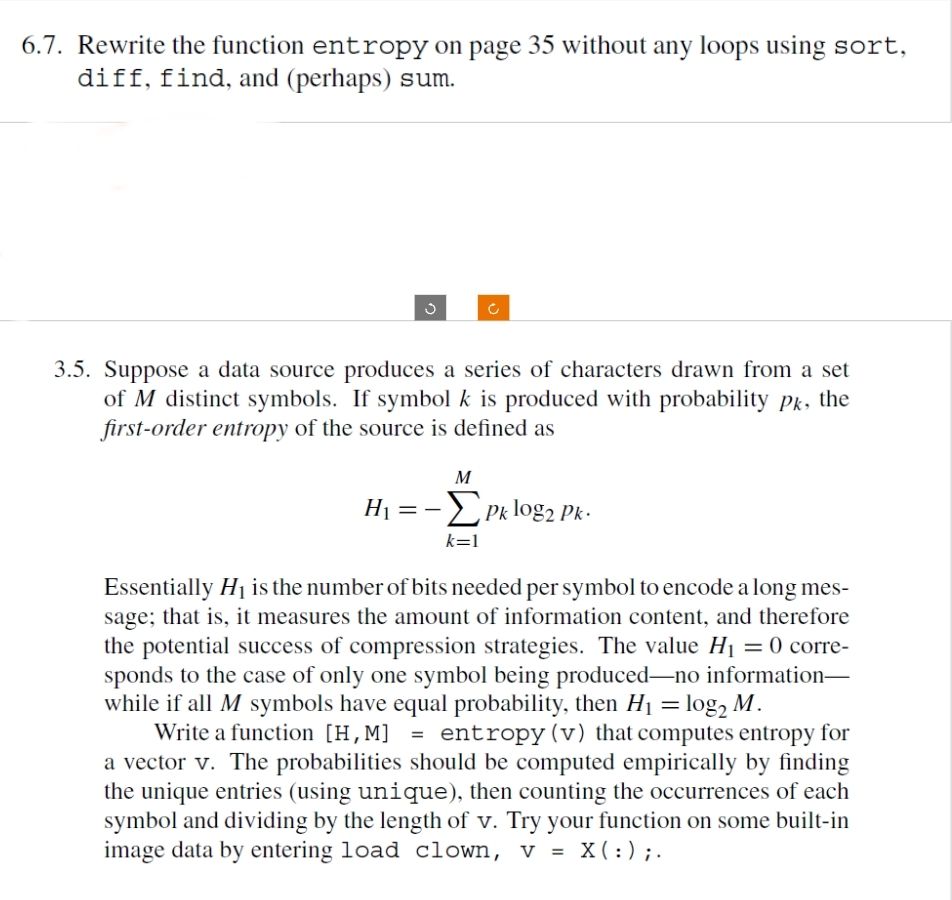 6.7. Rewrite the function entropy on page 35 without any loops using sort,
diff, find, and (perhaps) sum.
[|
3.5. Suppose a data source produces a series of characters drawn from a set
of M distinct symbols. If symbol k is produced with probability py. the
first-order entropy of the source is defined as
M
Hy= => nm logy pk.
k=1
Essentially Hj is the number of bits needed per symbol to encode a long mes-
sage: that is, it measures the amount of information content, and therefore
the potential success of compression strategies. The value Hy = 0 corre-
sponds to the case of only one symbol being produced—no information—
while if all M symbols have equal probability. then Hy = log, M.
Write a function [H,M] = entropy (v) that computes entropy for
a vector v. The probabilities should be computed empirically by finding
the unique entries (using unique), then counting the occurrences of each
symbol and dividing by the length of v. Try your function on some built-in
image data by entering load clown, v = X(:);.