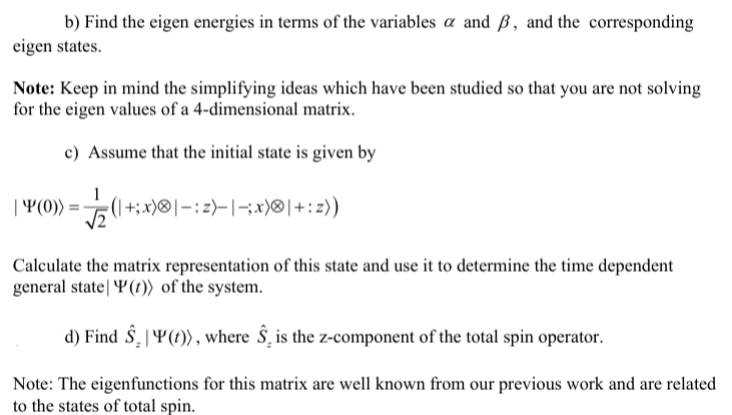
give answer in 2 step with explanation at the end of each step and final answer at the end:b) Find the eigen energies in terms of the variables @ and 2, and the corresponding
cigen states.
Note: Keep in mind the simplifying ideas which have been studied so that you are not solving
for the eigen values of a 4-dimensional matrix.
¢) Assume that the initial state is given by
1
W(0) = HB =12)= |= 0)®|+:2)
| W(0)) Ni (I+:0®[ =: 2) )
Calculate the matrix representation of this state and use it to determine the time dependent
general state W(¢)) of the system.
d) Find 8, |'¥(1)), where $, is the z-component of the total spin operator.
Note: The eigenfunctions for this matrix are well known from our previous work and are related
to the states of total spin.
Question:
give answer in 2 step with explanation at the end of each step and final answer at the end:b) Find the eigen energies in terms of the variables @ and 2, and the corresponding
cigen states.
Note: Keep in mind the simplifying ideas which have been studied so that you are not solving
for the eigen values of a 4-dimensional matrix.
¢) Assume that the initial state is given by
1
W(0) = HB =12)= |= 0)®|+:2)
| W(0)) Ni (I+:0®[ =: 2) )
Calculate the matrix representation of this state and use it to determine the time dependent
general state W(¢)) of the system.
d) Find 8, |'¥(1)), where $, is the z-component of the total spin operator.
Note: The eigenfunctions for this matrix are well known from our previous work and are related
to the states of total spin.
This is AI generated Response.
Asked by: Rahul
Created at: 2025-10-06 07:45:05
Final Answer:
RenderedRaw Text
Did you like this answer?
Let's tackle part **(b)** of the problem step by step:
## Step : Understanding the Hamiltonian Structure
Usually, such quantum spin problems, the Hamiltonian is of the form:
\[
\hat{H} = \alpha \hat{S}_{1z} \hat{S}_{2z} + \beta (\hat{S}_{1x} \hat{S}_{2x} + \hat{S}_{1y} \hat{S}_{2y})
\]
where \(\alpha\) and \(\beta\) are constants, and \(\hat{S}_{1}\) and \(\hat{S}_{2}\) are spin operators for two spin-\(\frac{1}{2}\) particles.
**Explanation:**
This Hamiltonian describes two coupled spins. The first term (\(\alpha\)) involves the z-components, while the second (\(\beta\)) couples the x and y components. The total spin states (singlet and triplet) are eigenstates of this Hamiltonian, letting us avoid diagonalizing a 4x4 matrix.
---
## Step 2: Finding the Eigenvalues (Eigen Energies)
The total spin can be either singlet (\(S=\)) or triplet (\(S=1\)):
- **Singlet state:** \(\left| S=, M= \right\rangle = \frac{1}{\sqrt{2}} (|+\rangle|-\rangle - |-\rangle|+\rangle)\)
- **Triplet states:**
- \(\left|1,1\right\rangle = |+\rangle|+\rangle\)
- \(\left|1,\right\rangle = \frac{1}{\sqrt{2}} (|+\rangle|-\rangle + |-\rangle|+\rangle)\)
- \(\left|1,-1\right\rangle = |-\rangle|-\rangle\)
The Hamiltonian can be rewritten in terms of total spin \(\vec{S} = \vec{S}_1 + \vec{S}_2\):
\[
\vec{S}_1 \cdot \vec{S}_2 = \frac{1}{2} (S_{\text{tot}}^2 - S_1^2 - S_2^2)
\]
For spin-\(\frac{1}{2}\):
- \(S_1^2 = S_2^2 = \frac{3}{4}\)
- \(S_{\text{tot}}^2 = S(S+1)\), with \(S=\) (singlet), \(S=1\) (triplet)
The eigenvalues are:
- For **triplet** (\(S=1\)): \(S_{\text{tot}}^2 = 2\)
- For **singlet** (\(S=\)): \(S_{\text{tot}}^2 = \)
Thus,
\[
\vec{S}_1 \cdot \vec{S}_2 = \begin{cases}
\frac{1}{2} (2 - \frac{3}{2}) = \frac{1}{4} & \text{(triplet)} \\
\frac{1}{2} ( - \frac{3}{2}) = -\frac{3}{4} & \text{(singlet)}
\end{cases}
\]
If the Hamiltonian is of the form \(H = \alpha S_{1z} S_{2z} + \beta (S_{1x} S_{2x} + S_{1y} S_{2y})\), then:
\[
H = \alpha S_{1z} S_{2z} + \beta \left[ \frac{1}{2}(S_1^+ S_2^- + S_1^- S_2^+) \right]
\]
But in terms of the singlet and triplet states, the eigenenergies are:
- **Triplet:** \(E_T = \frac{\alpha}{4} + \frac{\beta}{4}\)
- **Singlet:** \(E_S = -\frac{\alpha}{4} - \frac{3\beta}{4}\)
**Explanation:**
By using the symmetry of the problem and the known properties of spin-1/2 systems, we avoid diagonalizing the full matrix. The eigenstates are simply the singlet and triplet states, and the eigenenergies are functions of \(\alpha\) and \(\beta\).
---
## **Final Answer**
**Eigen energies in terms of \(\alpha\) and \(\beta\):**
- **Triplet states (\(S=1\)):** \(E_T = \frac{\alpha}{4} + \frac{\beta}{4}\)
- **Singlet state (\(S=\)):** \(E_S = -\frac{\alpha}{4} - \frac{3\beta}{4}\)
The corresponding eigenstates are, respectively, the triplet and singlet total spin states.
VIPSolutions focuses on clear, step‑by‑step explanations so you can learn quickly. Whether you need an AI‑generated walkthrough or a short hint to get unstuck, each solution is organized for fast reading and easy review later.
Search similar questions, compare approaches, and bookmark the best answers for revision. Our goal is simple: quick, reliable study help that feels natural—not noisy.
 VIPSolutions
 b) Find the eigen energies in terms of the variables @ and 2, and the corresponding
cigen states.
Note: Keep in mind the simplifying ideas which have been studied so that you are not solving
for the eigen values of a 4-dimensional matrix.
¢) Assume that the initial state is given by
1
W(0) = HB =12)= |= 0)®|+:2)
| W(0)) Ni (I+:0®[ =: 2) )
Calculate the matrix representation of this state and use it to determine the time dependent
general state W(¢)) of the system.
d) Find 8, |'¥(1)), where $, is the z-component of the total spin operator.
Note: The eigenfunctions for this matrix are well known from our previous work and are related
to the states of total spin.