 VIPSolutions
give answer in 2 step with explanation at the end of each step and final answer at the end:‘The Hamiltonian for two identical interacting spin % particles with mass m and charge e, in the presence of a magnetic field pointing in the z-direction B= BZ, is given by i -(2)ar CE JER) m n i (2) H+ ($0050 450 08 +5905) m where fis a constant with the appropriate units. As you can recognize it is a sum of the two Hamiltonians that we have studied
Question:
give answer in 2 step with explanation at the end of each step and final answer at the end: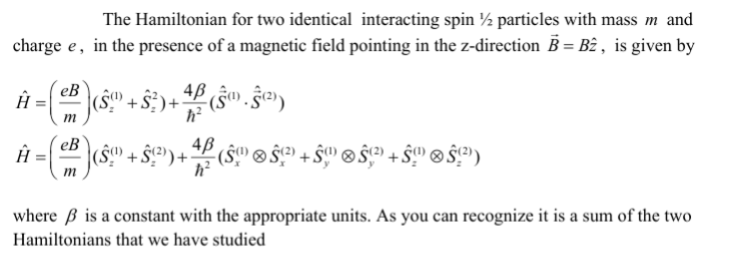 ‘The Hamiltonian for two identical interacting spin % particles with mass m and
charge e, in the presence of a magnetic field pointing in the z-direction B= BZ, is given by
i -(2)ar CE JER)
m n
i (2) H+ ($0050 450 08 +5905)
m
where fis a constant with the appropriate units. As you can recognize it is a sum of the two
Hamiltonians that we have studied
This is AI generated Response.
Asked by: Rahul
Created at: 2025-10-06 07:34:52
Asked by: Rahul
Created at: 2025-10-06 07:34:52
Final Answer:
Rendered
Raw Text
Did you like this answer?
## Step 1: Identify the Terms in the Hamiltonian
The Hamiltonian for two identical interacting spin-½ particles in a magnetic field is given by:
\[
\hat{H} = \left(\frac{eB}{m}\right) (\hat{S}_z^{(1)} + \hat{S}_z^{(2)}) + \frac{4\beta}{\hbar^2} (\hat{S}^{(1)} \cdot \hat{S}^{(2)})
\]
**Explanation:**
- The first term, \(\left(\frac{eB}{m}\right) (\hat{S}_z^{(1)} + \hat{S}_z^{(2)})\), represents the Zeeman effect, which is the energy of the spins in the external magnetic field along the z-axis.
- The second term, \(\frac{4\beta}{\hbar^2} (\hat{S}^{(1)} \cdot \hat{S}^{(2)})\), represents the interaction between the two spins.
---
## Step 2: Expand the Interaction Term
Expanding \(\hat{S}^{(1)} \cdot \hat{S}^{(2)}\) in terms of components, we get:
\[
\hat{S}^{(1)} \cdot \hat{S}^{(2)} = \hat{S}_x^{(1)} \otimes \hat{S}_x^{(2)} + \hat{S}_y^{(1)} \otimes \hat{S}_y^{(2)} + \hat{S}_z^{(1)} \otimes \hat{S}_z^{(2)}
\]
So the Hamiltonian becomes:
\[
\hat{H} = \left(\frac{eB}{m}\right) (\hat{S}_z^{(1)} + \hat{S}_z^{(2)}) + \frac{4\beta}{\hbar^2} \left[\hat{S}_x^{(1)} \otimes \hat{S}_x^{(2)} + \hat{S}_y^{(1)} \otimes \hat{S}_y^{(2)} + \hat{S}_z^{(1)} \otimes \hat{S}_z^{(2)}\right]
\]
**Explanation:**
- The interaction is written as a sum of tensor products of the spin operators for each particle in the x, y, and z directions.
---
## **Final Answer**
The Hamiltonian for two identical interacting spin-½ particles in a magnetic field is:
\[
\boxed{
\hat{H} = \left(\frac{eB}{m}\right) (\hat{S}_z^{(1)} + \hat{S}_z^{(2)}) + \frac{4\beta}{\hbar^2} \left[\hat{S}_x^{(1)} \otimes \hat{S}_x^{(2)} + \hat{S}_y^{(1)} \otimes \hat{S}_y^{(2)} + \hat{S}_z^{(1)} \otimes \hat{S}_z^{(2)}\right]
}
\]
This Hamiltonian includes both the Zeeman effect and the spin-spin interaction.
📢 Instructions:
- Ask anything relatd to above question only.
- For new Question goto :