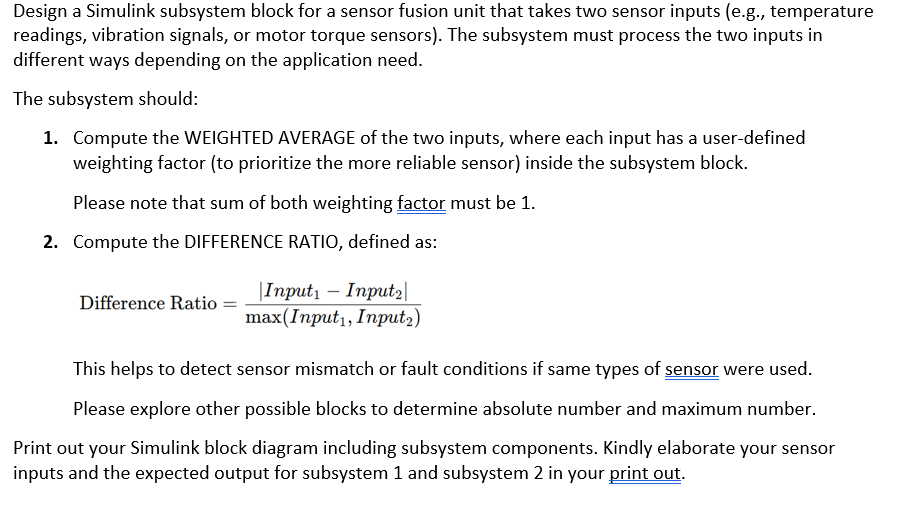
give answer in 2 step with explanation at the end of each step and final answer at the end:Design a Simulink subsystem block for a sensor fusion unit that takes two sensor inputs (e.g., temperature
readings, vibration signals, or motor torque sensors). The subsystem must process the two inputs in
different ways depending on the application need.
The subsystem should:
1. Compute the WEIGHTED AVERAGE of the two inputs, where each input has a user-defined
weighting factor (to prioritize the more reliable sensor) inside the subsystem block.
Please note that sum of both weighting factor must be 1.
2. Compute the DIFFERENCE RATIO, defined as:
I — I
Difference Ratio = |17Put1 — Inputal
max(Input,, Inputy)
This helps to detect sensor mismatch or fault conditions if same types of sensor were used.
Please explore other possible blocks to determine absolute number and maximum number.
Print out your Simulink block diagram including subsystem components. Kindly elaborate your sensor
inputs and the expected output for subsystem 1 and subsystem 2 in your print out.
Question:
give answer in 2 step with explanation at the end of each step and final answer at the end:Design a Simulink subsystem block for a sensor fusion unit that takes two sensor inputs (e.g., temperature
readings, vibration signals, or motor torque sensors). The subsystem must process the two inputs in
different ways depending on the application need.
The subsystem should:
1. Compute the WEIGHTED AVERAGE of the two inputs, where each input has a user-defined
weighting factor (to prioritize the more reliable sensor) inside the subsystem block.
Please note that sum of both weighting factor must be 1.
2. Compute the DIFFERENCE RATIO, defined as:
I — I
Difference Ratio = |17Put1 — Inputal
max(Input,, Inputy)
This helps to detect sensor mismatch or fault conditions if same types of sensor were used.
Please explore other possible blocks to determine absolute number and maximum number.
Print out your Simulink block diagram including subsystem components. Kindly elaborate your sensor
inputs and the expected output for subsystem 1 and subsystem 2 in your print out.
This is AI generated Response.
Asked by: Rahul
Created at: 2025-09-29 07:37:55
Final Answer:
RenderedRaw Text
Did you like this answer?
## Step 1: Weighted Average Calculation
**Task:**
Compute the weighted average of two sensor inputs (\(Input_1\) and \(Input_2\)) using user-defined weighting factors (\(w_1\) and \(w_2\)), where \(w_1 + w_2 = 1\).
**Formula:**
\[
\text{Weighted Average} = w_1 \cdot Input_1 + w_2 \cdot Input_2
\]
**Explanation:**
This formula lets you give more importance to the more reliable sensor by assigning it a higher weight. For example, if \(w_1 = .7\) and \(w_2 = .3\), \(Input_1\) is considered more reliable.
---
## Step 2: Difference Ratio Calculation
**Task:**
Calculate the difference ratio to detect mismatches or faults.
**Formula:**
\[
\text{Difference Ratio} = \frac{|Input_1 - Input_2|}{\max(Input_1, Input_2)}
\]
**Explanation:**
This ratio shows how different the two sensor readings are, normalized by the larger value. A high ratio indicates a possible sensor fault or mismatch.
---
## Final Answer: Simulink Subsystem Block Design
- **Inputs:**
- Sensor 1 (\(Input_1\))
- Sensor 2 (\(Input_2\))
- **User-defined parameters:**
- Weight 1 (\(w_1\)), Weight 2 (\(w_2\)), where \(w_1 + w_2 = 1\)
- **Subsystem Outputs:**
- **Subsystem 1:** Weighted Average
- **Subsystem 2:** Difference Ratio
### **Simulink Block Diagram Components:**
1. **Weighted Sum Block:** Multiplies each input by its respective weight and sums them.
2. **Abs Block:** Calculates the absolute difference between the inputs.
3. **Max Block:** Finds the maximum of the two inputs.
4. **Divide Block:** Divides the absolute difference by the maximum value.
### **Expected Output Example:**
- If \(Input_1 = 10\), \(Input_2 = 8\), \(w_1 = .6\), \(w_2 = .4\):
- **Weighted Average:** \(.6 \times 10 + .4 \times 8 = 6 + 3.2 = 9.2\)
- **Difference Ratio:** \(\frac{|10-8|}{\max(10,8)} = \frac{2}{10} = .2\)
---
**Summary:**
You now have a subsystem that computes both a weighted average (for reliable fusion) and a difference ratio (for fault detection) from two sensor inputs, ready for Simulink implementation.
VIPSolutions focuses on clear, step‑by‑step explanations so you can learn quickly. Whether you need an AI‑generated walkthrough or a short hint to get unstuck, each solution is organized for fast reading and easy review later.
Search similar questions, compare approaches, and bookmark the best answers for revision. Our goal is simple: quick, reliable study help that feels natural—not noisy.
 VIPSolutions
 Design a Simulink subsystem block for a sensor fusion unit that takes two sensor inputs (e.g., temperature
readings, vibration signals, or motor torque sensors). The subsystem must process the two inputs in
different ways depending on the application need.
The subsystem should:
1. Compute the WEIGHTED AVERAGE of the two inputs, where each input has a user-defined
weighting factor (to prioritize the more reliable sensor) inside the subsystem block.
Please note that sum of both weighting factor must be 1.
2. Compute the DIFFERENCE RATIO, defined as:
I — I
Difference Ratio = |17Put1 — Inputal
max(Input,, Inputy)
This helps to detect sensor mismatch or fault conditions if same types of sensor were used.
Please explore other possible blocks to determine absolute number and maximum number.
Print out your Simulink block diagram including subsystem components. Kindly elaborate your sensor
inputs and the expected output for subsystem 1 and subsystem 2 in your print out.