 VIPSolutions
give answer in 2 step with explanation at the end of each step and final answer at the end:2 na cota rtf nt, aang cor (R) comply cman od cor) Large spots are co- dominant with smail dots. Dense texture (T) is completely comer es re 8 N . 5) weston > (7) ortoaons Inn til cos, rane dot, dors lr ptr oso wih Orage, on an In) non, hrs rg rf lr sr: rs ot a0 ote kos spas core rr Keres lr ron some, parr io of er, Gots sot oy Hrovr re how sors shot sin 2 goorin Wns proponent ange, op spt, an re? 5 Oto 509 rg: po ry wt ot spt
Question:
give answer in 2 step with explanation at the end of each step and final answer at the end: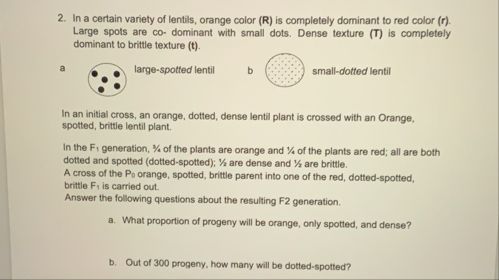 2 na cota rtf nt, aang cor (R) comply cman od cor)
Large spots are co- dominant with smail dots. Dense texture (T) is completely
comer es re 8
N
. 5) weston > (7) ortoaons
Inn til cos, rane dot, dors lr ptr oso wih Orage,
on an
In) non, hrs rg rf lr sr: rs
ot a0 ote kos spas core rr
Keres lr ron some, parr io of er, Gots sot
oy
Hrovr re how sors shot sin 2 goorin
Wns proponent ange, op spt, an re?
5 Oto 509 rg: po ry wt ot spt
This is AI generated Response.
Asked by: Pagal
Created at: 2025-09-15 09:22:20
Asked by: Pagal
Created at: 2025-09-15 09:22:20
Final Answer:
Rendered
Raw Text
Did you like this answer?
Let's solve each part step by step, with explanations after each step.
---
## **Step 1: Determine the Genotypes and F1 Cross**
### **Genetic Information**
- **Color:** Orange (R) is dominant to red (r).
- **Spot Size:** Large spots (L) are co-dominant with small spots (l), so **dotted (Ll)** and **spotted (LL or ll)**.
- **Texture:** Dense (T) is dominant to brittle (t).
### **Parental Cross**
- **Parent 1:** Orange, dotted, dense (must be **Rr Ll Tt**)
- **Parent 2:** Orange, spotted, brittle (must be **Rr LL tt** or **Rr ll tt**)
Let’s assume **Parent 2** is **Rr ll tt** for small-dotted lentil (as per image b).
#### **F1 Generation**
- Cross: **Rr Ll Tt** × **Rr ll tt**
### **F1 Gametes and Ratios**
- Color: \( Rr \times Rr \rightarrow \frac{3}{4} \) Orange, \( \frac{1}{4} \) Red.
- Spots: \( Ll \times ll \rightarrow \frac{1}{2} \) Ll (dotted), \( \frac{1}{2} \) ll (spotted).
- Texture: \( Tt \times tt \rightarrow \frac{1}{2} \) Tt (dense), \( \frac{1}{2} \) tt (brittle).
**Explanation:**
We determined the genotypes for each trait and their resulting proportions in the F1 generation, using basic Mendelian genetics.
---
## **Step 2: F2 Generation and Answering the Questions**
### **F2 Cross**
- The F1 plants are selfed or intercrossed. Let's use their genotypes for F2 proportions:
#### **a. What proportion of progeny will be orange, only spotted, and dense?**
- **Orange**: \( \frac{3}{4} \) (from Rr × Rr)
- **Only spotted:** "Only spotted" means **ll** (since Ll is "dotted," and LL or ll is "spotted").
- From Ll × ll: \( \frac{1}{2} \) Ll (dotted), \( \frac{1}{2} \) ll (spotted)
- **Dense:** \( \frac{1}{2} \) (Tt × tt → \( \frac{1}{2} \) Tt (dense), \( \frac{1}{2} \) tt (brittle))
**Multiply the probabilities:**
- \( \frac{3}{4} \) (orange) × \( \frac{1}{2} \) (spotted) × \( \frac{1}{2} \) (dense)
- \( = \frac{3}{16} \)
**Explanation:**
We multiplied the individual probabilities for each trait to find the overall proportion for plants that are orange, only spotted, and dense.
---
#### **b. Out of 300 progeny, how many will be dotted-spotted?**
- **Dotted-spotted**: This refers to heterozygotes (Ll) for spot size.
- From Ll × ll: \( \frac{1}{2} \) will be Ll (dotted), \( \frac{1}{2} \) will be ll (spotted)
So, **dotted (Ll): \( \frac{1}{2} \) of total progeny**.
- \( 300 \times \frac{1}{2} = 150 \)
**Explanation:**
Since half of the F2 progeny will be dotted (Ll), we multiply the total number by \( \frac{1}{2} \) to get the number.
---
## **Final Answers**
### **a. Proportion of progeny that will be orange, only spotted, and dense:**
**\(\boxed{\frac{3}{16}}\)**
### **b. Out of 300 progeny, how many will be dotted-spotted?**
**\(\boxed{150}\)**
📢 Instructions:
- Ask anything relatd to above question only.
- For new Question goto :