 VIPSolutions
give answer in 2 step with explanation at the end of each step and final answer at the end:9. Consider the following transformation az+b w=—-— A=ad—b | a a c #0 (a) Show that the map can be inverted to find a unique (single-valued) z as a function of w everywhere.
Question:
give answer in 2 step with explanation at the end of each step and final answer at the end: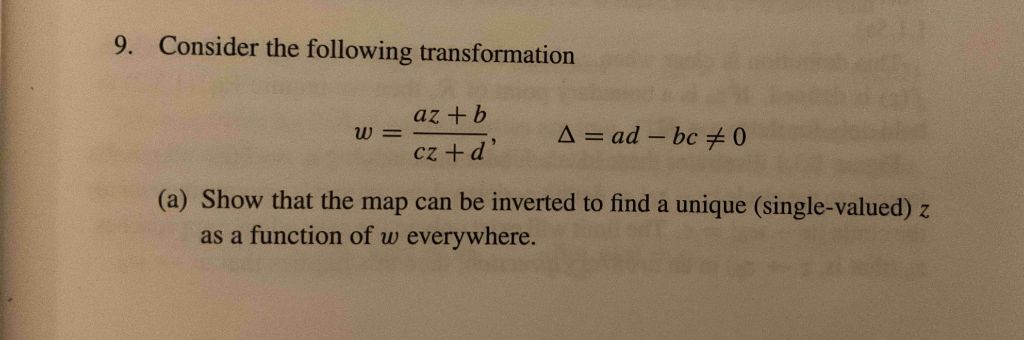 9. Consider the following transformation
az+b
w=—-— A=ad—b
| a a c #0
(a) Show that the map can be inverted to find a unique (single-valued) z
as a function of w everywhere.
This is AI generated Response.
Asked by: Pagal
Created at: 2025-09-10 12:02:10
Asked by: Pagal
Created at: 2025-09-10 12:02:10
Final Answer:
Rendered
Raw Text
Did you like this answer?
## Problem Restatement
Given the transformation:
\[
w = \frac{az + b}{cz + d}, \quad \Delta = ad - bc \neq 0
\]
Show that this map can be inverted to find a unique (single-valued) \( z \) as a function of \( w \) everywhere.
---
## **Step 1: Solve for \( z \) in terms of \( w \)**
Start from the given transformation:
\[
w = \frac{az + b}{cz + d}
\]
Multiply both sides by \( cz + d \) to clear the denominator:
\[
w(cz + d) = az + b
\]
\[
wcz + wd = az + b
\]
Bring all terms involving \( z \) to one side:
\[
wcz - az = b - wd
\]
\[
z(wc - a) = b - wd
\]
\[
z = \frac{b - wd}{wc - a}
\]
**Explanation:**
By algebraic manipulation, we have isolated \( z \) in terms of \( w \) (as long as \( wc - a \neq 0 \)). This gives us an explicit formula for \( z \) as a function of \( w \).
---
## **Step 2: Check for Uniqueness and Single-Valuedness**
The denominator, \( wc - a \), can be zero for some specific value of \( w \), but since the determinant \( \Delta = ad - bc \neq 0 \), the transformation is **one-to-one (invertible) everywhere except possibly at the point where \( wc - a = 0 \)**.
Solve \( wc - a = 0 \) for \( w \):
\[
wc - a = 0 \implies w = \frac{a}{c}
\]
At this value, the original transformation maps \( z = \infty \) to \( w = \frac{a}{c} \), which is consistent with the Möbius transformation's behavior at infinity. Everywhere else, the transformation is invertible.
**Explanation:**
Except at \( w = \frac{a}{c} \), where the formula breaks down (corresponding to \( z = \infty \)), the expression for \( z \) in terms of \( w \) is well-defined and single-valued. The nonzero determinant ensures the transformation is invertible everywhere else.
---
## **Final Answer**
**Yes, the map can be inverted to find a unique (single-valued) \( z \) as a function of \( w \) everywhere, except possibly at the point corresponding to \( z = \infty \) (i.e., \( w = \frac{a}{c} \)).**
The inverse is:
\[
z = \frac{b - wd}{wc - a}
\]
📢 Instructions:
- Ask anything relatd to above question only.
- For new Question goto :