 VIPSolutions
give answer in 2 step with explanation at the end of each step and final answer at the end:Bp cht or ET es Managers at Wagner Fabricating Company are reviewing the economic feasibility of manufacturing a part i 5 that the company currently purchases from a supplier. Forecasted annual demand for the part is 3200 units, ‘Wagner operates 250 days per year. ‘Wagner's financial analysts established a cost of capital of 14% for the use of funds for investments within the company. In addition, over the past year $600,000 was the average investment in the company's inventory. Accounting information shows that a total of $24,000 was spent on taxes and insurance related to the company’s inventory. In addition, an estimated $9000 was lost due to inventory shrinkage, which included damaged goods as well as pilferage. A remaining $15,000 was spent on warehouse overhead, including utility expenses for heating and lighting. An analysis of the purchasing operation shows that approximately two hours are required to process and coordinate an order for the part regardless of the quantity ordered. Purchasing salaries average $28 per hour, including employee benefits. In addition, a detailed analysis of 125 orders showed that $2375 was spent on telephone, paper, and postage directly related to the Rdering process. A one-week lead time is required to obtain the part from the supplier. An analysis of demand during the lead time shows it is approximately normally distributed with a mean of 64 units and a standard deviation of 10 units. Service-level guidelines indicate that one stock-out per year is acceptable. Currently, the company has a contract to purchase the part from a supplier at a cost of $18 per unit. However, over the past few months, the company’s production capacity has been expanded. As a result, excess capacity is now available in certain production departments, and the company is considering the alternative of producing the parts itself.
Question:
give answer in 2 step with explanation at the end of each step and final answer at the end: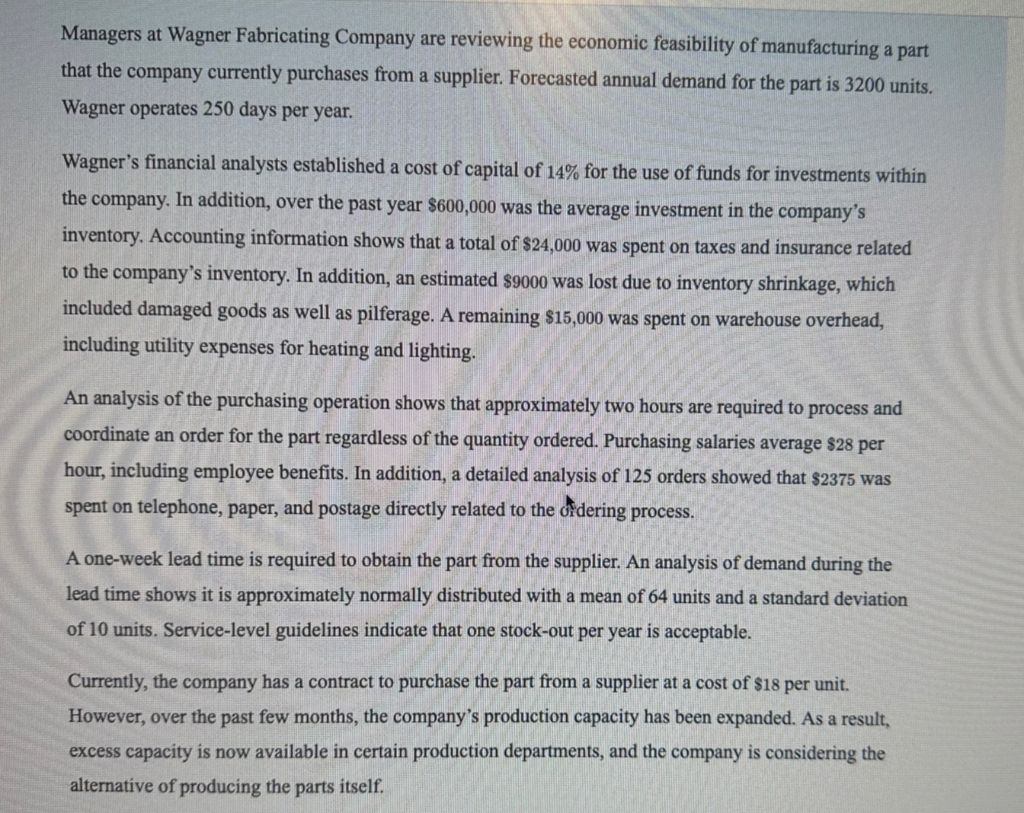 Bp cht or ET
es Managers at Wagner Fabricating Company are reviewing the economic feasibility of manufacturing a part i 5
that the company currently purchases from a supplier. Forecasted annual demand for the part is 3200 units,
‘Wagner operates 250 days per year.
‘Wagner's financial analysts established a cost of capital of 14% for the use of funds for investments within
the company. In addition, over the past year $600,000 was the average investment in the company's
inventory. Accounting information shows that a total of $24,000 was spent on taxes and insurance related
to the company’s inventory. In addition, an estimated $9000 was lost due to inventory shrinkage, which
included damaged goods as well as pilferage. A remaining $15,000 was spent on warehouse overhead,
including utility expenses for heating and lighting.
An analysis of the purchasing operation shows that approximately two hours are required to process and
coordinate an order for the part regardless of the quantity ordered. Purchasing salaries average $28 per
hour, including employee benefits. In addition, a detailed analysis of 125 orders showed that $2375 was
spent on telephone, paper, and postage directly related to the Rdering process.
A one-week lead time is required to obtain the part from the supplier. An analysis of demand during the
lead time shows it is approximately normally distributed with a mean of 64 units and a standard deviation
of 10 units. Service-level guidelines indicate that one stock-out per year is acceptable.
Currently, the company has a contract to purchase the part from a supplier at a cost of $18 per unit.
However, over the past few months, the company’s production capacity has been expanded. As a result,
excess capacity is now available in certain production departments, and the company is considering the
alternative of producing the parts itself.
Asked by: Pagal
Created at: 2025-09-10 07:00:06
Final Answer:
📢 Instructions:
- Ask anything relatd to above question only.
- For new Question goto :