 VIPSolutions
give answer in 2 step with explanation at the end of each step and final answer at the end:#1. Suppose that a
Question:
give answer in 2 step with explanation at the end of each step and final answer at the end: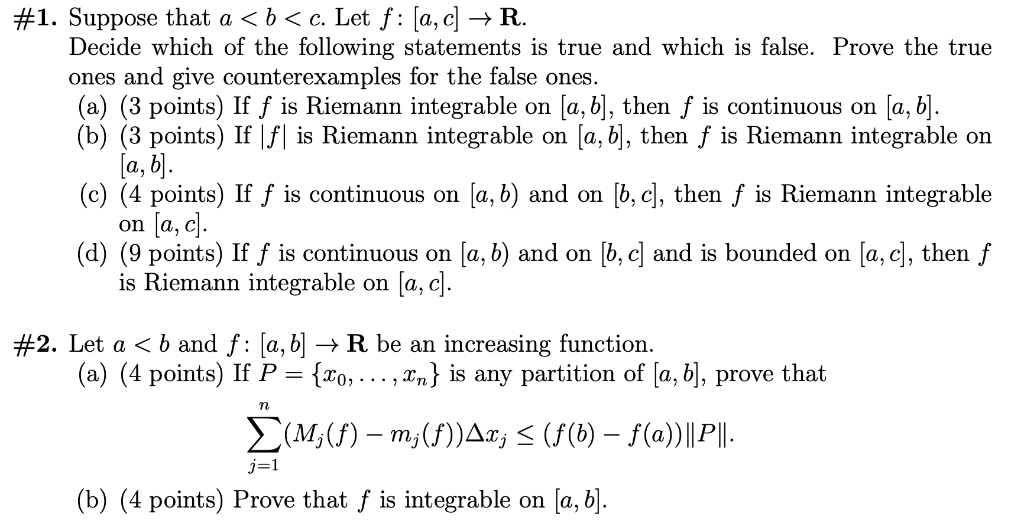 #1. Suppose that a
This is AI generated Response.
Asked by: Pagal
Created at: 2025-09-08 04:01:02
Asked by: Pagal
Created at: 2025-09-08 04:01:02
Final Answer:
Rendered
Raw Text
Did you like this answer?
Let's tackle each part step-by-step, with explanations after each step.
---
### **#1**
#### **(a) If \( f \) is Riemann integrable on \([a,b]\), then \( f \) is continuous on \([a,b]\).**
#### **Step 1:**
Recall that a function can be Riemann integrable even if it is not continuous everywhere, as long as the set of discontinuities has measure zero (is a null set).
**Explanation:**
A classic counterexample is the characteristic function of the rationals, which is not Riemann integrable, **but** a function with a jump discontinuity at a single point (e.g., \( f(x) = 1 \) for \( x \neq c \), \( f(c) = 0 \)) is Riemann integrable.
#### **Step 2:**
Therefore, the statement is **false**. A Riemann integrable function need not be continuous everywhere on \([a,b]\).
**Final Answer:**
**False.** Counterexample: The function \( f(x) = \begin{cases} 1 & x \neq c \\ 0 & x = c \end{cases} \) on \([a,b]\) is Riemann integrable, but not continuous at \( x = c \).
---
#### **(b) If \( |f| \) is Riemann integrable on \([a,b]\), then \( f \) is Riemann integrable on \([a,b]\).**
#### **Step 1:**
Consider the definition of Riemann integrability: a function is Riemann integrable if it is bounded and its set of discontinuities has measure zero. If \( |f| \) is Riemann integrable, \( f \) must be bounded, but \( f \) could still fail to be Riemann integrable if its discontinuities are too large.
**Explanation:**
Counterexample: Let \( f(x) = 1 \) if \( x \) is rational, \( f(x) = -1 \) if \( x \) is irrational. Then \( |f(x)| = 1 \), which is Riemann integrable, but \( f \) is not since the set of discontinuities is not measure zero.
#### **Step 2:**
So, the statement is **false**.
**Final Answer:**
**False.** Counterexample: The Dirichlet function as above.
---
#### **(c) If \( f \) is continuous on \([a,b]\) and on \([b,c]\), then \( f \) is Riemann integrable on \([a,c]\).**
#### **Step 1:**
Continuity implies Riemann integrability on each interval, but at \( b \), \( f \) may have a jump (discontinuity only at a single point).
**Explanation:**
A function with a single jump discontinuity at \( b \) (e.g., different left and right limits at \( b \)) is still Riemann integrable on \([a, c]\) because the set of discontinuities is a single point.
#### **Step 2:**
Thus, the statement is **true**.
**Final Answer:**
**True.** At worst, \( f \) is discontinuous at a single point \( b \), which does not prevent Riemann integrability.
---
#### **(d) If \( f \) is continuous on \([a,b]\) and on \([b,c]\) and is bounded on \([a,c]\), then \( f \) is Riemann integrable on \([a,c]\).**
#### **Step 1:**
Even if \( f \) is not continuous at \( b \), it's only one point of discontinuity. Boundedness ensures it doesn't blow up at any point.
**Explanation:**
A function which is continuous except at a single point, and bounded, is Riemann integrable (since the set of discontinuities is measure zero).
#### **Step 2:**
So, the statement is **true**.
**Final Answer:**
**True.** The function can have at most one discontinuity, which does not preclude Riemann integrability.
---
### **#2**
#### **(a) If \( P = \{x_0, \ldots, x_n\} \) is any partition of \([a,b]\), prove that**
\[
\sum_{j=1}^n (M_j(f) - m_j(f)) \Delta x_j \leq (f(b) - f(a))\|P\|,
\]
where \( M_j(f) \) and \( m_j(f) \) are the sup and inf of \( f \) on \([x_{j-1}, x_j]\), and \( \|P\| \) is the mesh size.
#### **Step 1:**
Since \( f \) is increasing, on each subinterval \([x_{j-1}, x_j]\), \( m_j(f) = f(x_{j-1}) \) and \( M_j(f) = f(x_j) \). So,
\[
M_j(f) - m_j(f) = f(x_j) - f(x_{j-1}).
\]
**Explanation:**
This follows from the monotonicity of \( f \).
#### **Step 2:**
So,
\[
\sum_{j=1}^n (f(x_j) - f(x_{j-1})) \Delta x_j \leq \sum_{j=1}^n (f(x_j) - f(x_{j-1})) \|P\| = (f(b) - f(a)) \|P\|,
\]
because \( \Delta x_j \leq \|P\| \) for all \( j \).
**Final Answer:**
\[
\boxed{
\sum_{j=1}^n (M_j(f) - m_j(f)) \Delta x_j \leq (f(b) - f(a)) \|P\|
}
\]
---
#### **(b) Prove that \( f \) is integrable on \([a,b]\).**
#### **Step 1:**
From part (a), we see that as \( \|P\| \to 0 \), the difference between upper and lower Riemann sums goes to zero.
**Explanation:**
This is the criterion for Riemann integrability: for every \( \epsilon > 0 \), there exists a partition \( P \) such that the difference between the upper and lower sums is less than \( \epsilon \).
#### **Step 2:**
Therefore, every increasing function on a closed interval is Riemann integrable.
**Final Answer:**
\[
\boxed{
\text{An increasing function on } [a, b] \text{ is Riemann integrable.}
}
\]
Question:
All parts final answer
This is AI generated Response.
Asked by: Pagal
Created at: 2025-09-08 04:16:53
Asked by: Pagal
Created at: 2025-09-08 04:16:53
Final Answer:
Rendered
Raw Text
Did you like this answer?
Let's analyze each part carefully, providing a step-by-step explanation.
---
## **#1**
### **(a) If \(f\) is Riemann integrable on \([a,b]\), then \(f\) is continuous on \([a,b]\).**
**Step 1:**
Recall the definition: Riemann integrability allows functions to have discontinuities, but only on a set of measure zero. Continuity everywhere is **not** necessary for Riemann integrability.
**Explanation:**
Counterexample: The characteristic function of rationals in \([a,b]\) (Dirichlet function) is not Riemann integrable. But consider a function with a single jump discontinuity, e.g.,
\[
f(x) = \begin{cases}
1 & x \neq c \\
0 & x = c
\end{cases}
\]
which is discontinuous only at \( c \), a single point. Such a function is Riemann integrable, but **not** continuous at \( c \).
**Conclusion:**
The statement is **false**.
**Final answer:** **False**
---
### **(b) If \(|f|\) is Riemann integrable on \([a,b]\), then \(f\) is Riemann integrable on \([a,b]\).**
**Step 1:**
Riemann integrability depends on the set of discontinuities and boundedness. While \(|f|\) being Riemann integrable implies \(f\) is bounded, it does **not** guarantee \(f\) is Riemann integrable.
**Explanation:**
Counterexample: Take the Dirichlet function \(f(x) = \begin{cases} 1 & \text{if } x \in \mathbb{Q} \\ -1 & \text{if } x \notin \mathbb{Q} \end{cases}\).
\(|f|\) is constantly 1, which is Riemann integrable, but \(f\) itself is not, because it is discontinuous everywhere.
**Conclusion:**
The statement is **false**.
**Final answer:** **False**
---
### **(c) If \(f\) is continuous on \([a,b)\) and on \([b,c]\), then \(f\) is Riemann integrable on \([a,c]\).**
**Step 1:**
Since \(f\) is continuous on \([a,b)\) and \([b,c]\), it may have a discontinuity at \(b\). But a single point of discontinuity does **not** prevent Riemann integrability.
**Explanation:**
A function with finitely many discontinuities (or just one point) on a closed interval is Riemann integrable.
**Conclusion:**
The statement is **true**.
**Final answer:** **True**
---
### **(d) If \(f\) is continuous on \([a,b)\) and on \([b,c]\), and bounded on \([a,c]\), then \(f\) is Riemann integrable on \([a,c]\).**
**Step 1:**
Since \(f\) is continuous everywhere except possibly at \(b\), and bounded, the only potential discontinuity is at the single point \(b\).
**Explanation:**
A function with at most finitely many discontinuities (here, one at \(b\)) on a closed interval is Riemann integrable.
**Conclusion:**
The statement is **true**.
**Final answer:** **True**
---
## **#2**
### **(a) For an increasing function \(f\), prove that**
\[
\sum_{j=1}^n (M_j(f) - m_j(f)) \Delta x_j \leq (f(b) - f(a)) \|P\|
\]
where \(M_j(f) = \sup_{x \in [x_{j-1}, x_j]} f(x)\), \(m_j(f) = \inf_{x \in [x_{j-1}, x_j]} f(x)\), and \(\|P\| = \max_j \Delta x_j\).
---
**Step 1:**
Since \(f\) is increasing, on each subinterval \([x_{j-1}, x_j]\),
\[
M_j(f) = f(x_j), \quad m_j(f) = f(x_{j-1}).
\]
Thus,
\[
M_j(f) - m_j(f) = f(x_j) - f(x_{j-1}).
\]
**Explanation:**
This follows directly from the monotonicity: the supremum is achieved at the right endpoint, the infimum at the left.
---
**Step 2:**
Now, sum over \(j\):
\[
\sum_{j=1}^n (f(x_j) - f(x_{j-1})) \Delta x_j.
\]
Note that
\[
f(x_j) - f(x_{j-1}) \leq f(b) - f(a),
\]
and
\[
\Delta x_j \leq \|P\| \quad \text{for all } j.
\]
Hence,
\[
\sum_{j=1}^n (f(x_j) - f(x_{j-1})) \Delta x_j \leq (f(b) - f(a)) \|P\|.
\]
**Final answer:**
\[
\boxed{
\sum_{j=1}^n (M_j(f) - m_j(f)) \Delta x_j \leq (f(b) - f(a)) \|P\|
}
\]
---
### **(b) Show that \(f\) is Riemann integrable on \([a, b]\).**
**Step 1:**
From part (a), as the mesh \(\|P\|\) becomes finer (\(\to 0\)), the difference between the upper sum (based on \(M_j(f)\)) and the lower sum (based on \(m_j(f)\)) goes to zero because:
\[
\sup_P \left( \text{Upper Sum} - \text{Lower Sum} \right) \leq (f(b) - f(a)) \|P\| \to 0 \text{ as } \|P\| \to 0.
\]
**Explanation:**
Since the difference between upper and lower sums can be made arbitrarily small, this implies \(f\) is Riemann integrable.
**Conclusion:**
Every increasing function on a closed interval is Riemann integrable.
**Final answer:**
\[
\boxed{
\text{An increasing function on } [a, b] \text{ is Riemann integrable}.
}
\]
---
## **Summary of final answers:**
- **(a):** False
- **(b):** False
- **(c):** True
- **(d):** True
- **(a) in #2:** The sum inequality holds for increasing \(f\).
- **(b) in #2:** Increasing functions are Riemann integrable.
Let me know if you'd like further clarification!
📢 Instructions:
- Ask anything relatd to above question only.
- For new Question goto :