 VIPSolutions
give answer in 2 step with explanation at the end of each step and final answer at the end:| Pad te fener Genes for pod WE . SE SDP 1 |B —— BE N.Y {= = pend ES edo Hook A 4 VL = a — So——
Question:
give answer in 2 step with explanation at the end of each step and final answer at the end: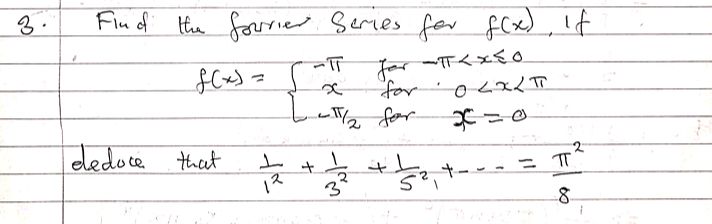 | Pad te fener Genes for pod WE
. SE SDP 1 |B ——
BE N.Y {= = pend
ES
edo Hook A 4 VL =
a — So——
This is AI generated Response.
Asked by: Pagal
Created at: 2025-09-08 01:04:11
Asked by: Pagal
Created at: 2025-09-08 01:04:11
Final Answer:
Rendered
Raw Text
Did you like this answer?
Let's solve the problem step by step:
### **Step 1: Find the Fourier Series for \( f(x) \)**
Given:
\[
f(x) =
\begin{cases}
-x & \text{for } -\pi < x < 0 \\
x & \text{for } 0 < x < \pi \\
0 & \text{for } x = 0
\end{cases}
\]
Notice **\( f(x) \) is an odd function** because \( f(-x) = -f(x) \), so the Fourier series will only have sine terms:
\[
f(x) = \sum_{n=1}^{\infty} b_n \sin(nx)
\]
where
\[
b_n = \frac{2}{\pi} \int_0^\pi f(x) \sin(nx) dx
\]
For \( 0 < x < \pi \), \( f(x) = x \):
\[
b_n = \frac{2}{\pi} \int_0^\pi x \sin(nx) dx
\]
Use integration by parts (\( u = x, dv = \sin(nx)dx \)):
\[
u = x, \quad dv = \sin(nx)dx \implies du = dx, \quad v = -\frac{1}{n}\cos(nx)
\]
\[
\int x \sin(nx) dx = -\frac{x}{n}\cos(nx) + \frac{1}{n}\int \cos(nx) dx = -\frac{x}{n}\cos(nx) + \frac{1}{n^2}\sin(nx)
\]
Evaluating from \( 0 \) to \( \pi \):
\[
\int_0^\pi x \sin(nx) dx = \left[ -\frac{x}{n}\cos(nx) + \frac{1}{n^2}\sin(nx) \right]_0^\pi
\]
\[
= -\frac{\pi}{n}\cos(n\pi) + 0 - (0 + 0) = -\frac{\pi}{n}(-1)^n
\]
So,
\[
b_n = \frac{2}{\pi} \times \left( -\frac{\pi}{n}(-1)^n \right) = -\frac{2}{n}(-1)^n = \frac{2}{n}(-1)^{n+1}
\]
**Fourier Series:**
\[
f(x) = \sum_{n=1}^{\infty} \frac{2}{n}(-1)^{n+1} \sin(nx)
\]
---
#### **Explanation:**
We calculated the Fourier sine coefficients for the given odd function and wrote its Fourier series.
---
### **Step 2: Deduce the Series \(\frac{1}{1^2} + \frac{1}{3^2} + \frac{1}{5^2} + \cdots = \frac{\pi^2}{8}\)**
Set \( x = \frac{\pi}{2} \) in the Fourier series:
\[
f\left(\frac{\pi}{2}\right) = \frac{\pi}{2}
\]
\[
\frac{\pi}{2} = \sum_{n=1}^{\infty} \frac{2}{n}(-1)^{n+1} \sin\left(n \frac{\pi}{2}\right)
\]
Now, \(\sin\left(n \frac{\pi}{2}\right)\) cycles as \(1, 0, -1, 0, 1, \ldots\) for \(n = 1, 2, 3, 4, 5, \ldots\). Only odd terms are nonzero:
For \( n = 1, 3, 5, \ldots \):
\[
\sin\left(n \frac{\pi}{2}\right) = (-1)^{(n-1)/2}
\]
So,
\[
\frac{\pi}{2} = \sum_{k=0}^{\infty} \frac{2}{2k+1} (-1)^{2k+2} (-1)^k
\]
But \( (-1)^{2k+2} = 1 \), so:
\[
\frac{\pi}{2} = 2\sum_{k=0}^{\infty} \frac{(-1)^k}{2k+1}
\]
This is a known result (Leibniz series for \(\pi\)), but to relate to the sum of reciprocals of odd squares, we use Parseval's identity:
Parseval's Identity:
\[
\frac{1}{\pi} \int_{-\pi}^{\pi} [f(x)]^2 dx = \sum_{n=1}^{\infty} b_n^2
\]
Calculate LHS:
\[
f(x) = |x| \implies [f(x)]^2 = x^2
\]
\[
\frac{1}{\pi} \int_{-\pi}^{\pi} x^2 dx = \frac{2}{\pi} \int_0^{\pi} x^2 dx = \frac{2}{\pi} \left[ \frac{x^3}{3} \right]_0^\pi = \frac{2}{\pi} \cdot \frac{\pi^3}{3} = \frac{2\pi^2}{3}
\]
RHS:
\[
b_n = \frac{2}{n}(-1)^{n+1}
\]
\[
b_n^2 = \frac{4}{n^2}
\]
So,
\[
\sum_{n=1}^{\infty} b_n^2 = 4 \sum_{n=1}^{\infty} \frac{1}{n^2}
\]
Equate both sides:
\[
\frac{2\pi^2}{3} = 4 \sum_{n=1}^{\infty} \frac{1}{n^2}
\]
\[
\sum_{n=1}^{\infty} \frac{1}{n^2} = \frac{\pi^2}{6}
\]
But we want only the **sum over odd n**:
\[
\sum_{k=0}^{\infty} \frac{1}{(2k+1)^2}
\]
It's known that:
\[
\sum_{n=1}^{\infty} \frac{1}{n^2} = \sum_{k=0}^{\infty} \frac{1}{(2k+1)^2} + \sum_{k=1}^{\infty} \frac{1}{(2k)^2}
\]
\[
= \sum_{k=0}^{\infty} \frac{1}{(2k+1)^2} + \frac{1}{4}\sum_{k=1}^{\infty} \frac{1}{k^2}
\]
\[
= S + \frac{1}{4} \cdot \frac{\pi^2}{6}
\]
So,
\[
\frac{\pi^2}{6} = S + \frac{\pi^2}{24}
\implies S = \frac{\pi^2}{6} - \frac{\pi^2}{24} = \frac{\pi^2}{8}
\]
---
#### **Explanation:**
By using Parseval's identity and separating the odd and even terms, we deduced the sum of reciprocals of odd squares.
---
## **Final Answer:**
\[
\boxed{
\frac{1}{1^2} + \frac{1}{3^2} + \frac{1}{5^2} + \cdots = \frac{\pi^2}{8}
}
\]
Question:
f(x) = \begin{cases} -π & \text{for } -\pi < x < 0 \\ x & \text{for } 0 < x < \pi \\ -π/2& \text{for } x = 0 \end{cases}
This is AI generated Response.
Asked by: Pagal
Created at: 2025-09-08 01:07:56
Asked by: Pagal
Created at: 2025-09-08 01:07:56
Final Answer:
Rendered
Raw Text
Did you like this answer?
Let's analyze the problem step by step:
### **Step 1: Determine the Fourier Series for \(f(x)\)**
Given:
\[
f(x) = \begin{cases}
-\pi & \text{for } -\pi < x < 0 \\
x & \text{for } 0 < x < \pi \\
-\pi/2 & \text{for } x=0
\end{cases}
\]
**Step 1 Explanation:**
First, observe the nature of \(f(x)\):
- For \(-\pi < x < 0\), \(f(x) = -\pi\)
- For \(0 < x < \pi\), \(f(x) = x\)
- At \(x=0\), \(f(0) = -\pi/2\)
Check whether \(f(x)\) is even, odd, or neither:
- For \(x \neq 0\), compare \(f(-x)\):
\[
f(-x) = \begin{cases}
-\pi & \text{if } x > 0 \Rightarrow -x < 0 \Rightarrow f(-x) = -\pi \\
(-x) & \text{if } -x > 0 \Rightarrow x < 0 \Rightarrow f(-x) = -x
\end{cases}
\]
- For \(x > 0\):
\[
f(-x) = -\pi
\]
\[
f(x) = x
\]
- For \(x < 0\):
\[
f(-x) = -x
\]
\[
f(x) = -\pi
\]
Since \(f(-x) \neq -f(x)\) in general, \(f(x)\) is neither purely even nor odd. But the function has a jump at zero, so it's a piecewise function.
---
**Fourier Series Expression:**
Given the general Fourier series on \([- \pi, \pi]\):
\[
f(x) = \frac{a_0}{2} + \sum_{n=1}^{\infty} \left[ a_n \cos(nx) + b_n \sin(nx) \right]
\]
- Since \(f(x)\) is neither symmetric nor antisymmetric, we need to compute both \(a_n\) and \(b_n\).
---
### **Step 2: Calculate Fourier coefficients \(a_n\) and \(b_n\)**
---
**Calculate \(a_0\):**
\[
a_0 = \frac{1}{\pi} \int_{-\pi}^{\pi} f(x) dx
\]
Break into parts:
\[
a_0 = \frac{1}{\pi} \left[ \int_{-\pi}^0 (-\pi) dx + \int_0^{\pi} x dx \right]
\]
Compute:
\[
\int_{-\pi}^0 (-\pi) dx = -\pi \times (0 - (-\pi)) = -\pi \times \pi = -\pi^2
\]
\[
\int_0^{\pi} x dx = \left[ \frac{x^2}{2} \right]_0^{\pi} = \frac{\pi^2}{2}
\]
So,
\[
a_0 = \frac{1}{\pi} (-\pi^2 + \frac{\pi^2}{2}) = \frac{1}{\pi} \left( -\frac{\pi^2}{2} \right) = - \frac{\pi}{2}
\]
---
**Calculate \(a_n\):**
\[
a_n = \frac{1}{\pi} \int_{-\pi}^{\pi} f(x) \cos(nx) dx
\]
Break into two parts:
\[
a_n = \frac{1}{\pi} \left[ \int_{-\pi}^0 (-\pi) \cos(nx) dx + \int_0^{\pi} x \cos(nx) dx \right]
\]
Calculate each:
1. \(\int_{-\pi}^0 -\pi \cos(nx) dx\):
\[
-\pi \int_{-\pi}^0 \cos(nx) dx = -\pi \left[ \frac{\sin(nx)}{n} \right]_{x=-\pi}^{0} = -\pi \left( \frac{\sin(0)}{n} - \frac{\sin(-n\pi)}{n} \right)
\]
Note that:
\[
\sin(0) = 0, \quad \sin(-n\pi) = - \sin(n\pi) = 0
\]
Thus,
\[
\int_{-\pi}^0 -\pi \cos(nx) dx = -\pi \times (0 - 0) = 0
\]
2. \(\int_0^{\pi} x \cos(nx) dx\):
Use integration by parts:
Let \(u = x \Rightarrow du = dx\)
\(dv = \cos(nx) dx \Rightarrow v = \frac{\sin(nx)}{n}\)
\[
\int x \cos(nx) dx = x \frac{\sin(nx)}{n} - \int \frac{\sin(nx)}{n} dx
\]
Calculate the second integral:
\[
\int \frac{\sin(nx)}{n} dx = - \frac{\cos(nx)}{n^2}
\]
Putting it all together:
\[
\int_0^{\pi} x \cos(nx) dx = \left[ x \frac{\sin(nx)}{n} \right]_0^{\pi} + \frac{\cos(nx)}{n^2} \Big|_0^{\pi}
\]
Evaluate:
\[
\left[ x \frac{\sin(nx)}{n} \right]_0^{\pi} = \frac{\pi \sin(n\pi)}{n} - 0 = 0
\]
(since \(\sin(n\pi) = 0\))
And
\[
\frac{\cos(n\pi) - \cos(0)}{n^2} = \frac{\cos(n\pi) - 1}{n^2}
\]
Recall:
\[
\cos(n\pi) = (-1)^n
\]
Therefore,
\[
a_n = \frac{1}{\pi} \times \left( 0 + \frac{(-1)^n - 1}{n^2} \right) = \frac{(-1)^n - 1}{\pi n^2}
\]
---
**Calculate \(b_n\):**
\[
b_n = \frac{1}{\pi} \int_{-\pi}^{\pi} f(x) \sin(nx) dx
\]
Break into two parts:
\[
b_n = \frac{1}{\pi} \left[ \int_{-\pi}^0 (-\pi) \sin(nx) dx + \int_0^{\pi} x \sin(nx) dx \right]
\]
1. \(\int_{-\pi}^0 -\pi \sin(nx) dx\):
\[
-\pi \left[ - \frac{\cos(nx)}{n} \right]_{x=-\pi}^{0} = -\pi \left( - \frac{\cos(0)}{n} + \frac{\cos(-n\pi)}{n} \right) = -\pi \left( - \frac{1}{n} + \frac{\cos(n\pi)}{n} \right)
\]
\[
= -\pi \left( - \frac{1}{n} + \frac{(-1)^n}{n} \right) = -\pi \left( \frac{-1 + (-1)^n}{n} \right) = \frac{\pi}{n} \left( 1 - (-1)^n \right)
\]
2. \(\int_0^{\pi} x \sin(nx) dx\):
Again, integrate by parts:
\(u = x \Rightarrow du = dx\)
\(dv = \sin(nx) dx \Rightarrow v = - \frac{\cos(nx)}{n}\)
\[
\int x \sin(nx) dx = -x \frac{\cos(nx)}{n} + \int \frac{\cos(nx)}{n} dx
\]
\[
= -x \frac{\cos(nx)}{n} + \frac{\sin(nx)}{n^2}
\]
Evaluate from \(0\) to \(\pi\):
\[
\left[ -x \frac{\cos(nx)}{n} + \frac{\sin(nx)}{n^2} \right]_0^{\pi} = \left( -\pi \frac{\cos(n\pi)}{n} + \frac{\sin(n\pi)}{n^2} \right) - \left( 0 + 0 \right)
\]
\[
= -\frac{\pi}{n} (-1)^n + 0 = - \frac{\pi}{n} (-1)^n
\]
Thus,
\[
b_n = \frac{1}{\pi} \left[ \frac{\pi}{n} (1 - (-1)^n) - \frac{\pi}{n} (-1)^n \right]
\]
Simplify:
\[
b_n = \frac{1}{\pi} \left( \frac{\pi}{n} (1 - (-1)^n) - \frac{\pi}{n} (-1)^n \right) = \frac{1}{n} (1 - (-1)^n) - \frac{1}{n} (-1)^n
\]
\[
b_n = \frac{1 - (-1)^n - (-1)^n}{n} = \frac{1 - 2(-1)^n}{n}
\]
---
### **Final Fourier Series Expression:**
\[
f(x) = - \frac{\pi}{2} + \sum_{n=1}^{\infty} \left[ \frac{(-1)^n - 1}{\pi n^2} \cos(nx) + \frac{1 - 2(-1)^n}{n} \sin(nx) \right]
\]
---
**Summary:**
- The constant term:
\[
a_0/2 = -\frac{\pi}{4}
\]
- Cosine coefficients:
\[
a_n = \frac{(-1)^n - 1}{\pi n^2}
\]
- Sine coefficients:
\[
b_n = \frac{1 - 2(-1)^n}{n}
\]
---
**This completes the Fourier series expansion for the given function \(f(x)\).**
📢 Instructions:
- Ask anything relatd to above question only.
- For new Question goto :