 VIPSolutions
give answer in 2 step with explanation at the end of each step and final answer at the end:"2. [Frad tu fourier Seces fou Me fanchin. Coy — i ee NR Wwe f= [2427 fer ell x,
Question:
give answer in 2 step with explanation at the end of each step and final answer at the end: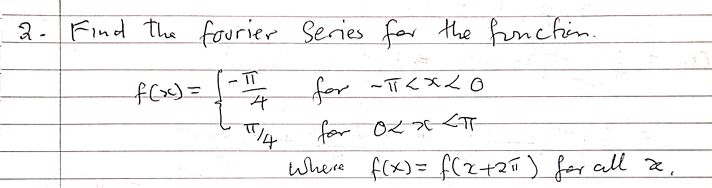 "2. [Frad tu fourier Seces fou Me fanchin. Coy —
i ee
NR
Wwe f= [2427 fer ell x,
This is AI generated Response.
Asked by: Pagal
Created at: 2025-09-08 00:56:49
Asked by: Pagal
Created at: 2025-09-08 00:56:49
Final Answer:
Rendered
Raw Text
Did you like this answer?
Let's solve the problem step-by-step:
---
### **Step 1: Identify the Function and Its Symmetry**
The function is given as:
\[
f(x) =
\begin{cases}
-\frac{\pi}{4}, & -\pi < x < 0 \\
\frac{\pi}{4}, & 0 < x < \pi
\end{cases}
\]
and is periodic with period \(2\pi\).
Notice that \(f(x)\) is an **odd function** since \(f(-x) = -f(x)\).
Therefore, the Fourier series will only have **sine terms** (i.e., only \(b_n\) coefficients).
**Explanation:**
Recognizing the symmetry simplifies our calculations, as we only need to compute the sine coefficients \(b_n\).
---
### **Step 2: Calculate Fourier Sine Coefficients \(b_n\)**
The general formula for the sine coefficients for a function of period \(2\pi\) is:
\[
b_n = \frac{1}{\pi} \int_{-\pi}^{\pi} f(x) \sin(nx) \, dx
\]
Since \(f(x)\) is odd, and \(\sin(nx)\) is also odd, their product is **even**, so we can write:
\[
b_n = \frac{2}{\pi} \int_{0}^{\pi} f(x) \sin(nx) \, dx
\]
But for \(0 < x < \pi\), \(f(x) = \frac{\pi}{4}\).
So,
\[
b_n = \frac{2}{\pi} \int_{0}^{\pi} \frac{\pi}{4} \sin(nx) \, dx
= \frac{2}{\pi} \cdot \frac{\pi}{4} \int_{0}^{\pi} \sin(nx) \, dx
= \frac{1}{2} \int_{0}^{\pi} \sin(nx) \, dx
\]
Now, compute the integral:
\[
\int_{0}^{\pi} \sin(nx) \, dx = \left[ -\frac{1}{n} \cos(nx) \right]_{0}^{\pi}
= -\frac{1}{n} (\cos(n\pi) - \cos(0))
= -\frac{1}{n} ((-1)^n - 1)
\]
So,
\[
b_n = \frac{1}{2} \left(-\frac{1}{n} ((-1)^n - 1)\right)
= -\frac{1}{2n} ((-1)^n - 1)
\]
For **odd \(n\)**: \((-1)^n - 1 = -2\),
For **even \(n\)**: \((-1)^n - 1 = 0\).
Thus,
\[
b_n =
\begin{cases}
\frac{1}{n}, & n \text{ odd} \\
0, & n \text{ even}
\end{cases}
\]
**Explanation:**
We simplified the calculation by using the function's symmetry and the properties of sine integrals, resulting in nonzero sine coefficients only for odd \(n\).
---
### **Final Answer: Fourier Series**
\[
\boxed{
f(x) = \sum_{n=1,\, n\,\text{odd}}^{\infty} \frac{1}{n} \sin(nx)
= \sin(x) + \frac{1}{3} \sin(3x) + \frac{1}{5} \sin(5x) + \cdots
}
\]
This is the Fourier series representation of the given function.
📢 Instructions:
- Ask anything relatd to above question only.
- For new Question goto :