 VIPSolutions
give answer in 2 step with explanation at the end of each step and final answer at the end:oD Fuad the fouree geries of He fumchon Cl few= (Uf cwex
Question:
give answer in 2 step with explanation at the end of each step and final answer at the end: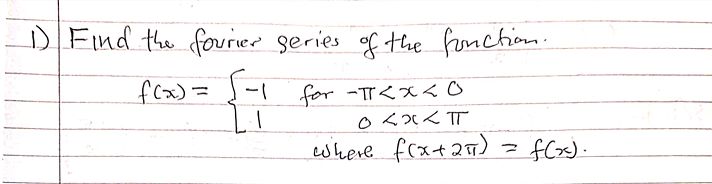 oD Fuad the fouree geries of He fumchon
Cl few= (Uf cwex
This is AI generated Response.
Asked by: Pagal
Created at: 2025-09-08 00:43:16
Asked by: Pagal
Created at: 2025-09-08 00:43:16
Final Answer:
Rendered
Raw Text
Did you like this answer?
Let's solve the problem step by step:
---
### **Step 1: Identify the Type of Function and Fourier Series Expansion**
Given:
\[
f(x) =
\begin{cases}
-1 & \text{for } -\pi < x < 0 \\
1 & \text{for } 0 < x < \pi
\end{cases}
\]
with period \(2\pi\): \(f(x+2\pi) = f(x)\).
This is an **odd function** (since \(f(-x) = -f(x)\)), so its Fourier series will only have sine terms:
\[
f(x) = \sum_{n=1}^{\infty} b_n \sin(nx)
\]
where
\[
b_n = \frac{1}{\pi} \int_{-\pi}^{\pi} f(x) \sin(nx) \, dx
\]
**Explanation:**
Since the function is odd, all cosine (even) terms and the constant term \(a_0\) will be zero.
---
### **Step 2: Calculate the Fourier Coefficients \(b_n\)**
\[
b_n = \frac{1}{\pi} \int_{-\pi}^{\pi} f(x) \sin(nx) \, dx
\]
Split the integral:
\[
b_n = \frac{1}{\pi} \left( \int_{-\pi}^{0} (-1)\sin(nx) dx + \int_{0}^{\pi} (1)\sin(nx) dx \right)
\]
\[
= \frac{1}{\pi} \left( -\int_{-\pi}^{0} \sin(nx) dx + \int_{0}^{\pi} \sin(nx) dx \right)
\]
Calculate each part:
\[
\int \sin(nx) dx = -\frac{1}{n}\cos(nx)
\]
So:
\[
\int_{-\pi}^{0} \sin(nx) dx = [-\frac{1}{n} \cos(nx)]_{-\pi}^{0} = -\frac{1}{n}(\cos(0) - \cos(-n\pi)) = -\frac{1}{n}(1 - (-1)^n)
\]
\[
\int_{0}^{\pi} \sin(nx) dx = [-\frac{1}{n} \cos(nx)]_{0}^{\pi} = -\frac{1}{n}(\cos(n\pi) - \cos(0)) = -\frac{1}{n}((-1)^n - 1)
\]
Plug into \(b_n\):
\[
b_n = \frac{1}{\pi} \left( -\left(-\frac{1}{n}(1 - (-1)^n)\right) + \left(-\frac{1}{n}((-1)^n - 1)\right) \right)
\]
\[
= \frac{1}{\pi} \left( \frac{1}{n}(1 - (-1)^n) - \frac{1}{n}((-1)^n - 1) \right)
\]
\[
= \frac{1}{\pi} \left( \frac{1}{n}(1 - (-1)^n + 1 - (-1)^n) \right)
\]
\[
= \frac{1}{\pi} \left( \frac{2}{n}(1 - (-1)^n) \right)
\]
Now, for **even \(n\), \(1 - (-1)^n = 0\)**.
For **odd \(n\), \(1 - (-1)^n = 2\)**.
So, for **odd \(n\)**:
\[
b_n = \frac{4}{n\pi}
\]
for **even \(n\)**:
\[
b_n = 0
\]
**Explanation:**
The only nonzero Fourier coefficients are for the sine terms with odd \(n\).
---
## **Final Answer: Fourier Series**
\[
\boxed{
f(x) = \frac{4}{\pi} \left( \sin x + \frac{1}{3} \sin 3x + \frac{1}{5} \sin 5x + \cdots \right)
}
\]
where the sum runs over odd values of \(n\).
📢 Instructions:
- Ask anything relatd to above question only.
- For new Question goto :