 VIPSolutions
give answer in 2 step with explanation at the end of each step and final answer at the end:4. Find the general solution to dy 2 _ =i) where the piecewise defined function is _f Tt 0
Question:
give answer in 2 step with explanation at the end of each step and final answer at the end: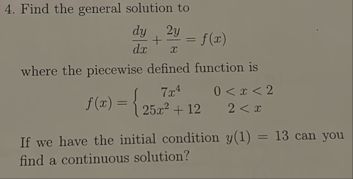 4. Find the general solution to
dy 2 _
=i)
where the piecewise defined function is
_f Tt 0
This is AI generated Response.
Asked by: Pagal
Created at: 2025-09-07 07:21:17
Asked by: Pagal
Created at: 2025-09-07 07:21:17
Final Answer:
Rendered
Raw Text
Did you like this answer?
Let's solve the problem step-by-step.
---
### **Step 1: Solve the differential equation for both regions**
The equation is:
\[
\frac{dy}{dx} + \frac{2y}{x} = f(x)
\]
where
\[
f(x) = \begin{cases}
7x^4 & 0 < x < 2 \\
25x^2 + 12 & 2 < x
\end{cases}
\]
This is a first-order linear ODE. The integrating factor is:
\[
\mu(x) = \exp\left(\int \frac{2}{x} dx\right) = x^2
\]
Multiplying both sides by \(x^2\):
\[
x^2 \frac{dy}{dx} + 2x y = x^2 f(x)
\]
\[
\frac{d}{dx}(x^2 y) = x^2 f(x)
\]
**For \(0 < x < 2\):**
\[
\frac{d}{dx}(x^2 y) = x^2 \cdot 7x^4 = 7x^6
\]
Integrate both sides:
\[
x^2 y = \int 7x^6 dx = 7 \cdot \frac{x^7}{7} = x^7 + C_1
\]
\[
y = \frac{x^7 + C_1}{x^2}
\]
**For \(2 < x\):**
\[
\frac{d}{dx}(x^2 y) = x^2 (25x^2 + 12) = 25x^4 + 12x^2
\]
Integrate both sides:
\[
x^2 y = \int (25x^4 + 12x^2) dx = 25 \cdot \frac{x^5}{5} + 12 \cdot \frac{x^3}{3} + C_2 = 5x^5 + 4x^3 + C_2
\]
\[
y = \frac{5x^5 + 4x^3 + C_2}{x^2}
\]
**Explanation**:
We solved the ODE separately for each region using the method for first-order linear equations and integrating factor.
---
### **Step 2: Apply the initial condition and ensure continuity**
Given: \(y(1) = 13\)
For \(0 < x < 2\):
\[
y = \frac{x^7 + C_1}{x^2}
\]
Plug \(x = 1\):
\[
13 = \frac{1^7 + C_1}{1^2} = 1 + C_1 \implies C_1 = 12
\]
So,
\[
y = \frac{x^7 + 12}{x^2}, \quad 0 < x < 2
\]
For \(2 < x\):
\[
y = \frac{5x^5 + 4x^3 + C_2}{x^2}
\]
To ensure continuity at \(x = 2\), set both expressions equal at \(x = 2\):
\[
\frac{2^7 + 12}{2^2} = \frac{5(2^5) + 4(2^3) + C_2}{2^2}
\]
Calculate:
- \(2^7 = 128\)
- \(2^2 = 4\)
- \(2^5 = 32\)
- \(2^3 = 8\)
Left side: \(\frac{128 + 12}{4} = \frac{140}{4} = 35\)
Right side: \(\frac{5 \times 32 + 4 \times 8 + C_2}{4} = \frac{160 + 32 + C_2}{4} = \frac{192 + C_2}{4}\)
Set equal:
\[
35 = \frac{192 + C_2}{4} \implies 140 = 192 + C_2 \implies C_2 = 140 - 192 = -52
\]
So,
\[
y = \frac{5x^5 + 4x^3 - 52}{x^2}, \quad 2 < x
\]
**Explanation**:
We applied the initial condition to find \(C_1\) and used continuity at \(x = 2\) to find \(C_2\).
---
## **Final Answer**
The continuous solution is:
\[
y(x) =
\begin{cases}
\frac{x^7 + 12}{x^2} & 0 < x < 2 \\
\frac{5x^5 + 4x^3 - 52}{x^2} & 2 < x
\end{cases}
\]
Yes, a continuous solution exists.
📢 Instructions:
- Ask anything relatd to above question only.
- For new Question goto :