 VIPSolutions
give answer in 2 step with explanation at the end of each step and final answer at the end: Sketch the phase diagram for the ordinary differential equation dw dt = ( w − 3 ) 2 − 1 . What are the steady state solutions for this ODE? Which of these steady state solutions are stable? For initial condition w ( 0 ) = 3 , what is the limiting value of w ( t ) as t → ∞ ?Sketch the phase diagram for the ordinary differential equation dw dt = (w-3)2 -1. What are the steady state solutions for this ODE? Which of these steady state solutions are stable? For initial condition w (0) = 3, what is the limiting value of w(t) ast — «0?
Question:
give answer in 2 step with explanation at the end of each step and final answer at the end:
Sketch the phase diagram for the ordinary differential equation dw dt
=
(
w
−
3
)
2
−
1
.
What are the steady state solutions for this ODE? Which of these steady state solutions are stable? For initial condition w
(
0
)
=
3
,
what is the limiting value of w
(
t
)
as t
→
∞
?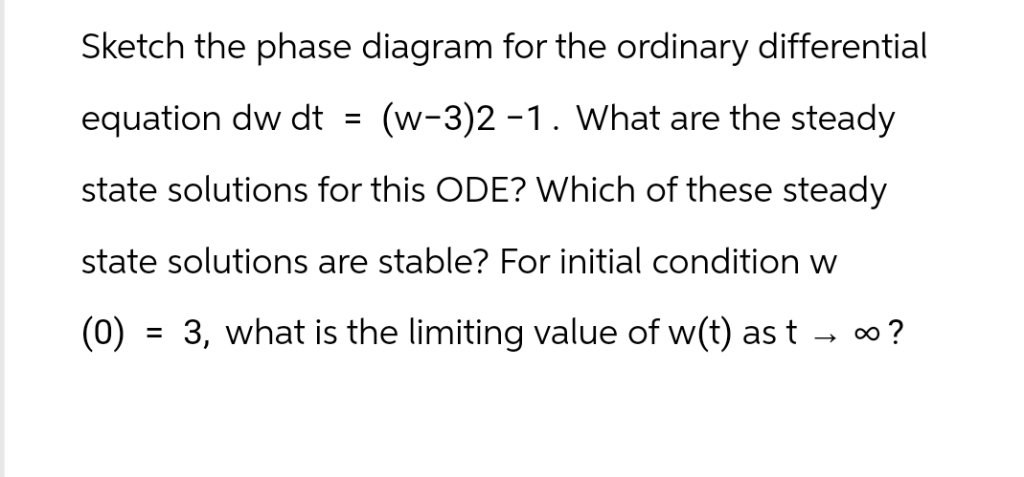 Sketch the phase diagram for the ordinary differential
equation dw dt = (w-3)2 -1. What are the steady
state solutions for this ODE? Which of these steady
state solutions are stable? For initial condition w
(0) = 3, what is the limiting value of w(t) ast — «0?
This is AI generated Response.
Asked by: Pagal
Created at: 2025-09-05 23:48:54
Asked by: Pagal
Created at: 2025-09-05 23:48:54
Final Answer:
Rendered
Raw Text
Did you like this answer?
Let's tackle the problem step by step:
---
### **Step 1: Find the steady state solutions**
The ODE is:
\[
\frac{dw}{dt} = (w-3)^2 - 1
\]
**Steady states** occur when \(\frac{dw}{dt} = 0\):
\[
(w-3)^2 - 1 = 0
\]
\[
(w-3)^2 = 1
\]
\[
w-3 = \pm 1
\]
\[
w = 4 \quad \text{or} \quad w = 2
\]
**Explanation:**
The steady state solutions are found by setting the derivative to zero and solving for \(w\). The solutions are \(w = 2\) and \(w = 4\).
---
### **Step 2: Stability of steady states and long-term behavior**
To determine stability, we analyze the sign of \(\frac{dw}{dt}\) around \(w = 2\) and \(w = 4\).
- For \(w < 2\): \((w-3)^2 - 1 > 0\) (since the squared term is always positive and increases as we move away from 3)
- For \(2 < w < 4\): \((w-3)^2 - 1 < 0\)
- For \(w > 4\): \((w-3)^2 - 1 > 0\)
Let's check the direction of the flow:
- **At \(w = 2\):**
- For \(w\) just less than 2, \(\frac{dw}{dt} > 0\) (increasing).
- For \(w\) just greater than 2, \(\frac{dw}{dt} < 0\) (decreasing).
- This means \(w = 2\) is **stable**.
- **At \(w = 4\):**
- For \(w\) just less than 4, \(\frac{dw}{dt} < 0\) (decreasing).
- For \(w\) just greater than 4, \(\frac{dw}{dt} > 0\) (increasing).
- This means \(w = 4\) is **unstable**.
Now, **for the initial condition \(w(0) = 3\)**:
\[
\frac{dw}{dt}\Big|_{w=3} = (3-3)^2 - 1 = -1 < 0
\]
So, \(w\) will decrease and move towards the stable fixed point at \(w = 2\).
**Explanation:**
- \(w = 2\) is a **stable** steady state; \(w = 4\) is **unstable**.
- Starting at \(w = 3\), the solution will approach \(w = 2\) as \(t \to \infty\).
---
### **Final Answers**
- **Steady state solutions:** \(w = 2\) (stable), \(w = 4\) (unstable)
- **Limiting value as \(t \to \infty\) for \(w(0) = 3\):**
\(\boxed{2}\)
---
#### **(Optional: Phase Diagram Sketch Explanation)**
- Draw a number line with points at \(w = 2\) and \(w = 4\).
- Arrows point **towards** \(w = 2\) (stable) and **away from** \(w = 4\) (unstable).
- For \(w < 2\) or \(w > 4\), arrows point **away** from steady states.
📢 Instructions:
- Ask anything relatd to above question only.
- For new Question goto :