 VIPSolutions
give answer in 2 step with explanation at the end of each step and final answer at the end:Problem 3. Nar Ui comet, Anion € 1 (1 is ve tion Nema’ ron Bunt wu M— “ [suse an [ ho, forall v & H' (U). Suppose f € L? (U).. Prove that (3) has a weak solution if and only if ee -
Question:
give answer in 2 step with explanation at the end of each step and final answer at the end: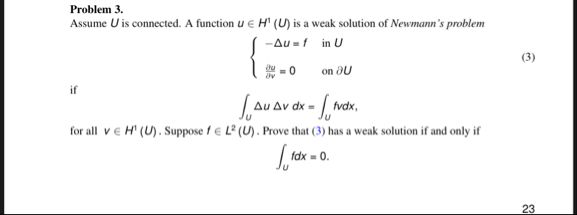 Problem 3.
Nar Ui comet, Anion € 1 (1 is ve tion Nema’ ron
Bunt wu
M—
“
[suse an [ ho,
forall v & H' (U). Suppose f € L? (U).. Prove that (3) has a weak solution if and only if
ee
-
This is AI generated Response.
Asked by: Pagal
Created at: 2025-09-05 16:45:25
Asked by: Pagal
Created at: 2025-09-05 16:45:25
Final Answer:
Rendered
Raw Text
Did you like this answer?
Let's solve the problem step by step as you requested:
---
**Step 1: Weak Formulation and Necessary Condition**
We are given Neumann's problem:
\[
\begin{cases}
-\Delta u = f & \text{in } U \\
\frac{\partial u}{\partial \nu} = 0 & \text{on } \partial U
\end{cases}
\]
The weak form is:
\( u \in H^1(U) \) is a weak solution if
\[
\int_U \nabla u \cdot \nabla v \, dx = \int_U f v \, dx, \quad \forall v \in H^1(U)
\]
Let's test with \( v = 1 \), which is admissible since \( 1 \in H^1(U) \):
\[
\int_U \nabla u \cdot \nabla 1 \, dx = \int_U f \cdot 1 \, dx
\]
But \( \nabla 1 = 0 \), so the left side is 0, which gives:
\[
0 = \int_U f \, dx
\]
**Explanation:**
For the weak solution to exist, it is **necessary** that \( \int_U f \, dx = 0 \).
---
**Step 2: Sufficiency (Existence of Solution if \( \int_U f = 0 \))**
Suppose \( \int_U f \, dx = 0 \).
The bilinear form \( a(u, v) = \int_U \nabla u \cdot \nabla v \, dx \) is continuous and coercive on the subspace
\[
V = \left\{ v \in H^1(U) : \int_U v \, dx = 0 \right\}
\]
because constants are the kernel of the Laplacian with Neumann BCs.
For any \( f \) with zero mean, the linear functional \( L(v) = \int_U f v \, dx \) is continuous and well defined on \( V \). By the **Lax-Milgram theorem**, there exists a unique \( u \in V \) such that
\[
\int_U \nabla u \cdot \nabla v \, dx = \int_U f v \, dx, \quad \forall v \in V
\]
Since the solution is unique up to an additive constant, a weak solution exists.
**Explanation:**
If \( \int_U f \, dx = 0 \), a weak solution **does exist** (unique up to constants) via the Lax-Milgram theorem.
---
## Final Answer
**The Neumann problem (3) has a weak solution if and only if**
\[
\int_U f \, dx = 0.
\]
Question:
Solve in step by step in all parts. give answer in 2 step with explanation at the end of each step and final answer at the end:
This is AI generated Response.
Asked by: Pagal
Created at: 2025-09-05 16:46:51
Asked by: Pagal
Created at: 2025-09-05 16:46:51
Final Answer:
Rendered
Raw Text
Did you like this answer?
**Step 1: Deriving the necessary condition for existence**
*Explanation:*
Starting from the weak formulation of the Neumann problem:
\[
\int_U \nabla u \cdot \nabla v \, dx = \int_U f v \, dx, \quad \forall v \in H^1(U).
\]
Choose \( v = 1 \), which is admissible because constant functions are in \( H^1(U) \). Then:
\[
\int_U \nabla u \cdot \nabla 1 \, dx = \int_U f \cdot 1 \, dx,
\]
but \(\nabla 1 = 0\), so the left side is zero:
\[
0 = \int_U f \, dx.
\]
*Therefore,* **a necessary condition** for the existence of a weak solution is:
\[
\boxed{\int_U f \, dx = 0.}
\]
---
**Step 2: Showing sufficiency and existence of solutions**
*Explanation:*
Assuming \(\int_U f \, dx = 0\), consider the subspace:
\[
V = \left\{ v \in H^1(U) : \int_U v \, dx = 0 \right\}.
\]
On \( V \), the bilinear form
\[
a(u,v) = \int_U \nabla u \cdot \nabla v \, dx
\]
is continuous, coercive, and symmetric. The linear functional
\[
L(v) = \int_U f v \, dx
\]
is continuous on \( V \) because \( f \) has zero mean and is in \( L^2(U) \).
By the **Lax-Milgram theorem**, there exists a unique \( u \in V \) such that:
\[
a(u,v) = L(v), \quad \forall v \in V.
\]
This \( u \) is a weak solution of the Neumann problem, unique up to an additive constant (since the problem's kernel consists of constants).
*Hence,* **a weak solution exists if and only if**:
\[
\boxed{\int_U f \, dx = 0.}
\]
---
## **Final Answer:**
**The Neumann problem (3) has a weak solution if and only if**
\[
\boxed{\int_U f \, dx = 0.}
\]
📢 Instructions:
- Ask anything relatd to above question only.
- For new Question goto :