 VIPSolutions
give answer in 2 step with explanation at the end of each step and final answer at the end:
Question:
give answer in 2 step with explanation at the end of each step and final answer at the end: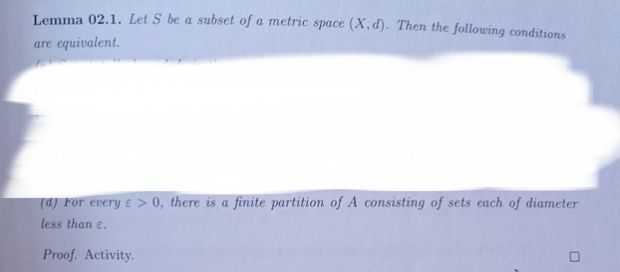
This is AI generated Response.
Asked by: Pagal
Created at: 2025-09-05 12:48:26
Asked by: Pagal
Created at: 2025-09-05 12:48:26
Final Answer:
Rendered
Raw Text
Did you like this answer?
Certainly! I'll focus on part (a) since the rest is obscured. Here is the step-by-step explanation:
---
### Step 1: Understanding the Statement
**Given:**
Let \( S \) be a subset of a metric space \( (X, d) \).
**Condition (a):**
For every \( \varepsilon > 0 \), there is a finite partition of \( S \) consisting of sets each of diameter less than \( \varepsilon \).
**Explanation:**
This means that no matter how small a positive number \( \varepsilon \) you choose, you can break \( S \) into finitely many pieces (subsets) so that the "size" (diameter) of each piece, measured by the largest distance between any two points in that piece, is less than \( \varepsilon \).
---
### Step 2: Interpreting the Implication
**What does this mean?**
This condition is a classical characterization of *total boundedness* in metric spaces.
- A set is **totally bounded** if for every \( \varepsilon > 0 \), it can be covered by finitely many subsets of diameter less than \( \varepsilon \).
- Equivalently, this is often stated as: For every \( \varepsilon > 0 \), there exists a finite \( \varepsilon \)-net for \( S \).
**Explanation:**
Total boundedness is a stronger property than boundedness. Every totally bounded set is bounded, but not every bounded set is totally bounded. This property is crucial in analysis and topology, especially in compactness arguments.
---
## Final Answer:
**The condition (a) is stating that \( S \) is totally bounded in the metric space \( (X, d) \).**
- Step 1: The statement requires that \( S \) can always be split into finitely many subsets of arbitrarily small diameter.
- Step 2: This is the definition of total boundedness.
**Final Answer:**
Condition (a) means that \( S \) is totally bounded in the metric space \( (X, d) \).
📢 Instructions:
- Ask anything relatd to above question only.
- For new Question goto :