 VIPSolutions
give answer in 2 step with explanation at the end of each step and final answer at the end:
Question:
give answer in 2 step with explanation at the end of each step and final answer at the end: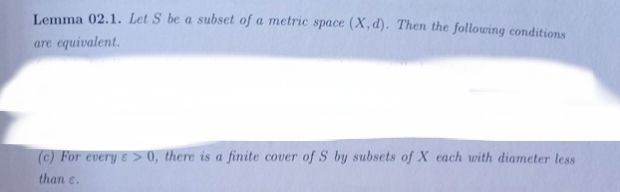
This is AI generated Response.
Asked by: Pagal
Created at: 2025-09-05 12:44:36
Asked by: Pagal
Created at: 2025-09-05 12:44:36
Final Answer:
Rendered
Raw Text
Did you like this answer?
Let's analyze the statement given in the image **step by step**:
---
### Step 1: Understanding the Statement
**Lemma 02.1:**
Let \( S \) be a subset of a metric space \( (X, d) \). Then the following conditions are equivalent.
*(Only condition (c) is visible):*
(c) For every \( \varepsilon > 0 \), there is a finite cover of \( S \) by subsets of \( X \) each with diameter less than \( \varepsilon \).
**Explanation:**
This condition is describing a property of the set \( S \): for any positive number \( \varepsilon \), you can cover \( S \) using only finitely many subsets of \( X \), and each of these subsets has a "diameter" (the greatest distance between any two points in the subset) less than \( \varepsilon \).
---
### Step 2: Identifying the Concept
**Key Concept:**
This property is the definition of **total boundedness** in a metric space.
**Explanation:**
A subset \( S \) of a metric space \( (X, d) \) is said to be *totally bounded* if for every \( \varepsilon > 0 \), \( S \) can be covered by finitely many subsets of diameter less than \( \varepsilon \) (often, these subsets are taken to be open balls, but the definition here uses general subsets).
---
## **Final Answer:**
**Condition (c) is the definition of a set being *totally bounded* in a metric space.**
📢 Instructions:
- Ask anything relatd to above question only.
- For new Question goto :