 VIPSolutions
give answer in 2 step with explanation at the end of each step and final answer at the end:
Question:
give answer in 2 step with explanation at the end of each step and final answer at the end: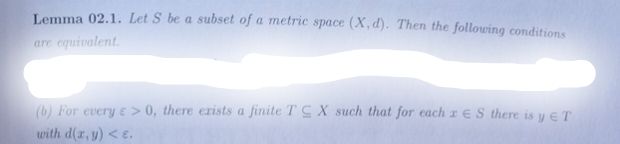
This is AI generated Response.
Asked by: Pagal
Created at: 2025-09-05 12:40:01
Asked by: Pagal
Created at: 2025-09-05 12:40:01
Final Answer:
Rendered
Raw Text
Did you like this answer?
Certainly! Let's break down and explain the statement step by step:
---
**Step 1: Understanding the context and terms**
- The lemma is about a subset \( S \) of a metric space \((X, d)\), where \( d \) is the metric (distance function).
- The lemma lists "equivalent" conditions (though only (b) is visible).
- Condition (b) is:
"For every \( \varepsilon > 0 \), there exists a finite \( T \subseteq X \) such that for each \( x \in S \), there is a \( y \in T \) with \( d(x, y) < \varepsilon \)."
**Explanation:**
This says that for any chosen "radius" \( \varepsilon \), you can find a finite set of points in \( X \) (called \( T \)) so that every point in \( S \) is within distance \( \varepsilon \) of some point in \( T \).
---
**Step 2: Interpreting the meaning of condition (b)**
- This is the definition of "total boundedness" for the set \( S \) in the metric space \((X, d)\).
- In other words, \( S \) is called totally bounded if for every \( \varepsilon > 0 \), you can cover \( S \) with finitely many open balls of radius \( \varepsilon \) (centered at points in \( T \)).
**Explanation:**
Total boundedness is a stronger property than boundedness. It means you can always "approximate" all points in \( S \) by finitely many points (the centers of the covering balls) as closely as you like, depending on \( \varepsilon \).
---
**Final Answer:**
Condition (b) states that for every \( \varepsilon > 0 \), there exists a finite set \( T \subseteq X \) such that every point in \( S \) is within \( \varepsilon \) of some point in \( T \). This is precisely the definition of "total boundedness" of the set \( S \) in the metric space \((X, d)\).
📢 Instructions:
- Ask anything relatd to above question only.
- For new Question goto :