 VIPSolutions
give answer in 2 step with explanation at the end of each step and final answer at the end: 4. Copper Oxide Layers The common building blocks for most high temperature (high Tc) su perconductors are copper oxide layers as shown in the figure below. Assume the distance between the copper atoms (dark circles) is a. For simplicity assume that in the third dimension these CuO2 layers are simply stacked ( copper above copper, oxygen above oxygen) with spacing c, and there are no other atoms in the crystal structure. In first approximation, the layers have four -fold symmetry; the crystal is tetragonal. 0.0.0.0 0.0. 0.0. (i) tetragonal (ii) orthorhombic (a) Sketch the Bravais lattice and indicate a possible set of primitive lattice vectors. What is the unit cell, and what is the basis? (b) In La2CuO4 one discovers at closer inspection, that the CuO2 lattice is actually not flat; but that the oxygen atoms are moved out of the plane ( up or down) in an alternating fashion (see the figure above where + means up and means down. What is the primitive cell and lattice spacing for this crystal ? What is the reciprocal lattice ?6) a) A body B of mass 10 kg is suspended to a massless spring with spring constant 0.1 N/m. It is pulled slightly and starts to oscillate. i) Assuming that the oscillation is a SHM, find the undamped angular frequency w, and i write down the equation of motion relating the acceleration d?x/dt? to the displacement x. b) The body B is then plunged in a beaker filled with a liquid. It experiences a damping force , Fy = -y v, 1) Write down the equation of motion relating the acceleration d*x/dt? to the velocity dx/dt, displacement x, w, and the damping ratio ( = Eva ~ can now be varied. ii) Sketch the body's displacement with time variation in the cases of a) over damping with ¢ > 1, or (3) under damping with ¢ < 1 or 7) critical damping with ¢ = 1. iii) Sketch the variation of the quality factor Q = 1/2¢ with time. c) What driving force F, would be required to make the damped har- monic motion become simple harmonic motion?
Question:
give answer in 2 step with explanation at the end of each step and final answer at the end:
4. Copper Oxide Layers The common building blocks for most high temperature (high Tc) su perconductors are copper oxide layers as shown in the figure below.
Assume the distance between the copper atoms (dark circles) is a. For simplicity assume that in the third dimension these CuO2 layers are simply stacked ( copper above copper, oxygen above oxygen) with spacing c, and there are no other atoms in the crystal structure. In first approximation, the layers have four -fold symmetry; the crystal is tetragonal. 0.0.0.0 0.0. 0.0. (i) tetragonal (ii) orthorhombic (a) Sketch the Bravais lattice and indicate a possible set of primitive lattice vectors. What is the unit cell, and what is the basis? (b) In La2CuO4 one discovers at closer inspection, that the CuO2 lattice is actually not flat; but that the oxygen atoms are moved out of the plane ( up or down) in an alternating fashion (see the figure above where + means up and means down. What is the primitive cell and lattice spacing for this crystal ?
What is the reciprocal lattice ?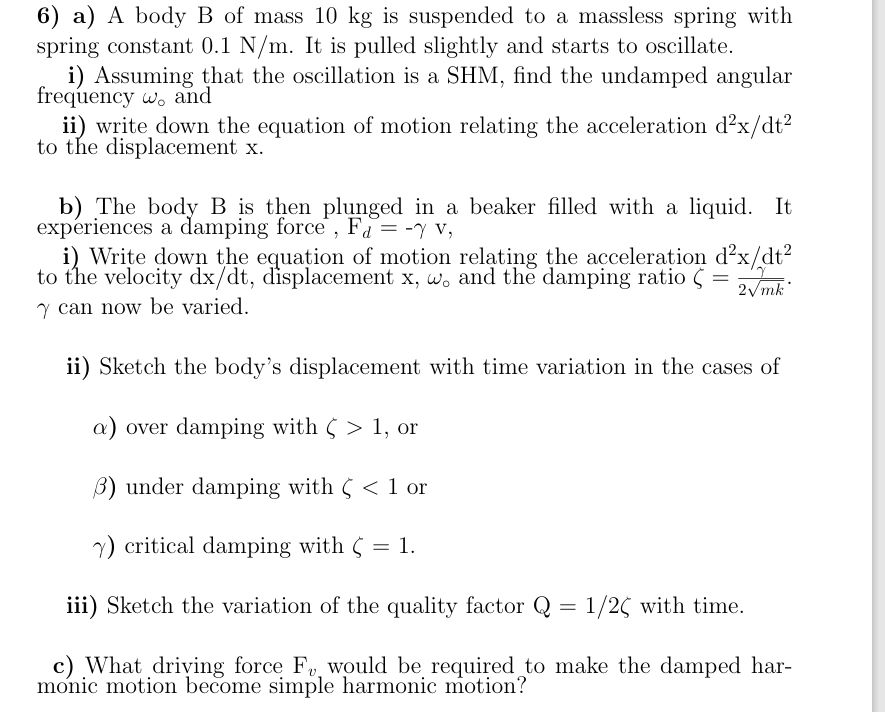 6) a) A body B of mass 10 kg is suspended to a massless spring with
spring constant 0.1 N/m. It is pulled slightly and starts to oscillate.
i) Assuming that the oscillation is a SHM, find the undamped angular
frequency w, and
i write down the equation of motion relating the acceleration d?x/dt?
to the displacement x.
b) The body B is then plunged in a beaker filled with a liquid. It
experiences a damping force , Fy = -y v,
1) Write down the equation of motion relating the acceleration d*x/dt?
to the velocity dx/dt, displacement x, w, and the damping ratio ( = Eva
~ can now be varied.
ii) Sketch the body's displacement with time variation in the cases of
a) over damping with ¢ > 1, or
(3) under damping with ¢ < 1 or
7) critical damping with ¢ = 1.
iii) Sketch the variation of the quality factor Q = 1/2¢ with time.
c) What driving force F, would be required to make the damped har-
monic motion become simple harmonic motion?
Asked by: Rahulkumar
Created at: 2025-09-03 07:19:50
Final Answer:
📢 Instructions:
- Ask anything relatd to above question only.
- For new Question goto :