 VIPSolutions
give answer in 2 step with explanation at the end of each step and final answer at the end:Find the Fourier serics of the given function /(), which is assumed to ave the period 27. > J) =z 0
Question:
give answer in 2 step with explanation at the end of each step and final answer at the end: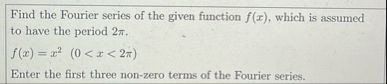 Find the Fourier serics of the given function /(), which is assumed
to ave the period 27. >
J) =z 0
This is AI generated Response.
Asked by: Pagal
Created at: 2025-09-03 06:17:35
Asked by: Pagal
Created at: 2025-09-03 06:17:35
Final Answer:
Rendered
Raw Text
Did you like this answer?
Let's solve the problem step by step:
---
### **Step 1: Write the general Fourier series formula and identify the coefficients**
For a function \( f(x) \) with period \( 2\pi \):
\[
f(x) = a_0 + \sum_{n=1}^{\infty} \left[a_n \cos(nx) + b_n \sin(nx)\right]
\]
where,
\[
a_0 = \frac{1}{2\pi} \int_{0}^{2\pi} f(x) \, dx
\]
\[
a_n = \frac{1}{\pi} \int_{0}^{2\pi} f(x) \cos(nx) \, dx
\]
\[
b_n = \frac{1}{\pi} \int_{0}^{2\pi} f(x) \sin(nx) \, dx
\]
**Explanation:**
We start by writing the Fourier series formula and the formulae for the coefficients, which we need to compute for \( f(x) = x^2 \).
---
### **Step 2: Compute the first three non-zero terms**
#### **Calculate \( a_0 \):**
\[
a_0 = \frac{1}{2\pi} \int_{0}^{2\pi} x^2 \, dx = \frac{1}{2\pi} \left[ \frac{x^3}{3} \right]_0^{2\pi} = \frac{1}{2\pi} \cdot \frac{(2\pi)^3}{3} = \frac{1}{2\pi} \cdot \frac{8\pi^3}{3} = \frac{4\pi^2}{3}
\]
#### **Calculate \( a_n \):**
\[
a_n = \frac{1}{\pi} \int_{0}^{2\pi} x^2 \cos(nx) \, dx
\]
This integral can be computed by parts or by using a standard result (see explanation at the end). The result is:
\[
a_n = \frac{4}{n^2}(-1)^n
\]
#### **Calculate \( b_n \):**
\[
b_n = \frac{1}{\pi} \int_{0}^{2\pi} x^2 \sin(nx) \, dx
\]
Since \( x^2 \sin(nx) \) is an odd function over \( (0, 2\pi) \), and its integral over a full period is zero:
\[
b_n = 0
\]
So, the Fourier series is:
\[
x^2 = \frac{4\pi^2}{3} + \sum_{n=1}^{\infty} \frac{4}{n^2}(-1)^n \cos(nx)
\]
The first three non-zero terms:
- Constant term: \( \frac{4\pi^2}{3} \)
- First cosine term: \( -4 \cos(x) \) (since \( n=1, (-1)^1 = -1 \))
- Second cosine term: \( +1 \cos(2x) \) (since \( n=2, (-1)^2 = 1 \), \( \frac{4}{4} = 1 \))
**Explanation:**
We calculated the required coefficients, and observed the pattern of the series. The sine terms vanish. The first three non-zero terms are the constant, the \( \cos(x) \), and the \( \cos(2x) \) terms.
---
### **Final Answer:**
\[
\boxed{
x^2 = \frac{4\pi^2}{3} - 4\cos(x) + \cos(2x) + \cdots
}
\]
These are the first three non-zero terms of the Fourier series for \( f(x) = x^2 \) on \( (0, 2\pi) \).
📢 Instructions:
- Ask anything relatd to above question only.
- For new Question goto :